


Last Updated: May 25, 2026
Search Engine Optimization (SEO) for Software-as-a-Service (SaaS) businesses is fundamentally different from traditional SEO. Unlike eCommerce or local service businesses, SaaS companies must educate, nurture, and convert users across long buying cycles. The competition is intense, customer acquisition costs are rising, and organic traffic has become one of the most sustainable growth channels available.
If you are looking for the best SEO strategy for a SaaS, this in-depth guide covers everything — from keyword research and technical foundations to content architecture, backlinks, and advanced scaling strategies. The focus is on building a long-term, compounding organic growth engine that drives qualified leads and recurring revenue.
Why SaaS SEO Is Different From Traditional SEO
SaaS SEO is complex because:
- Buyers conduct extensive research before committing.
- Decision cycles are longer.
- Multiple stakeholders are often involved.
- Competition is global.
- Organic traffic must convert into trials or demos.
Unlike product-based websites that target transactional queries, SaaS companies must capture:
- Awareness-stage searches
- Consideration-stage searches
- Comparison and alternative searches
- Feature-specific searches
- Integration-related searches
A strong SaaS SEO strategy aligns content with the entire customer journey.
Keyword Research: The Foundation of SaaS SEO
Without precise keyword research, even the best content strategy fails.
Types of SaaS Keywords to Target
| Keyword Type | Search Intent | Example |
| Informational | Awareness | “how to improve team productivity” |
| Problem-Based | Consideration | “tools to manage remote teams” |
| Feature-Specific | Solution Discovery | “task automation software” |
| Comparison | Decision | “Tool A vs Tool B” |
| Alternative | High Intent | “best alternatives to X” |
| Transactional | Conversion | “project management software pricing” |
Long-Tail Keywords: The Conversion Engine
Long-tail keywords often have:
- Lower search volume
- Lower competition
- Higher conversion rates
Example:
Instead of targeting “CRM software,” target:
- “CRM software for small healthcare clinics”
- “Affordable CRM for startups under $50 per month”
These keywords reflect strong buying intent.
Search Intent Mapping for SaaS
Understanding search intent is critical.
SaaS Buyer Journey and SEO Mapping
| Funnel Stage | User Intent | Content Type |
| Awareness | Problem identification | Educational blog posts |
| Consideration | Solution comparison | Guides and tool comparisons |
| Decision | Vendor evaluation | Pricing pages, case studies |
| Retention | Feature expansion | Tutorials and integration pages |
Every high-performing SaaS SEO strategy maps content to this journey.
Building a Topic Cluster Architecture
Modern SaaS SEO relies heavily on topical authority.
Pillar + Cluster Model
Create a comprehensive pillar page, then support it with related cluster content.
Example Structure
Pillar Page:
- The Complete Guide to Workflow Automation Software
Cluster Pages:
- Best Workflow Tools for Marketing Teams
- Workflow Automation for Healthcare
- How to Automate Team Reporting
- Workflow Software Pricing Comparison
Internal linking between these pages improves:
- Crawlability
- Topical authority
- User engagement
- Ranking potential
Content Strategy That Drives Qualified Traffic
Content is the primary growth lever in SaaS SEO.
High-Impact SaaS Content Types
- Ultimate Guides
Long-form, authoritative content (2,000+ words) targeting high-value keywords.
- Comparison Pages
High-conversion pages such as:
- “X vs Y”
- “Best Alternatives to X”
These pages attract decision-stage buyers.
- Use-Case Pages
Industry-specific landing pages:
- Software for healthcare
- Software for fintech
- Software for agencies
- Feature Pages
Dedicated pages for:
- Automation
- Reporting
- Integrations
- Security
- Case Studies
Real results improve trust and conversion rates.
Technical SEO for SaaS Websites
Technical SEO ensures search engines can properly crawl and index your website.
Critical Technical SEO Elements
- Mobile-first optimization
- Fast page speed (Core Web Vitals)
- Clean URL structure
- XML sitemap
- Optimized robots.txt
- Proper canonical tags
- Schema markup (FAQ, Product, Review)
Page Speed Impact on Conversions
| Page Load Time | Conversion Impact |
| 1 second | Highest conversions |
| 3 seconds | Moderate drop |
| 5+ seconds | Significant decline |
SaaS websites often include dashboards, scripts, and animations. Optimization is essential.
Backlink Strategy: Authority Drives Rankings
Backlinks remain one of the strongest ranking factors.
High-Quality SaaS Backlink Strategies
- Guest blogging on industry sites
- Publishing original data reports
- Creating free tools and calculators
- Partner integration pages
- Listing on SaaS directories
- Digital PR campaigns
Quality is more important than quantity. A few high-authority links outperform hundreds of low-quality ones.
Programmatic SEO for SaaS Scaling
Programmatic SEO allows SaaS companies to scale landing pages using templates and structured data.
Examples include:
- Integration pages (Tool A + Tool B)
- Location-based pages
- Industry-specific variations
- Feature-specific combinations
This approach captures thousands of long-tail queries at scale.
Key Components of a Winning 2026 SaaS SEO Framework
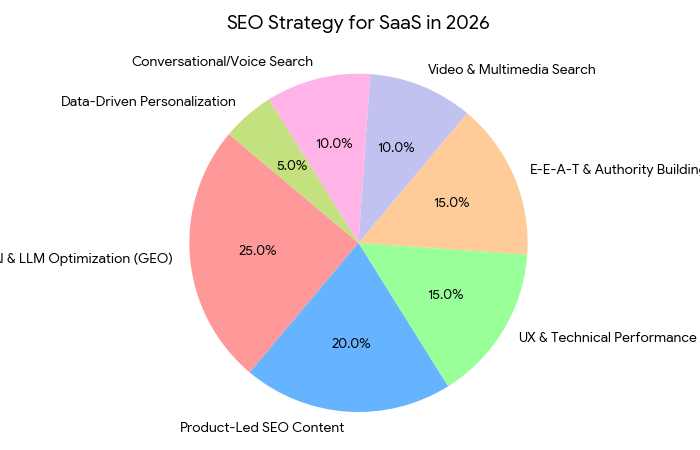
The pie chart below illustrates a strategic breakdown for SEO Strategy for SaaS in 2026. The chart highlights the shift towards AI-driven optimization, product-led content, and user-centric technical performance.
Key Components of the 2026 SaaS SEO Strategy:
- AI & LLM Optimization (GEO – 25.0%): Focusing on visibility within generative AI engines and LLM-based search results.
- Product-Led SEO Content (20.0%): Creating high-intent content that integrates product solutions directly into the search journey.
- UX & Technical Performance (15.0%): Ensuring seamless page experience, Core Web Vitals, and accessibility.
- E-E-A-T & Authority Building (15.0%): Establishing brand authority through expert-driven content and high-quality citations.
- Video & Multimedia Search (10.0%): Optimizing for visual and short-form video platforms that appear in search results.
- Conversational/Voice Search (10.0%): Capturing natural language queries and long-tail conversational intents.
- Data-Driven Personalization (5.0%): Using user data to deliver hyper-relevant content experiences.
Conversion Optimization Within SEO
Traffic without conversion is wasted effort.
Key Conversion Elements for SaaS Pages
- Clear call-to-action (Start Free Trial, Book Demo)
- Social proof (logos, testimonials)
- Transparent pricing
- Feature comparison tables
- Interactive demos
- Live chat support
SEO should not only drive traffic but also improve signups.
SaaS SEO Pricing and Investment Comparison
Here’s a general breakdown of SEO investment options:
| Resource Type | Monthly Cost Range | Best For |
| In-House SEO Specialist | $3,000–$7,000 | Growing SaaS startups |
| SEO Agency | $4,000–$15,000 | Full-service execution |
| SEO Tools | $99–$399 | Data and keyword research |
| Freelance Writers | $75–$300 per article | Content production |
| Link Building Services | $500–$2,000 | Authority growth |
Long-term ROI from SEO typically surpasses paid ads once rankings stabilize.
Measuring SaaS SEO Success
Track the right metrics.
Core SEO Metrics
- Organic traffic growth
- Keyword rankings
- Click-through rate (CTR)
- Backlink growth
- Conversion rate from organic
- Customer acquisition cost (CAC) from SEO
Organic traffic should steadily increase over 6–12 months with consistent effort.
Advanced SaaS SEO Strategies for 2026
SEO continues evolving. Here’s what works now:
AI-Optimized Content
Structure content clearly for featured snippets and AI-driven search responses.
Semantic SEO
Cover entire topics comprehensively rather than focusing on single keywords.
Answer-Focused Formatting
Use:
- Clear subheadings
- FAQ sections
- Bullet lists
- Short, direct answers
Customer-Led SEO
Create content directly from:
- Customer interviews
- Support tickets
- Sales objections
- Community discussions
This ensures real-world relevance.
Common SaaS SEO Mistakes to Avoid
- Targeting only high-volume keywords
- Ignoring internal linking
- Neglecting technical SEO
- Publishing thin content
- Failing to optimize for conversions
- Overlooking comparison keywords
Avoiding these mistakes significantly improves results.
12-Month SaaS SEO Roadmap
| Month | Focus Area |
| 1–2 | Keyword research and technical audit |
| 3–4 | Publish pillar content |
| 5–6 | Build cluster articles |
| 7–8 | Start backlink outreach |
| 9–10 | Launch programmatic pages |
| 11 | Update underperforming content |
| 12 | Full audit and optimization |
SEO success compounds over time. The first few months build momentum. The following months accelerate growth.
Final Thoughts: What Is the Best SEO Strategy for a SaaS?
The best SEO strategy for a SaaS is not a single tactic — it’s a structured ecosystem that combines:
- Deep keyword research
- Intent-based content
- Technical optimization
- Strong internal linking
- Authority-building backlinks
- Conversion-focused landing pages
- Continuous monitoring and improvement
SaaS SEO is a long-term investment. When executed properly, it becomes a predictable and scalable growth channel that reduces dependency on paid advertising and increases lifetime customer value.
If your goal is sustainable organic traffic, qualified leads, and higher recurring revenue, implementing a strategic SaaS SEO framework is not optional — it is essential.