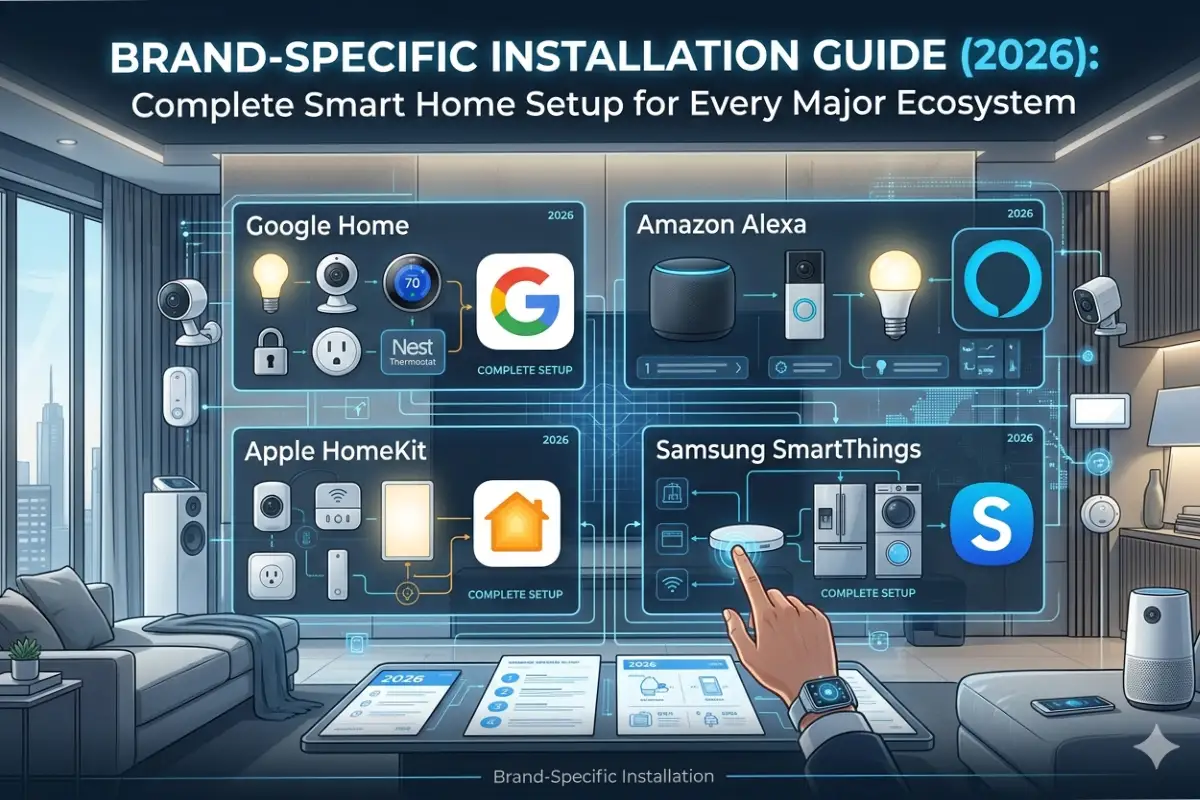

Last Updated: June 22, 2026
Smart homes have changed a lot in the few years. Now in 2026 people who own homes are not just putting in one device. They are making whole systems that connect lights, security, temperature control, entertainment and automation all together.
However one problem is still there:
Choosing the smart home system and putting it in correctly.
If you are thinking about using Google Home, Amazon Alexa, Apple HomeKit, Samsung SmartThings or Ring you need to know that each smart home system is different and has its way of being set up its own rules for what works with it its own good points and its own limitations.
This brand-by-brand guide is part of our Smart Home Installation.
This guide will show you how to install and set up each home system one step at a time and it will also compare the features, costs, security and automation abilities of each Smart Device Installation Guides system, like Google Home, Amazon Alexa, Apple HomeKit, Samsung SmartThings and Ring.
Why Brand-Specific Installation Matters
Many homeowners purchase smart devices without considering ecosystem compatibility.
The result often includes:
- Devices that won’t connect
- Multiple apps for different products
- Limited automation options
- Reduced voice assistant functionality
- Security vulnerabilities
A properly planned installation creates:
- Unified device control
- Better automation routines
- Improved reliability
- Stronger security
- Easier future upgrades
Smart Home Market Statistics (2026)
| Smart Home Platform | Global Market Share (2026 Estimate) |
| Amazon Alexa | 34% |
| Google Home | 29% |
| Apple HomeKit | 18% |
| Samsung SmartThings | 11% |
| Others | 8% |
Ecosystem Adoption Growth
| Year | Smart Home Users Worldwide |
| 2022 | 350 Million |
| 2023 | 410 Million |
| 2024 | 480 Million |
| 2025 | 570 Million |
| 2026 | 650+ Million |
The rise of Matter and Thread standards has accelerated adoption while improving cross-platform compatibility.
For general install steps, see our device installation guides.
Smart Home Ecosystems Understanding
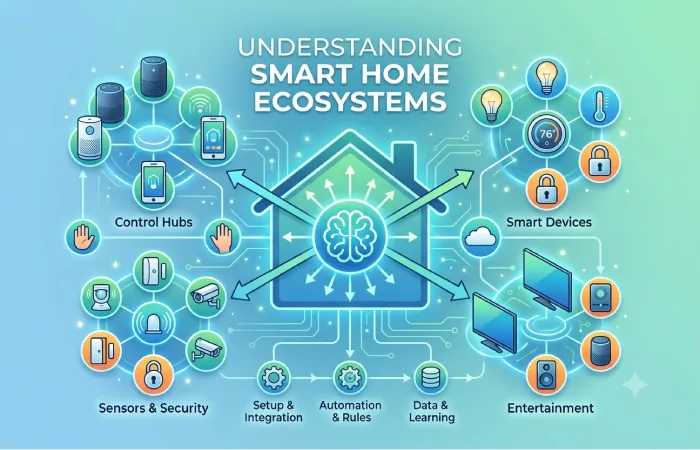
There are smart home ecosystems that serve as the central point for all the smart devices.
Main Ecosystems Include:
| Platform | Voice Assistant | Best For |
| Google Home | Google Assistant | AI automation |
| Amazon Alexa | Alexa | Device compatibility |
| Apple HomeKit | Siri | Security & privacy |
| Samsung SmartThings | Multiple Assistants | Advanced automation |
| Ring | Alexa Integration | Home security |
Google Home Installation Guide
What Is Google Home?
Google Home is the smart home ecosystem provided by Google using Google Assistant.
It excels at:
- Voice commands
- AI automation
- Smart displays
- Android integration
- Matter device support
Hardware Requirements
Before installation, gather:
- Google Nest Hub
- Google Nest Mini
- Wi-Fi connection
- Smartphone
- Google Account
Step-by-Step Google Home Installation
Step 1: Install Google Home App
Download the app on:
- Android
- iPhone
Login to your Google account.
Step 2: Connect Device
Power on:
- Nest Hub
- Nest Audio
- Nest Mini
This app will detect devices nearby.
Step 3: Connect Wi-Fi
Choose:
- Home network
- Network password
Wait for synchronization.
Step 4: Assign Rooms
Examples:
- Living Room
- Bedroom
- Kitchen
- Office
This improves voice command accuracy.
Step 5: Add Smart Devices
Tap:
Add → Device → Works with Google Home
Connect:
- Lights
- Cameras
- Locks
- Thermostats
- Sensors
Google Home Strengths
Pros
- Excellent AI capabilities
- Strong Android integration
- Great voice recognition
- Advanced routines
Cons
- Limited privacy controls
- Requires Google ecosystem for best experience
Setting up Amazon Alexa Smart Home System
Why Is Alexa Still So Popular in 2026?
Alexa works with many devices and is the most commonly used smart home platform in the world.
Devices Used
- Echo Dot
- Echo Show
- Alexa App
- Amazon Account
Alexa Installation Process
Step 1: Install Alexa App
Sign in using Amazon credentials.
Step 2: Power Up Echo Device
Connect to power.
It is automatically put into setup mode.
Step 3: Connecting to Wi-Fi
Follow in-app instructions.
Step 4: Setting Up Voice Profile
Alexa learns:
- Voice preferences
- Family members
- Personal responses
Step 5: Add Smart Devices
Navigate:
Devices → Add Device
Supported categories include:
- Lighting
- Cameras
- Thermostats
- Smart plugs
- Locks
Creating Alexa Routines
Example:
When:
- Motion detected
Then:
- Turn on hallway lights
- Send phone notification
This creates true automation rather than simple remote control.
Alexa Ecosystem Evaluation
| Category | Score /10 |
| Compatibility | 10 |
| Automation | 9 |
| Security | 8 |
| Ease of Use | 9 |
| AI Features | 9 |
Apple HomeKit Installation
Why HomeKit Is Different
Apple focuses heavily on:
- Privacy
- Security
- Local processing
- End-to-end encryption
HomeKit is ideal for Apple users.
Requirements
You need:
- iPhone
- iPad
- Apple TV or HomePod
- Apple ID
HomeKit Setup Guide
Step 1: Open Apple Home App
The Home app comes pre-installed.
Step 2: Add Accessory
Tap:
“+” → Add Accessory
Scan HomeKit QR code.
Step 3: Assign Location
Examples:
- Kitchen
- Living Room
- Garage
Step 4: Create Home
Set:
- Home name
- Users
- Permissions
Step 5: Configure Automations
Examples:
- Sunset lighting
- Door lock triggers
- Security alerts
HomeKit Security Comparison
| Feature | HomeKit | Alexa | |
| End-to-End Encryption | Yes | Partial | Partial |
| Local Processing | Extensive | Moderate | Moderate |
| Privacy Controls | Excellent | Good | Good |
| Secure Video | Excellent | Good | Good |
Setting up Samsung SmartThings Smart Home System
Why Are Samsung SmartThings Special?
SmartThings is an automation system for all smart devices.
It supports:
- Google Assistant
- Alexa
- Siri
- Matter
- Zigbee
- Z-Wave
Hardware Needed
- SmartThings Hub
- SmartThings App
- Samsung Account
Installation Process
Step 1: Connect Hub
Plug hub into:
- Router
- Power source
Step 2: Install App
Install SmartThings app.
Step 3: Link Devices
Add:
- Sensors
- Cameras
- Switches
- Appliances
Step 4: Set Up Automations
Examples:
IF:
- Temperature is above 30°C
THEN:
- Turn on AC
- Close blinds
SmartThings Advantages
Pros
- Advanced automation
- Massive compatibility
- Flexible integrations
Cons
- Steeper learning curve
- More complex setup
Ring Doorbell Installation Guide
Why Ring Dominates Smart Security
Ring continues to be one of the most reliable brands of video doorbells and security systems.
Requirements for Installation
You need:
- Ring Doorbell
- Smartphone
- Ring App
- Wi-Fi
Ring Doorbell Installation Process
Step 1: Battery Charging
Make sure that the battery is fully charged before installation.
Step 2: Mount Doorbell
Attach:
- Mounting bracket
- Screws
- Security plate
Install at approximately 48 inches from ground level.
Step 3: Connect Ring App
Use QR Code.
Step 4: Connect to Wi-Fi
Choose strongest signal area.
Step 5: Configure Motion Zones
Customize:
- Detection area
- Notification settings
- Recording preferences
Ring Performance Metrics (2026)
| Feature | Rating |
| Video Quality | 9.5/10 |
| Motion Detection | 9/10 |
| Installation Ease | 9/10 |
| Mobile App | 9/10 |
| Smart Integrations | 9.5/10 |
Matter and Thread: The Future of Smart Home Installation

One of the most prevalent trends in 2026 is Matter compatibility.
Advantages are:
- Cross-platform compatibility
- Easier setup
- Better reliability
- Reduced ecosystem lock-in
Matter Compatibility Comparison
| Platform | Matter Support |
| Google Home | Excellent |
| Alexa | Excellent |
| HomeKit | Excellent |
| SmartThings | Excellent |
| Ring | Good |
Which Ecosystem Should You Choose?
| User Type | Recommended Platform |
| Android Users | Google Home |
| Apple Users | HomeKit |
| Beginners | Alexa |
| Advanced Automation | SmartThings |
| Security Focused | Ring + Alexa |
| Privacy Focused | HomeKit |
Want price comparison? Check our cost & services breakdown.
Common Installation Mistakes
Avoid these frequent problems:
Weak Wi-Fi Coverage
Use:
- Mesh Wi-Fi
- Wi-Fi 7 Routers
Mixing Too Many Ecosystems
Choose one primary platform.
Ignoring Firmware Updates
Updates improve:
- Security
- Stability
- Compatibility
Poor Device Placement
Incorrect placement affects:
- Cameras
- Sensors
- Voice Assistants
Expert Insights (E-E-A-T Section)
Real-World Installation Experience
Following the implementation of smart home devices in apartments, houses, and small offices, some common trends appear:
- Google Home offers top-of-the-line AI-powered automation.
- Alexa offers the widest device compatibility.
- HomeKit provides the strongest privacy protections.
- SmartThings enables the deepest automation workflows.
- Ring remains one of the easiest security systems to install.
Incorrect network configurations cause the majority of installation problems.
Wi-Fi 6E or Wi-Fi 7 networks help achieve optimal performance of smart home devices.
FAQs
What smart home ecosystem has the easiest installation?
Amazon Alexa allows for relatively easy installation.
Is Google Home better than Alexa?
Google Home excels in AI and voice understanding, while Alexa supports more devices.
Is Apple HomeKit worth it?
Definitely, for those who use Apple products and care about privacy.
Does Ring require Alexa?
No. However, Ring works best when integrated with Alexa devices.
Is SmartThings difficult to install?
Initial setup is straightforward, but advanced automations require additional learning.
Final Verdict
When you are picking the home stuff that is right for you it depends on the devices you have what you think about privacy what you want to happen automatically and how much money you want to spend.
For people who own homes:
- Google Home is the best choice if you want a smart home that is really smart and can do lots of things on its own.
- Alexa is the choice if you have a lot of different devices and you want them to work well together in a simple way.
- HomeKit is the choice if you use Apple devices and you really care about keeping your information private.
- SmartThings is the choice if you want to be able to control lots of things in your home and make them work together in complicated ways.
- Ring is the choice if you want to make your home more secure with things like cameras and alarms.
Now that Matter is becoming the standard for all homes in 2026 it is easier to build a smart home that will still be good, in the future. The important thing is to pick one system and follow a plan when you are setting everything up from the beginning.