
Last Updated: September 21, 2026
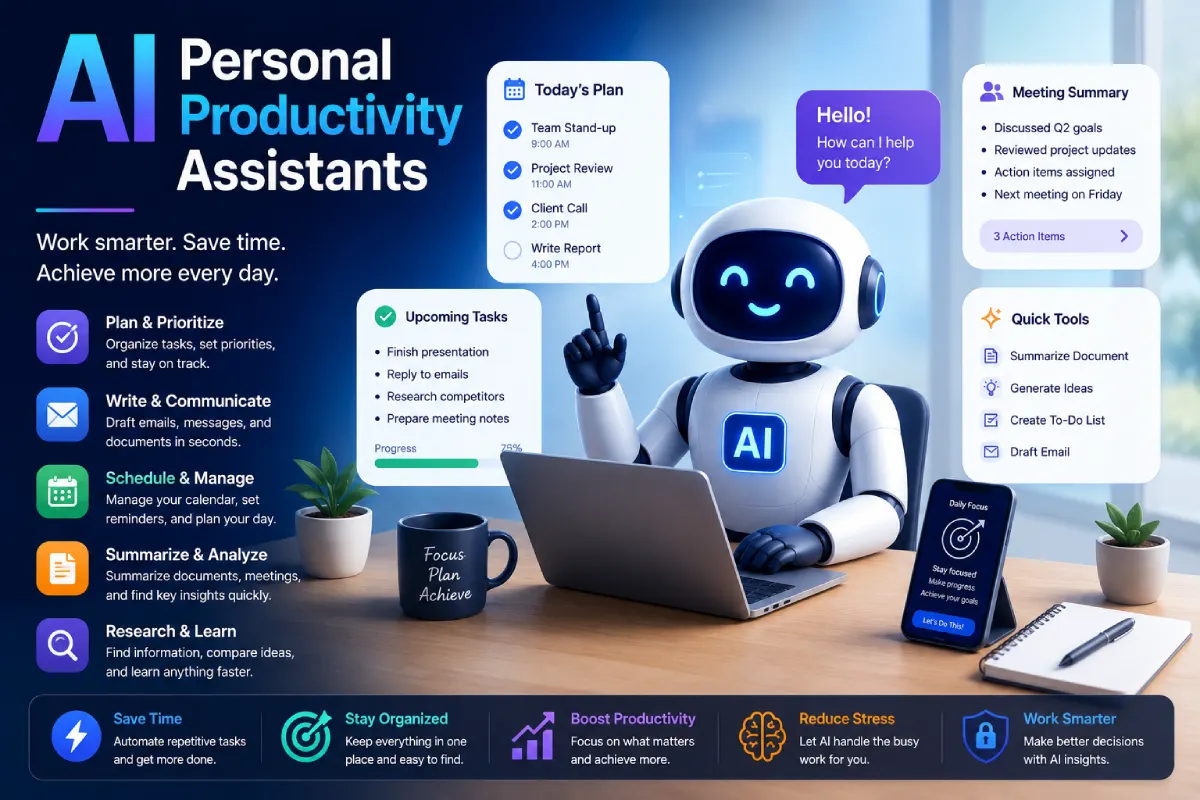
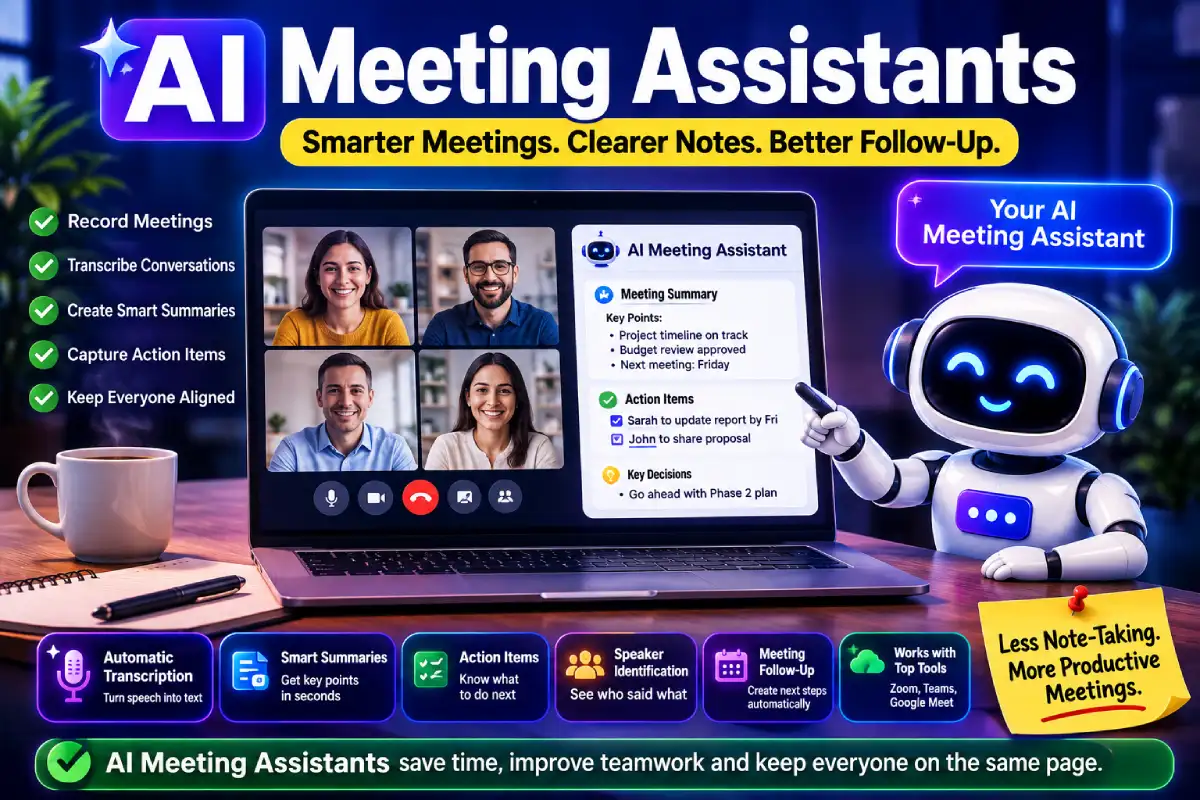
AI meeting assistants are increasingly becoming a useful tool for productive teams that spend much of their working day in meetings. Rather than writing notes when you want to contribute to a discussion, an AI meeting assistant can record what is said, identify those main points, then, after the meeting, bring the important information together, identify tasks and summarize what was discussed.
Thus, AI meeting assistants are especially valuable if you belong to remote teams, sales teams, project managers, customer support teams, or if you run a lot of meetings. They fit naturally into a wider AI productivity strategy as well. Your Productivity and AI covers various AI-powered productivity categories and meeting assistants can be considered as a standalone cluster under that topic.
But the greatest benefit is not just having meeting recorded. It utilizes conversations and turns them into valuable information and things to do automatically so that no one has to write it all down by hand.
“For the overarching strategy, read our complete guide on Productivity and AI.
What are AI meeting assistants?
AI meeting assistants are programs assisted by AI that help in various aspects of the process.
Depending on the platform, they can:
- Record meetings
- Transcribe conversations
- Identify speakers
- Create summaries
- – on the back of the agenda, identify what actions to be taken and based on what time profile (how often tasks need to be performed?);
- Emphasize key decisions.
- Create minutes of the meeting
- Search past conversations.
- Send follow-up emailing:
- Integration with project management tools (e.g., Excel)
- Analyze conversations
Certain assistants are built for working with the audio from video conferencing programs. Other tools can keep track of an in-room discussion or take in audio and video files that have been uploaded.
Depending on your team‘s real needs, the features are different from one tool to another.
How Do AI Meeting Assistants Function?
The process is usually simple.
Use 1: Join or Record the Meeting.
The assistant either joins a supported meeting platform or records the audio of the meeting.
Step 2: Transcribe the Conversation
Speech Recognition Technology. Takes spoken words and transforms them into text.
Step 3: Analyze the Discussion
AI analysis extracts the transcript‘s most important discussion topics, decisions, questions, and tasks.
Step 4: Create a Summary
A summary: Instead of reading the whole hour long transcript the participants can read a shorter summary.
Step 5: Extract Action Items
It is able to recognize tasks and connect a project manag and a task management system if any exist, depending on the platform.
What this does is turn a discussion into an actual record that people can make use of.
What are the capabilities of AI Meeting Assistants?
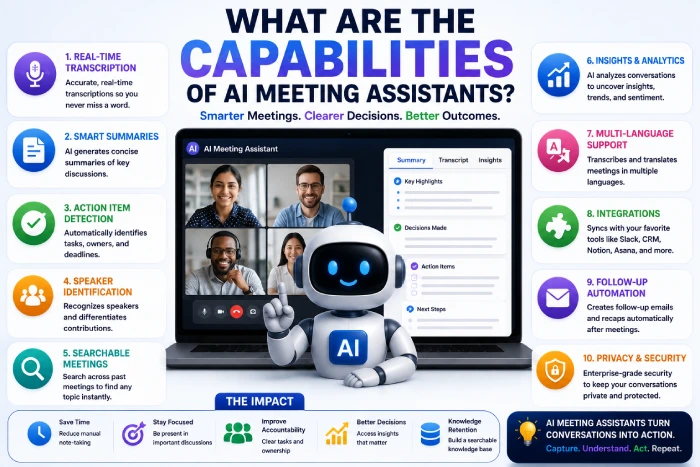
1. Transcribe Meetings
The most frequent is this:
Rather than having someone transcribe at the meeting, the secretary creates a searchable text of the minutes.
This can be useful for:
- Team meetings
- Client calls
- Interviews
- Sales calls
- Brainstorming sessions
- Project discussions
- Training sessions
They can also make it easier to find what someone said at a later date.
2. Create Meeting Summaries
Long meetings can be so packed with information that not all of it is of equal matter.
It can also condense the main points of a discussion, shortening a long conversation into a condensed summary.
A useful summary might include:
- Main topics
- Important decisions
- Problems discussed
- Next steps
- Unresolved questions
Allows employees to avoid the extra work of writing minutes after the meeting.
3. Capture Action Items
It isn‘t so much the fact of meetings that is the trouble it‘s what follows that is the problem.
AI based meeting assistants can recognize purpose or intended action statements.
For example:
Sarah would have updated the landing page by Friday.
The AI may turn this into an action item:
Task: Update landing page
Owner: Sarah
Deadline: Friday
The actual automation level is software-dependent.
4. Identify Important Decisions
Off the top of my head, decisions in meetings that people forget later on.
AI can identify key decisions and include those.
This creates a useful reference when someone asks:
“How come we did this?”
The summary decision can be quick compared to searching through the full recording.
5. Generate Follow-Up Emails
Certain AI assistants may be useful for taking a meeting note and turning it into some sort of follow up communication.
For example, after a client meeting, AI could create a draft containing:
- Appreciated note:
- Main discussion points
- Agreed actions
- Proposed date for our next meeting
- Outstanding questions
An email should be sent but a human should check it first.
“To take the next step, see our detailed guide on AI Data Analysis and Reporting.”
Benefits of AI Meeting Assistants
Save Time
One of the most significant benefits is that it eliminates the need for manual note recording.
Allows employees to free write when entering notes so they can spend time speaking during the conversation.
Improve Meeting Documentation
Significant information can be saved automatically.
This is particularly beneficial for teams which have numerous meetings each week.
Make Meetings More Accessible
Transcripts and summaries provide a record that can be used to explain to those who missed a meeting what occurred.
Before seeking that assistance, they can even look at the summary and the action items.
Improve Accountability
When action items are clearly documented, it becomes easier to understand:
- Assignee?
- What should be done?
- How often does it have to be completed?
It can clear confusion after the meetings.
Make Information Searchable
Transcript provides an archive of the interactions, which can be Google searched.
For example, a team member might search for:
What is the conclusion we reached? What was we decided about the product launch?
Providing a back-archiv of meetings is the obvious starting point in that it makes it easy to find that information.
AI Meeting Assistants for Different Teams
Project Management Teams
Project managers can use AI meeting assistants to capture:
- Project updates
- Delays
- Decisions
- Task assignments
- Risks
- Deadlines
Meeting summaries can then be linked to project documentation or task-management flow sheets.
Sales Teams
Sales representatives can use AI to document customer conversations and identify:
- Customer requirements
- Objections
- Product interests
- Competitor mentions
- Follow-up tasks
And it can actually cut down on manual CRM entry following sales calls.
Marketing Teams
Marketing teams can use meeting assistants during:
- Campaign planning
- Content meetings
- Client calls
- Creative reviews
- Strategy sessions
This produces summaries that can facilitate transforming conversations into actions.
Customer Support Teams
Customer conversations may reveal critical information about product issues and customer expectations.
AI: can be used to record/monitor these debates and identify common themes.
AI Meeting Assistants vs. Traditional Note-Taking
| Feature | Manual Notes | AI Meeting Assistant |
| Transcription | Manual | Automated |
| Meeting summary | Manual | AI-assisted |
| Action items | Manual | AI-assisted |
| Searchable conversations | Limited | Usually available |
| Speaker identification | Manual | Often automated |
| Follow-up drafts | Manual | AI-assisted |
| Time required | Higher | Lower |
| Human review | Required | Still recommended |
Necessarily not. Creativity is still, in particular to the user, a key aspect of making notes.
For critical meetings, individuals might still wish to add background, decisions, or data that the EI missed.
How to Choose the Right AI Meeting Assistant
1. Check Meeting Platform Compatibility
Firstly, ensure it can work with the communication systems that your team use.
Consider compatibility with:
- Zoom
- Microsoft Teams
- Google Meet
- Other conferencing platforms
Find out if the tool is compatible with your current workflow it‘s not worth trying to shoehorn a powerful tool into a workflow it was never designed to support.
2. Look at Transcription Quality
There are several important features such as:
Consider how well the tool handles:
- Different accents
- Multiple speakers
- Technical terminology
- Background noise
- Fast conversations
- Multiple languages
Put it through its paces using real meetings before you decide to stay committed long-term.
3. Evaluate Summary Quality
You need more than a transcript.
The AI should do the job of trying to determine what information is actually relevant.
Look for summaries that clearly separate:
- Key points
- Decisions
- Action items
- Questions
- Follow-ups
4. Check Integrations
The best AI meeting assistants should work with your pattern of working.
Useful integrations may include:
- Such as…
- CRM platforms
- Slack
- Microsoft Teams
- Google Drive
- Notion
- Calendar applications
Integrations make it possible to transform meeting information into actual work instead of just writing it into yet another application.
5. Review Privacy and Security
Meetings will also contain the up-to-date business information.
Before using an AI meeting assistant, understand:
- Where the recordings are stored.
- The provisions for transcripts.
- Meetings who is eligible to attend
- The duration the data is kept for:
- How customer data is utilized (for example, for model training)
- What controls administrators can implement
Require your organization to have guidelines on recording and AI use for confidential meetings in place.
Common Mistakes When Using AI Meeting Assistants
Recording Everything Without a Policy
The point I‘m trying to make is that not every conversation needs to be on record.
Make sure it‘s clear internally on the circumstances under which AI recording is justified.
Trusting Every Summary
Can be very intelligent but not grasp certain nuances of conversations or contexts.
Re-read significant abstracts for overuse.
Ignoring Consent
All participants need to be aware if a meeting is being video/audio recorded or transcribed, within existing legislation and organizational policy.
Creating Too Many Notifications
If you tend to automatically generate multiple tasks and reminders for every discussion, it will likely become cluttered.
Be cautious with how and when you use automation.
Choosing Features Instead of Workflow Fit
A long list of AI capabilities is pointless if the tool can‘t plug into your team‘s current workflow.
Best Practices for Using AI Meeting Assistants
Tell Participants
Be transparent about your recording and transcription processes.
Review Important Summaries
For sensitive meetings with key clients, or in client meetings on financial, legal, strategic or other critical matters.
Turn Decisions Into Tasks
Make sure that the summary reports of meetings are not being become passive records.
Turn key decisions into next actions.
Keep Sensitive Information Protected
Ensure to follow the privacy and security standards of your organization.
Create a Standard Meeting Workflow
For example:
Meeting (record)→ AI transcript (generate)→ Summary (produce)→ Decisions (make)→ Action items (assign)→ Project management system
This enhances the utility of the device enormously.
Are AI Meeting Assistants Actually Replacing Notes from a Meeting?
They may lessen the reliance on conventional note scribbling, yet they do not entirely eradicate human presence.
AI is fast at gathering great swathes of data.
Humans are still more efficient at understanding organizational contexts, assessing significance, identifying nuanced issues, and determining the next course of action.
The strongest approach is usually:
AI catches the flow. Humans lend an evaluation.
Frequently Asked Questions
Introduction of AI meeting assistant?
AI meeting assistant is an intelligent software. It records, transcribes, summarizes, analyzes and organize the conversation during the meeting.
Can AI assistants for meetings assist by taking notes?
Yes. Several can generate summaries, highlight the main points, and pull out actions items.
Is it possible for each AI meeting assistant to create action items?
There are various tools that can automatically detect potential action items from a conversation (and some that can associate those tasks to project management or other productivity systems).
Is AI meeting assistants not accurate?
If equipment reliability, environmental conditions, properties of tape-recording, and speech characteristics are not carefully considered when using the tool to transcribe data, transcription accuracy may not be adequate. It‘s necessary to check critical information, for example: accents, background noise, polyps, or technical words.
Can Artificial Intelligence (AI) meeting assistants be integrated with Zoom and Microsoft Teams?
Since many AI meeting assistants work well with common video conferencing tools, the important part is to check and find out if it supports the tool you choose to work with.
Is a meeting assistant supposed to be safe?
They may be used safely when organizations use the correct permissions, policies regarding retention of the data, recording policies, and access controls. Always review privacy and security practices.
Conclusion
AI meeting assistants can turn meetings from temporary conversations into searchable, organized sources of information.
They can transcribe discussions, summarize key points, capture action items, identify decisions, and help teams follow up more efficiently.
For businesses holding frequent meetings, these capabilities can reduce administrative work and improve accountability.
However, AI should support the meeting workflow rather than replace human judgment.
Choose a tool that works with your existing meeting platforms, provides reliable transcription, creates useful summaries, integrates with your productivity stack, and meets your organization’s privacy requirements.
The goal isn’t simply to record more meetings.
The goal is to turn meetings into clearer decisions, actionable tasks, and better productivity.