Last Updated: October 1, 2026
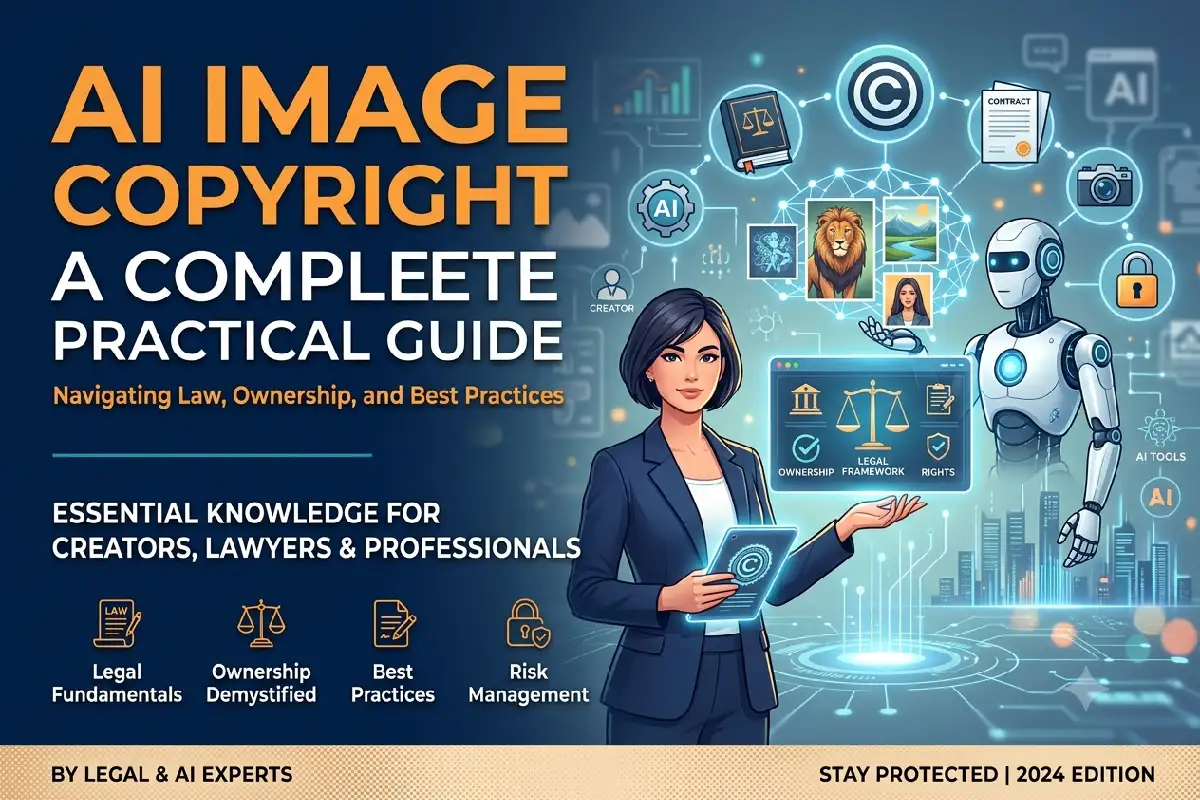
AI image generators have removed the challenge of visual creation quite surprisingly. A few words of prompt can quickly turn into a drawing, idea for product, social media graphic, or an authentic simulation of a real-world environment.
However, while the owner of the “author‘s” image owns the copyright10 in that image, creation of the image and ownership of copyright in that image are not necessarily the same.
AI image copyright problems arise in situations like who has copyright in an image generated with the aid of AI; how much of the image must be that of a human author; whether the generated image can be used commercially; and how is data that is very similar to copied work affected.
These protocols are new and evolving and are different from country to country. Here we will describe the general principles as simply as possible, not how each AI image should be regarded.
Author note: This is not official legal guidance but a bit of general information. Be aware that copyright rules differ depending on the location and circumstances.
AI Image Copyright: Meaning and Key Concepts
Copyright is a protection of intellectual property right for original works of authorship. Classic works of this category cover photographs, drawings, paintings, books, movies and music.
AI complicates things because a substantial part of what is seen may be generated by the software.
Easily the most important question is How much of the finished picture was actually created by a human?
In the U. S., the Copyright Office still considers human authorship an important prerequisite. Its report on the matter in 2025 determined that utterly AI generated material is not copyrightable, while expression created by a human author as part of a work containing AI generated material can be copyrightable. The work must be examined to determine if a person‘s contribution is enough.
This creates an important distinction between three situations:
| Creation process | Copyright position in the U.S. |
| Image created almost entirely by AI | Purely AI-generated material is not copyrightable |
| AI image substantially modified creatively by a person | Human-created elements may be protected |
| Human artwork incorporated into an AI-assisted work | Original human expression may remain protected |
Simply typing a prompt does not automatically establish copyright over everything the system produces. The U.S. Copyright Office has said that, with current generally available technology, prompts alone do not provide sufficient human control over the expressive elements of an output.
Why AI Image Copyright Matters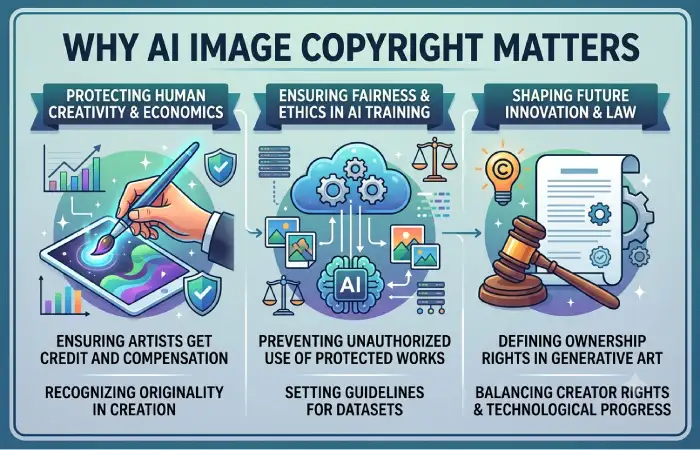
AI images are not just experimented on anymore. Companies and creators are using them for visual content on blogs, as advertising ideas, for presentations, social media content, product mockups, thumbnails, and commercial content.
That makes ownership important.
Imagine that a company generates an image for an advertising campaign. The image becomes popular and another business starts using something nearly identical. The original company may assume that because it generated the picture first, it automatically owns copyright in the entire image.
That assumption may be wrong.
The level of human creative involvement can affect what parts of a work qualify for copyright protection.
Questions of copyright infringement can go the other way as well. An image generated with an AI may include elements, be it characters or photographs or logos or art or whatever, that may be similar to other protections. The use of AI doesn’t automatically make everything it produces runs safely.
Hence the need for both protection and permission.
Key Types, Methods, and Examples
There does not exist a single genre of AI generated art. The way an image is produced can make a major difference.
Fully AI-Generated Images
There is one input by the person to the whole system: he enters a prompt and immediately accepts whatever output he gets.
For example:
” Construct a sci-fi city with mountains in the distance at sunset. ”
It is also to be noted that most expressive aspect of a system including composition, buildings, lighting, textures and placement can be deduced.
According to the existing U.S. Copyright Office method, no work merely created by a machine will be given copyright if it has no human involvement.
AI-Assisted Human Artwork
AI can also involve an element of collaboration:
A designer might draw an original character, use AI to experiment with backgrounds, manually combine several elements, change the composition, repaint sections, and make substantial creative edits.
Here, copyright analysis becomes more nuanced.
The U.S. Copyright Office states that using AI as an assisting tool does not prevent copyright protection for human-authored expression. Creative modifications and the human selection, coordination, or arrangement of material may also qualify for protection.
AI Images Based on Existing Material
Another situation occurs when someone provides an existing photograph, drawing, or design and asks an AI system to transform it.
Copyright questions may then involve both the original work and newly created material.
If you did not produce or otherwise license the original image, obtaining a copy of it does not automatically grant you the right to copy, alter, publish, or sell it.
Human and AI Composite Images
More and more, designers blend together photographs, illustrations, typography, AI backgrounds, and hand-drawn graphics.
Copyright might cover those human-made parts, or their creative allocation to the final file, instead of every single part that falls within the final version.
How to Use or Apply AI Image Copyright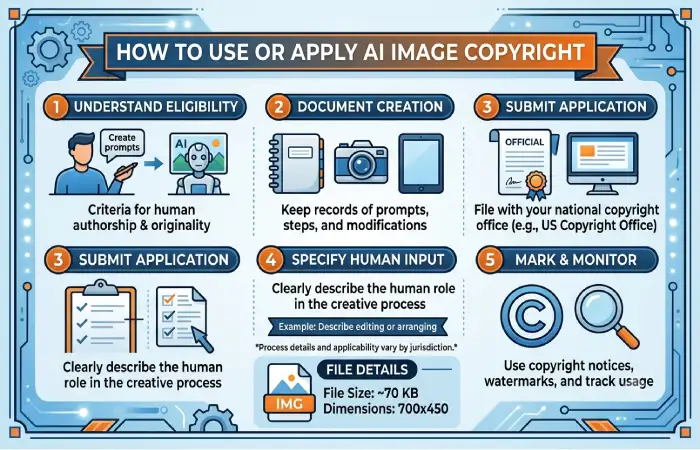
A practical workflow can reduce unnecessary copyright problems.
1. Check the AI platform’s terms
Before using generated images commercially, understand the provider’s current terms. Copyright law and a platform’s contractual usage rights are separate issues.
2. Keep records of your creative process
Make a backup copy of original sketch, source document, sources, source images, interlayer sketches, important source images, and key source image edits. These can help document which parts of the final work came from your own creative decisions.
3. Add meaningful human creativity
Don’t assume that generating dozens of images automatically creates stronger copyright protection.
Instead, consider original composition, manual illustration, retouching, typography, creative arrangement, or other substantial changes.
4. Review important images before publication
Search for identifiable copyrighted characters, logos, art work, photographs or other material that could potentially pose copyright problems.
Special attention should be given to commercials campaigns.
5. Understand registration requirements
For situations where registration is appropriate, applicants should be prepared to clearly specify the original human-authorship and any AI-generated material. The U.S. Copyright Office has issued the following guidance on AI-generated content:
Best Practices and Common Mistakes
A logical way to think about copyrighting images generated by AI should begin by considering AI a tool of art creation, not by assuming that the tool itself determines the ownership issue.
It is good practice to retain editable project files, document significantly contributed human elements, double-check licensing, cite original sources, and give special care to major commercial projects.
One common mistake is assuming “I generated it, so I automatically own copyright in everything.”
Another is confusing commercial permission from an AI service with copyright ownership. A platform may allow certain uses under its terms, but that does not necessarily mean every generated element receives copyright protection under national law.
Creators should also avoid assuming that an AI-generated image cannot affect someone else’s rights. AI generation does not create a universal exemption from copyright, trademark, publicity, or other applicable laws.
Finally, avoid treating copyright rules as identical worldwide. National laws and legal interpretations can differ considerably.
Final Thoughts
AI image copyright issues will become more straightforward once you begin to think in terms of human acting.
AI can help generate ideas, backgrounds, textures, variations, and visual starting points.
However, under the present U.S. methodology, copyright protects original human expression not merely machine-made expressions. Human inputs such as adaptations, arrangements, configurations, etc, would remain protected.
For the creators of daily life, a practical solution is simple: treat AI as a tool, output real creative work, record (what you created), know the platform conditions, check key commercial photos before publishing them.
As AI tools advance, so will the Copyright rules that govern them and as time goes on, businesses and professional creators of content are advised to revisit the particular rules that apply to them depending on the countries they do business in.