
Last Updated: September 29, 2026
AI writing technologies can assist with ideation, outlining, summarization, and the initial draft process by enabling users to complete these tasks more quickly. However, this increased speed introduces a new challenge: ensuring that the end product is correct, valuable, autonomous, transparent when necessary, and has had human review.
This is the place for responsible AI writing.
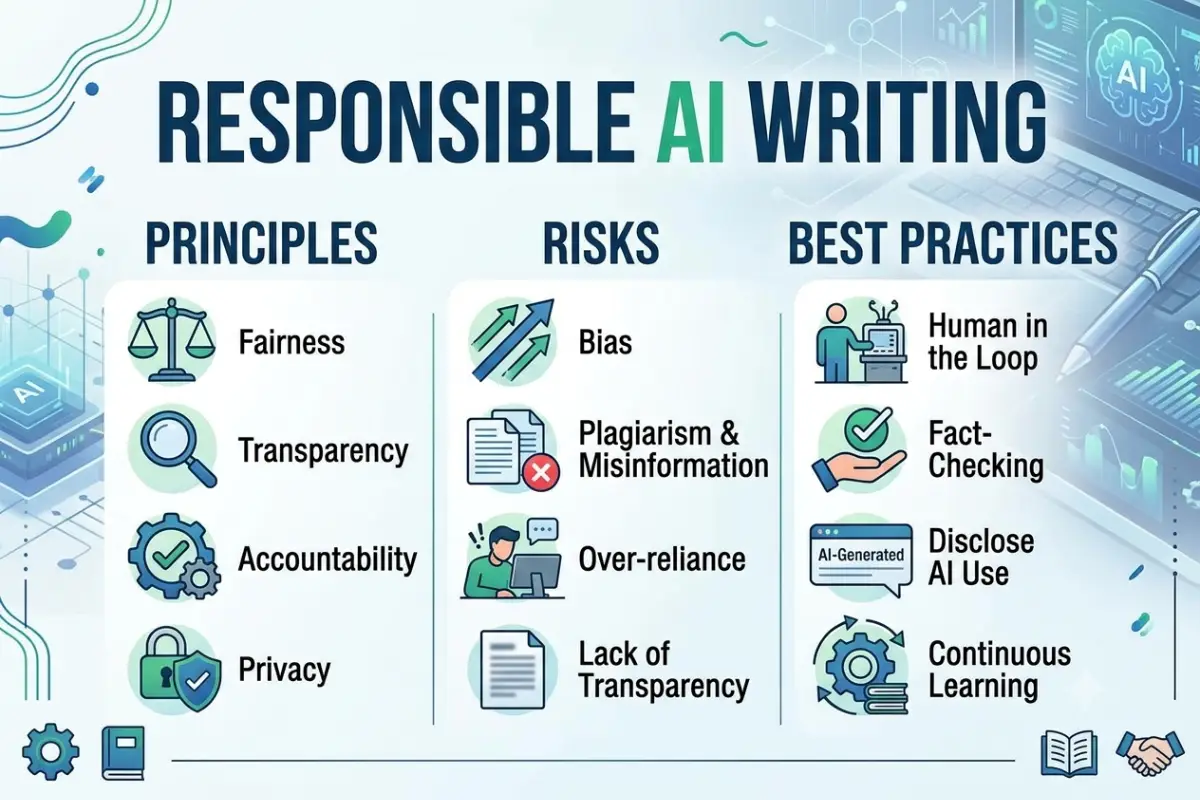
Responsible AI writing would be defined as employing AI as a tool to aid the creation of the writing and keeping human oversight on the judgments made and accountability for the completed work. Duties involved, for example, would be not pasting an answer directly into a site but verifying facts, improving the writing, avoiding personal information and ensuring the work is useful to the end user.
What Makes an AI-Powered Text Responsible?
Responsible AI writing: use of AI assisted writers with human one-click input, fact check, privacy awareness, editorial standards & requirements and transparency.
AI really can produce believable writing extremely rapidly. But that doesn‘t make it accurate.
An AI tool may produce:
- Incorrect facts
- Outdated information
- Unsupported statistics
- Invented references
- Repetitive wording
- Overconfident claims
- Generic explanations
Hence why the person publishes the content should still be responsible for what gets to the reader. You see AI as a help and not an auto publisher.
Why Responsible AI Writing Matters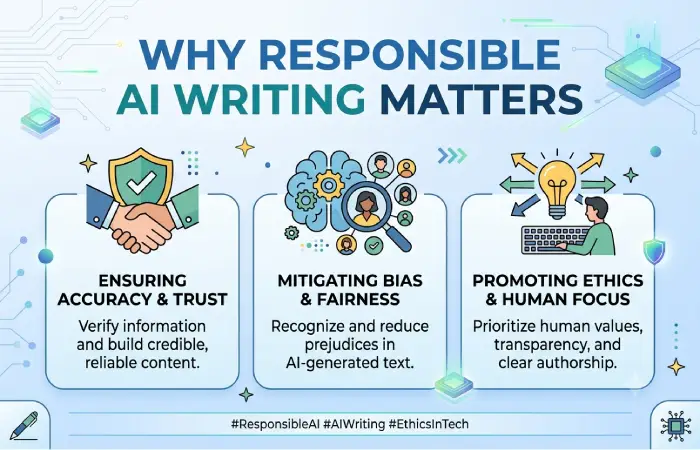
Publishing a substantial volume of AI generated text, if not thoroughly proofread, can pose a number of issues.
Accuracy
AI-generated responses may be wrong despite sounding confident. Claims based on statistics, research, product specs, health, finance, law, or news are especially noteworthy Significant Assertions should be verified with fair references that are to be published.
Content Quality
Fast does not mean that swiftly can make 20 articles in vain.
Good content still requires:
- What is search intent? When interpreting search behavior, the first important difference to consider is the intent of the search.
- Logical structure
- Useful examples
- Appropriate depth
- Editorial judgment
- Accurate information
- Natural language
AI can help speed up certain stages of the process but it can’t substitute a high standard of edit.
Reader Trust
Readers don‘t want to have to find the question answer within an article, they want thearticle to provide the answers. If an extraneous voice appears obviously wrong or an insubstantia! claim has been fabricated, or there is senseless repetition, then trust is lost very rapidly. Responsible AI utilisation, puts the Readership before Good publication.
Use AI as an Assistant, Not the Final Editor
The addition of a human in the process is one of the easiest responsible AI writing practice.
AI can help with:
- Topic brainstorming
- Keyword variations
- Article outlines
- Headline ideas
- First drafts
- Summaries
- Grammar improvements
- Paraphrasing rephrasing complex sentences
The last proof should also have been checked by someone who knows his way around the topic and the purpose of it.
Ask:
- True or false?
- Is this part useful?
- Has the following been left out?
- Do you think the article sounds repetitive?
- Supported references (support)? Can I provide reliable support for, key claims?
That editorial step is what takes something that could be an AI-generated, generic piece and makes it a useful piece.
Always Fact-Check Important Claims
Never assume a claim is right just because it is clearly written.
Use primary sources or other scholarly references to confirm facts whenever feasible.
For instance, if a fitness article about guidelines for physical activity found said, it should use trustworthy health organizations at an AXES unmentioned in an AI AI statement.
Similarly, any software article covering about any features or getting a quote should verify the provider for current offering/pricing.
Pay particular attention to:
- Numbers
- Dates
- Research findings
- Quotes
- Product specifications
- Regulations
- Medical information
- Financial information
If the source is irreproducible, then think again whether the claim should be in the article.
Protect Private and Sensitive Information
Moreover, privacy is also an essential aspect of responsible AI authoring. Do not input any sensitive data into an AI system until you know how the system administrators use and handle that data.
Sensitive material may include:
- Customer information
- Passwords
- Information on business finances and other business-related writings that should remain confidential.
- Employee records
- Unpublished financial data.
- Individual patient identifiers?
- Client confidentiality material
Do you consider that the AI writing platform used for your business must have privacy, data storage and organization controls?
Avoid Fake Expertise
AI can effortlessly create experienced sounding language. This is not expert content advice.
Do not invent:
- Personal experiences
- Product testing
- Professional credentials
- Interviews
- Case studies
- Research
- Customer testimonials
As if nobody actually tried out a product, the article shouldn‘t have said, “During our testing. Never invent an expert quote in case an article wasn’t read by one. Experiential knowledge has value because it is knowledge.
Responsible AI Writing for SEO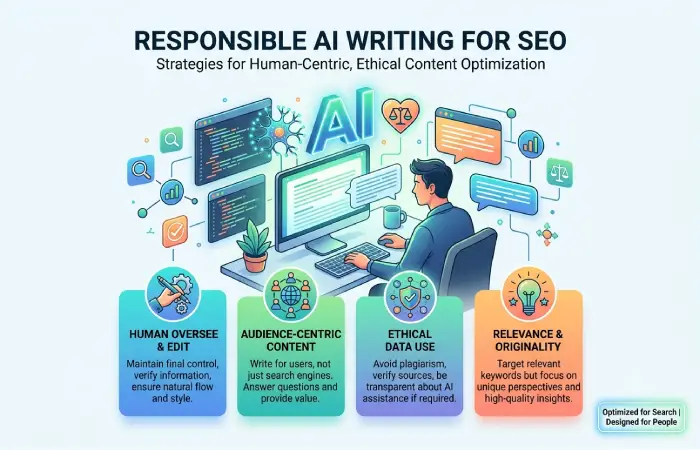
AI-related content and SEO do not necessarily become opposites.
The more relevant question, then, is: is this content really helpful?
Rather than bot-writing the 1,000th near-identical article, AI can be used as a supplement, combining it with a human-led content strategy.
A responsible SEO workflow could look like this:
- Decipher the search purpose.
- Investigate the subject.
- Construct an independent outline.
- Make use of AI for help with the writing process.
- Add knowledge that is based on experience.
- Check key facts.
- I suggest to enhance the examples and the explanations.
- Include reliable sources.
- Eliminate the extraneous and awkward language.
The target should always be: create a page because your readers need it, not just because there is a keyword sitting there.
Common Responsible AI Writing Mistakes
Publishing the First Draft
Generant AI should normally be considered as initial material rather than completed work.
Trusting Every Citation
(i.e. prove that the sources exist and corroborate the claim).
Creating Fake Experience
No matter what, do not pass off automatic writing as your own experience.
Ignoring Brand Voice
AI written content can be very negative. Copy text so that it aligns with the publication and target audience.
Producing Content Only for Search Engines
The use of the keywords should be the topic and not the spewing of class domination. Please respond in a natural written style to the authentic question asked by the user.
A Simple Responsible AI Checklist
Before publishing AI-assisted content, check:
- Is the information accurate?
- Have important claims been verified?
- Are the sources genuine?
- Is private information protected?
- Is any experience or expertise being falsely implied?
- Does the article offer original value?
- Does it answer search intent?
- Has a human reviewed the final version?
If the answer to any important question is no, the article probably needs another editing pass.
FAQs
What is meant by responsible AI writing?
Responsible AI writing refers to the use of AI systems with human supervision, fact verification, privacy considerations, establishing what level of transparency is adequate and defining editorial responsibility.
The above paragraph raises the question–should we fact-check –the content generated by AI? If so, then how?
Yes. However, factual information may have to be fact-checked as AI may generate inaccurate, incomplete or obsolete data;
Is it feasible to utilize AI technologies for SEO content such as blog posts, articles, and other online writing?
Distribute The computer can facilitate with research and paragraph outlines, editing, and drafting; but the finished product should continue to hold the emphasis on accuracy, emanating from the writer‘s own head; avoiding plagiarism or other plagiarism-like ‘pandaemonium,’ usefulness and preserving the reader‘s intention.
Do we still need human editing?
Manual review is needed to verify correctness, context, tone, originality of the content, and whether the content is really targeted at the intended audience.
Conclusion
Responsible AI writing is not about not usingartificial intelligence. It is about using it responsibly.
The process of illustration, outlining, drafting and editing can be made more efficient with the use of AI, but it is still the author who published the content who is ultimately responsible for the work.
Double-check critical statements, keep private data private, steer clear of invented know-how, contribute human feeling, and scrutinize every major statement before posting.
The best, most useful AI-powered content will marry the ‘convenience’ of the machine to something that should never be taken over by the machine: the human mind and human editorial oversight.
Please implement a ‘use the AI writing system’ button Include a ‘Use the AI’ workflow Show the ability to inform the user ‘this is the act of the AI’