

Last Updated: September 28, 2026
Chatbots based on AIs are now widespread, being used for customer support, productivity, research, shopping, learning and everyday workflow using business 24/7. They can respond to queries in under a second while carrying out mundane conversations automatically.
Someone may input their name, email address, details about themselves or the company, account information or any number of other sensitive data in the knowledge that it.
This makes the privacy and security of an AI chatbot a significant concern when dealing with AI.
Privacy- centers on information being gathered, applied, stored, and shared. Security- centers on protecting that informationandthe chatbot system within from leaks, destruction, unauthorized uses, alteration and cyber threats.
This practical guide provides a step-by-step description of the main concepts, dangers and security strategies and practices that a business or individual need to know about.
AI Chatbot Privacy And Security: Meaning and Key Concepts
Personal data privacy of AI chatbotmeanthe policies and procedures for handling and storage of sensitive or private data that is collected during a chatbot conversation.
Take as an illustration the situation where a user interacts with a customer service chatbot and provides information such as e-mail address, order number, delivery details. The organization providing the chatbot requires suitable controls over the processing of that data.
Such as safeguarding the chatbot, the system on which the chatbot operates, associated databases/APIs, user accounts, and the conversations (history).
Several concepts are especially important.
Data Collection
Chatbots may process information directly entered by users as well as technical information generated during an interaction.
Organizations should understand what information is actually necessary. Collecting unnecessary information creates additional privacy and security exposure.
Data Storage and Retention
Some chatbot applications store chat history to monitor, analyze, improve the service, or for archiving or other reasons.
There should be clear retention policy, instead of keeping the chatbot data for indefinite time without any purpose.
Access Control
Not every employee or system should have access to chatbot conversations.
The access control can be performed based on a person‘s role. Strong authentication offers an extra level of security.
Encryption
Encryption is used to protect information from being accessed by unauthorised parties.
Data can be protected as it moves between the user‘s device and the chatbot service and when stored on company systems.
Consent and Transparency
Individuals should have access to intelligible information regarding the treatment of their data.
Organizations can issue privacy notices that state the nature of the information they collect and how long it is kept for, reasons for collecting it and whether there is any sharing of it with other services.
Why AI Chatbot Privacy And Security Matters
Sometimes, users may disclose unexpectedly sensitive information to a chatbot.
Users may enter:
- Personal information
- Customer account details
- Internal company information
- Financial information
- Contact information
- Business documents
- Login information
It could also interfaced with a customer relationship management platform, a helpdesk, a database, a payment system or any other internal business tool.
The integrations enhance the capabilities of chatbots; however, if they are not configured properly such features could introduce security concerns.
Protecting Customer Trust
When people are aware of safeguards and protection measures, they are very comfortable using a digital service.
A major incident involving a chatbot can undermine customer confidence and cause operational and reputational issues for an organisation.
Meeting Privacy Requirements
The data collected by, through or accessible to the chatbot can be subject to either the GDPR [ ], or more generally to other requirements relating to data protection under different national and/or regional legislations.
So it became important for organizations to be aware of what rules are relevant in their particular case.
Protecting Confidential Business Information
Risks to privacy impact not just the customers.
People are increasingly turning to AI helper tools to write, interpret, code, research and manage documents. Copy-pasting sensitive data from confidential contracts, customer lists, credentials, proprietary code or unstated business data into a rogue chatbot is needless risk.
It is recommended that companies explicitly specify the tools their staff can use and what data it can (or should) contain.
Key Types, Methods, and Examples
There are different security measures that are incorporated to enable secure operating of an AI Chatbot.
| Security Method | Main Purpose |
| Encryption | Protect data during transmission and storage |
| Authentication | Verify the identity of users |
| Access controls | Restrict who can access information |
| Data minimization | Reduce unnecessary collection |
| Monitoring | Detect suspicious activity |
| Data retention rules | Control how long information remains stored |
| Security testing | Find vulnerabilities before attackers do |
Prompt Injection Protection
The security issue that AI chatbots currently have is called prompt injection.
An attacker may generate commands to trick an AI into following inappropriate rules or leaking information.
Thus, AI chabots should not only follow the model instructions in their operation not to constitute a security barrier. Sensitive operations should have additional authorization and application-level controls.
API Security
Many business chatbots communicate with other applications through APIs.
For example, a support chatbot could access data of a user order from e-commerce database.
Never unnecessarily publish API keys and credentials. Appropriate authentication, permission controls, rate-limit, monitoring, and management of credentials can limit API risk.
Personal Data Protection
Consider an online store using an AI chatbot.
The chatbot may need an order number to check delivery status. It probably does not need unrelated personal information.
This demonstrates the principle of data minimization: collect and process only the information necessary for the task.
Human Verification for Sensitive Actions
Not every action requested should be taken automatically by a chatbot.
Sensitive operations i.e. modifying account details, viewing private records, approving financial transactions etc. This can be done either in a two level system where the user is authenticated twice or by requiring a human authorisation.
How to Use or Apply AI Chatbot Privacy And Security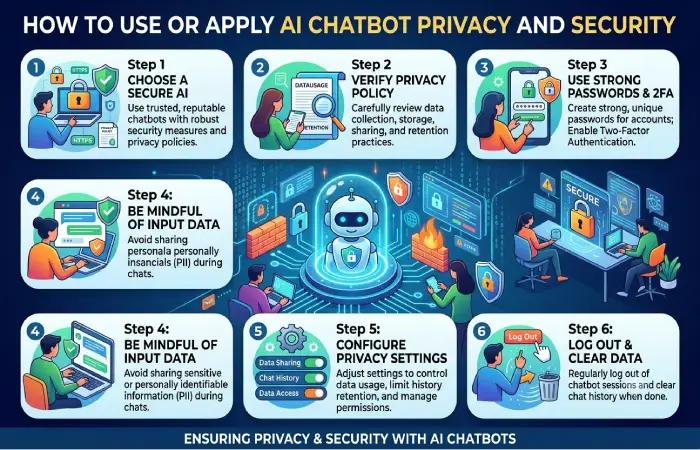
Organizations can treat chatbot security as an ongoing process instead of a one-time setup.
1. Identify the Data Being Processed
Start by understanding what information enters the chatbot.
Prepare to set apart as separate categories ordinary information from those categories requiring special protection: identifying information, financial data, authentication information, sensitive company information, and subject to regulation.
2. Reduce Unnecessary Data Collection
Question whether you really need the info.
If the bot can perform the task without gathering all of a user‘s information, not gathering it all could lower the risk.
3. Choose Chatbot Providers Carefully
Companies need to see the provider‘s privacy and security papers before they actually start using a new technology.
Important questions include:
- Where is conversation data stored?
- How long is information retained?
- Who can access it?
- Is customer data used for model training?
- What security controls are available?
- Can retention settings be configured?
- What happens when data is deleted?
Answers can vary considerably between providers and service plans.
4. Secure Integrations
A chatbot integrated with business systems should only have access to the required permissions.
For instance, a chatbot created to verify the shipping status of an order might need user read access to certain order-related information only.
5. Test Before Deployment
Security testing should be completed before releasing a chatbot to customers or employees.
Testing can include unusual prompts, attempts to retrieve restricted information, malicious inputs, authorization checks, and scenarios involving connected applications.
6. Monitor the System
Security doesn‘t stop at deployment.
Organizations need to respond by watching for odd behaviors, repeated unauthorized requests, anomalous API activity and other warning signs that they may want to look into.
Best Practices and Common Mistakes
Privacy and security of Strong AI chatbots remains generally achieved through a combination of technical controls and appropriate organizational policies.
A few best practices include:
- Collect only necessary information.
- Encrypt sensitive data.
- Use strong authentication and access controls.
- Update the software and the integrations.
- Formulate a definite data-retention policy.
- Carefully examine the third party who makes AI assistance.
- Protect API keys and other credentials.
- Test chatbots for security weaknesses.
- Conduct employee training on safe use of AI.
- Make privacy information accessible and easy to understand to users,
A typical mistake on this list is the misconception that all that goes into a chatbot is private.
Do not share passwords, personal access codes, bank details,private documents, email ID passwords or personal details in any form unless you are comfortable with the privacy policy of the service and the details remain required.
Secondly, a dterm-1ifferent error is that a business solely focuses on the AI model.
A chatbot would typically remain just one component of a broad ecosystem where websites, APIs, databases, the cloud, user accounts and third-party applications could all remain involved. A vulnerability in the broader ecosystem is likely to impact the security of the chatbot.
Another area where you can go wrong is by providing too much access to an AI assistant.
This issue remains reduced by following a principle of least privilege. A chatbot should only remain given the information and rights it needs to perform its functions.
Final Thoughts
AI chatbot privacy and security need to remain designed into development and deployment rather than tack on an problem, when it exists.
Organizations should know what data a chatbot processes, reduce data collection to the basics, lockdown integrations, monitor who has access, identify vulnerabilities and regularly review the systems.
It is up to the user to determine an important factor. Ask yourself, do I really need to input sensitive data into the AI chatbot or wonder how your service will utilize your information.
There are many arguments in support of ai chatbots, but it is important that this outweighs the need for convenience that can contribute towards negligence in data management. When designed with privacy and security in mind, ai chatbots can remain used by companies that want to feel more confident while also ensuring that their employees, customers and data stays more secure.