

Last Updated: September 28, 2026
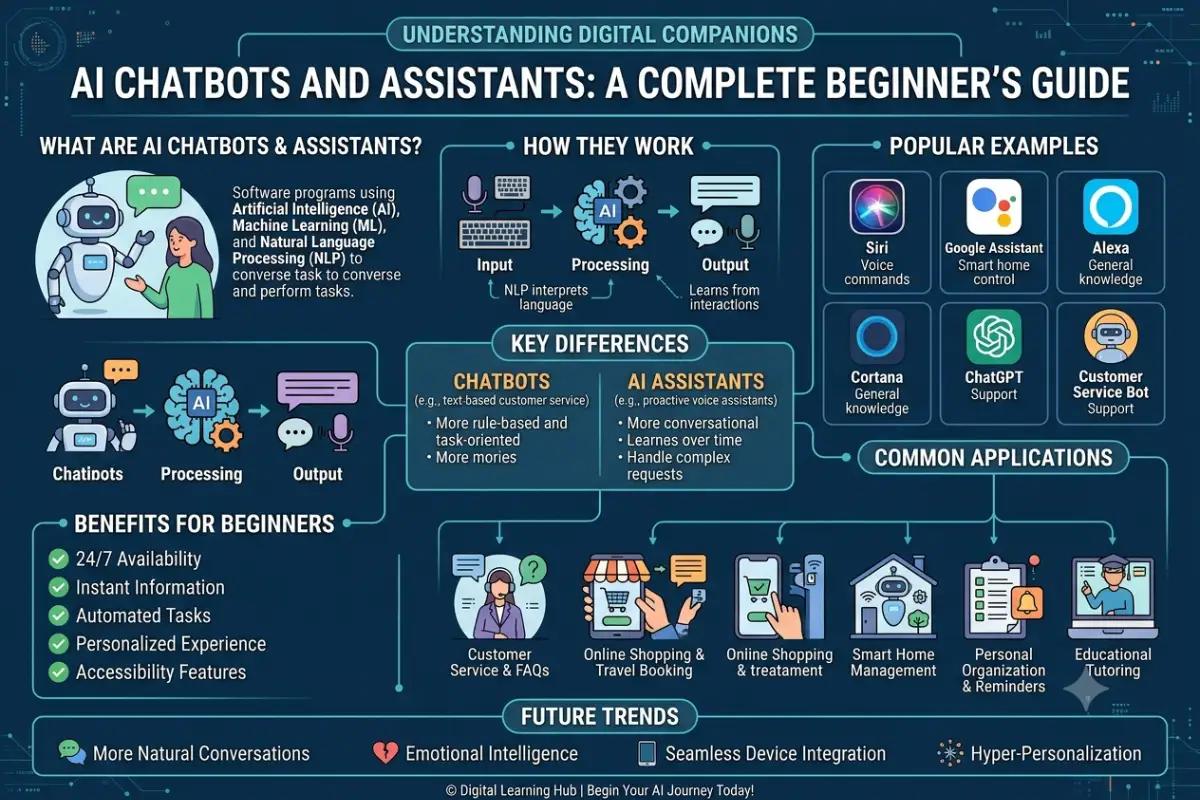
AI chatbots have advanced at an incredible rate over the past three years. The initial AI chatbots were more or less just rule-based computer programs. Currently, AI-enabled assistants are available to companies and consumers that can recognize questions, respond in natural language, perform searches in knowledge bases, and assist with routine activities.
However, as your chatbot isn’t the same as any other; other chatbots may be slightly different. for example, you have some that are simple designed to just answer simple customer questions and others that have higher levels of artificial intelligence to gather answers to complex questions in natural language.
Another benefit of understanding the different kind of artificial intelligence chatbots that there are is being able to choose the right technology for your customer or sales, marketing, productivity or business needs.
Types Of AI Chatbots: Meaning and Key Concepts
A chatbot, in the context of artificial intelligence, is a computer program capable to communicate with human via text or voice. The way in which the chatbot has been developed can determine whether it responds to information as per instructions or it uses AI.
The primary distinction between the types of chatbots is how they determine what to respond with.
Conventional Chatbots are most often rule-based, keyword-based, and decision-tree, or canned response-based. AI-based Chatbots, on the other hand, can use more sophisticated tools and technologies, including:
A contemporary chatbot could have these technologies all combined.
For example, a customer service chatbot might use fixed flows to make returns, but apply generative AI to cover unanticipated questions about the product.
Key Technologies Behind AI Chatbots

Modern chatbot systems are facilitated by a number of technologies, including:
Natural Language Processing (NLP): Allows a computer software to understand, process and analyze human language.
ML (Machine Learning): Enables programs or systems to detect trends through data and to enhance some predictions or categorizations.
Large Language Models ( LLMs): AI models trained on vast quantities of text data that can interpret requests and craft human-like replies.
Retrieval systems : Enable a chatbot to access approved documents, databases, knowledge bases prior to responding.
APIs and integrations: Enable chatbots to integrate with other systems, including CRM platforms, calendar applications, order databases, and support tools.
The specific bundle is to be decided by the task of the bot.
Why Types Of AI Chatbots Matters
Picking the right kind of chatbot makes a difference because each one addresses distinct issues.
An online shop which answers questions like “where‘s my order?” might not need the same technology as developing an AI assistant for employees.
Using a complex chatbot when it is not needed introduces expensive development and more ongoing maintenance. Conversely a simple rule based chatbot handling complex customer questions can be very frustrating.
Understanding chatbot types helps businesses consider factors such as:
- Customer experience
- Implementation cost
- Response accuracy
- Scalability
- Automation capabilities
- Security and privacy
- Integration requirements
- Maintenance needs
The goal should not simply be to choose the most advanced AI system. It should be to choose a chatbot that matches the task.
Key Types, Methods, and Examples
There are several major types of AI chatbots commonly used today.
1. Rule-Based Chatbots
Rule-based chatbots are among the simplest chatbot systems.
The replies are based on set of rules or decision tree. The user has to choose options or enter particular keyword and then bot replies with pre-set answer.
For example:
Chatbot: Done. Please type the number of your order.
The most effective in these situations were the chatbots.
Common uses include FAQs, appointment selection, basic troubleshooting and order tracking.
Their biggest limitation is flexibility. Questions outside the predefined flow may not receive useful answers.
2. Keyword-Based Chatbots
Keyword based chatbots recognize certain keywords or phrases in a message.
For instance, if a customer writes:
“My payment was declined.”
The chatbot may detect words such as “payment” and “declined” and provide troubleshooting information.
Keyword systems can handle more variation than simple button-based bots, but they may misunderstand context when similar words have different meanings.
3. NLP Chatbots
The NLP chatbots are designed in a way that they understand utterance in normal language better.
Rather than asking the word-for-word query, the chatbot tries to find out what the user means.
Someone could write:
“Where’s my package?”
or:
“Can you tell me when my parcel will arrive?”
An NLP system may recognize that both questions involve order tracking.
This makes conversations feel more natural and reduces dependence on exact keywords.
4. Machine Learning Chatbots
Machine learning chatbots apply models, trained on data, to responsibilities on the system such as extracting and detecting intent, requests classification or choosing the suitable answers
These systems may be helpful if the organization experiences many different types of questions from customers.
Unfortunately, “machine learning” doesn‘t necessarily imply the chatbot is being “learning” from each conversation. Changes typically require a specific training, testing, and assessment phase.
5. Generative AI Chatbots
AI chatbots are one of the most significant breakthroughs in conversational technology.
Rather than selecting from fixed answers these systems are able to write text on demand at a user‘s request.
Some widely-used large language models are OpenAI ChatGPT, New Bing, Bard, Gemini from google, Claude from anthropic, Copilot and so on.
Generative AI chatbots support various tasks including document creation, summarizing, idea-generation, programming aid, information research and answering intricate queries
Generated answers are also not necessarily correct. Important information should still be verified.
6. Retrieval-Augmented Chatbots
Retrieval-augmented chatbots: combines generative AIs with extra sources of information.
The chatbot can also make use of an existing body of evidence (such as approved documents or database), if available before responding to any query.
For instance, a company might be able to link an AI assistant to internal product manuals.
When an employee asks a technical question, the system searches those documents and uses relevant information to formulate its answer.
This approach is commonly associated with retrieval-augmented generation (RAG).
7. Transactional Chatbots
The transactional type chatbot is to persuade the user to perform a task.
Depending on their integrations and permissions, they may help users:
- Schedule appointments
- Check order status
- Update account details
- Create support tickets
- Make reservations
- Process certain requests
The problem with these kinds of bots is they typically are integrated with other business systems via application programming interfaces (APIs).
8. Voice AI Chatbots
Not all chatbots communicate through text.
Voice ai enables interaction of users using speech. They tend to use speech to text, text to speech, conversational ai, natural language understanding.
One of the possibilities is using them in customer service, receptions, waiting rooms, accessibility, and voice assistants.
How to Use or Apply Types Of AI Chatbots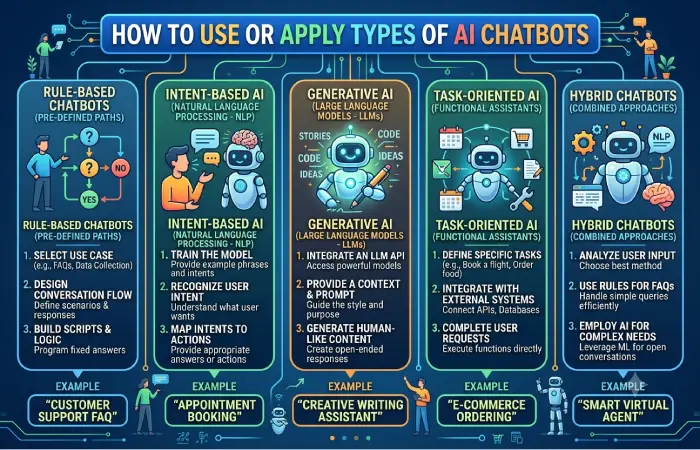
Choose the right chatbot for the problem you want to solve.
For straightforward and predictable questions, all you may need is a simple rule-based chatbot.
An NLP tool that business for different customers language may need. Generative AI for conversations, summarization, creation.
A useful selection process looks like this:
| Requirement | Suitable Chatbot Type |
| Simple FAQ | Rule-based |
| Recognize common phrases | Keyword/NLP |
| Understand user intent | NLP |
| Generate flexible responses | Generative AI |
| Answer from company documents | Retrieval-augmented |
| Complete business actions | Transactional |
| Handle spoken conversations | Voice AI |
Historically, a number of newer systems utilize a compabined approach.
An example is that an AI customer service advisor/assistant can use generative AI for chatting, retrieval to get the company‘s documents and APIs to obtain order information.
Best Practices and Common Mistakes
The technical aspects will make the chatbot, but effectively “the most valuable part if you want to create a brilliant chatbot is the knowledge behind it. The AI itself can very often be quite simple, comparatively.”
Have a well-defined purpose. Define what actions and utterances (whatever the users can say) users will be able to do with the chatbot.
Make DIALOGs easy to understand and provide instructions for user input.
Business-related use of AI should be constrained to information to which access is granted. Customer and company information should be treated in line with specified privacy and security requirements.
Test chatbot responses, too. Generative AI may produce wrong or unsupported responses.
Make sure you aren’t trying to automate everything right away. In the beginning automating just a handful of things from several identities will be easier to test and optimize.
Another mistake is removing human support completely. It may be the case that some conditions are unusual, sensitive or complex enough that there should be the opportunity for users to get in touch with someone.
Choosing the Right Type of AI Chatbot
There isn‘t an architecture for chatbots that will work universally.
They‘re still effective for simple, predictable workflows, where the conversation simply follows a set of expected steps. While NLP-based conversational engines allow far more flexible interactions; generative AI can support a much wider range of language functions.
The most efficient chatbot solutions really use a combination of all of these methods.
Prior to using a chatbot, it is useful to identify what the user requirements are, what data can be sufficiently retrieved and maybe more importantly what things should be done by the human.
When the various types of AI chatbot are understood it is easier to design a system that it actually useful rather than having AI just because it is there to be used.
Frequently Asked Questions
What are the most popular types of AI chatbots?
Types of chatbots. Common types are rule-based, keyword-based, NLP, Machine learning, Generative AI, Retrieval-augmented, Transactional, and Voice chatbots.
How do rule-based and AI chatbots differ?
Rule-based chatbots match specific, pre-determined scripts. But intelligent chatbots are able to analyze natural language and produce or identify appropriate responses.
What is generative AI chatbot?
Generative AI chatbot, which uses an AI model to generate response in the moment rather than pure answer-to-answer.
Optimal model of chatbot for customer service is what?
It depends on the complexity of customer requests. Simple FAQs might be fine with rules-based systems, but the wide variety of support requirements might call for a more sophisticated approach using NLP, retrieval, generative AI or a hybrid.
How to combine several different types of chatbots?
Yes. Manychatbot systems use a combination of conversational AI, retrieval, predefined workflows and integrations to address various aspects of the same customer interaction.