

Last Updated: September 28, 2026
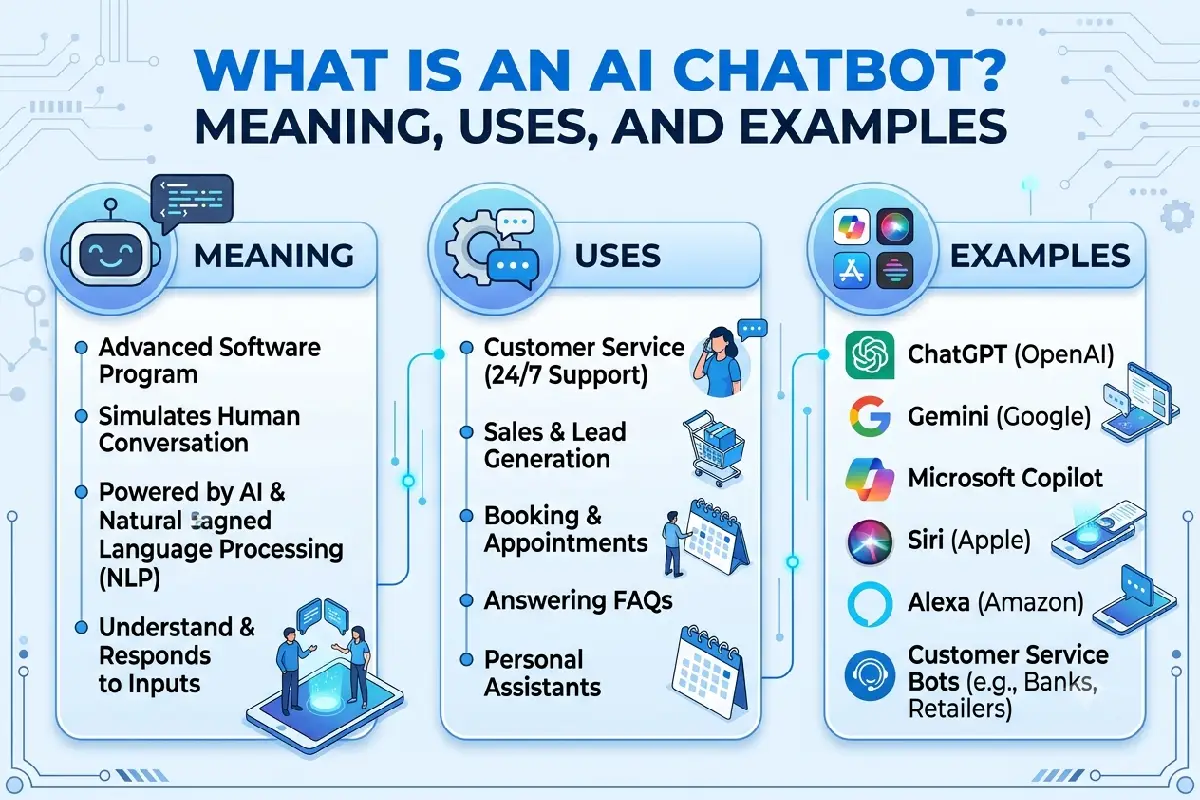
AI chatbots are now familiar players in our everyday digital lives. They field customers’ questions, aid individuals in composition, suggest items, demystify complex subjects, and even perform mundane jobs for workers.
How AI chatbots work, however, can be quite complicated. Beneath a basic chat window lies a lot of artificial intelligence, language understanding, machine learning and big data.
This will explain the functionality of AI chatbots in an easy understandable way, the core technologies, the different types, examples of usage, the do‘s and don‘ts.
How AI Chatbots Work: Meaning and Key Concepts
A chatbot is a computer program that can detect what a user is trying to say or doing and produce a response accordingly. In comparison with the conventional computer programs, contemporary AI chatting system do not merely response to set of command but also are able to understand the normal language.
The basic process usually looks like this:
User message → Language processing → Intent/context understanding → Response generation → Final answer
For example,
Could you walk me through the process of resetting my password?
The chatbot takes the sentence and quickly runs through identifying relevant concepts e.g. “reset”, “password”. It then infers what you are likely trying to do and produces a generated or retrieved appropriate answer.
Natural Language Processing
The natural language processing (NLP) enables computers to understand human language.
It allows a chatbot to work with questions written in different ways. For example:
- “What is/ How do I change my password?”
- “How do I change my password?”
- “I forgot my password.”
- ” Help me to reset the login password. “
While these sentences are different, they are used to do the same thing.
Machine Learning
Machine learning enables AI systems to learn from discovering the pattern in the data instead of having all rules explicitly coded in the program.
Currently, chatbot models are trained on large corpus of texts. As the model is trained it learns various statistical models between words/phrases/concepts and the way language itself works.
Large Language Models
Some of the more advanced AI chatbots are built on large language models.
The LLM reads the conversation so far and, based on what it has learned, predicts the next combinations of tokens, which are a very small part of language to generate an answer. It looks a bit like a matter of taking instructions from a database of a huge number of ready-made responses.
Here is the set of tasks an advanced chatbot can complete: summarize a document, answer questions, explain concepts, generate ideas, compose drafts, translate language, follow up with questions and yes/no questions.
Why How AI Chatbots Work Matters
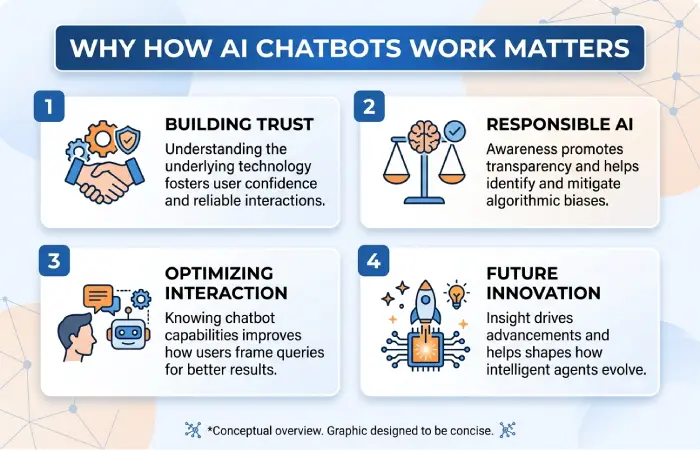
Knowing how they operate will enable users and businesses to make best use of AI chatbots.
Another important facet is that since the answer must come from an answer synthesized by an AI human, the answer is not necessarily true or fact. It is possible for a human-like language model to make a wrong answer from sheer confidence.
Being aware of this limitation can lead users to check critical data, in particular medical, financial, legal, security or corporate information.
The businesses can also understand on which tasks they should automate.
A chatbot may work well for:
- Frequently asked questions
- Basic customer support
- Product information
- Internal knowledge searches
- Appointment assistance
- Lead qualification
- Simple troubleshooting
More complex or delicate cases may continue to need a human in the loop.
Key Types, Methods, and Examples
There are many types of chatbot and they each work in a different way. Some are more prevalent than others.
1. Rule-Based Chatbots
Rule-based a determined number of instructions and paths to follow.
For example, a chatbot might ask:
“What can I help you with?”
The user then selects from this range of facilities a button for orders, returns, payments or technical assistance.
These are rigid, predictable bots.
2. Retrieval-Based Chatbots
Retrieval Based Systems scan through a pre-approved repository of information and return relevant portions in response to the user question.
These types of Know[ledge] can be used for customer service, company policies and documentation, and internal knowledge bases.
3. Generative AI Chatbots
Generative AI chatbots generate responses on the fly, leveraging language models.
They are can provide a much more flexible conversation and can do a lot of tasks including writing, brainstorm, summary, help with coding, question answering.
4. Hybrid Chatbots
A hybrid chatbot combines multiple approaches.
For example, a company may have a set of standard protocols for payment requests and then use generative AI for basic product inquiries.
This can allow for more flexibility while retaining greater control over sensitive processes.
How to Use or Apply How AI Chatbots Work
Know what is going on in the background can help you communicating to AI chatbots.
Suppose you simply ask:
“Write about marketing.”
The query is extremely wide; the chatbot thus has to make predictions.
A clearer prompt could be:
Please produce a document of 500 words, suitable as a beginner’s guide, explaining how email marketing works for a small business.
Since the second prompt provides more context to the AI.
A helpful prompt normally describes what needs to be done, the context, the specifications and the output needed.
AI Chatbot Workflow
Here is a simplified example of what happens when you submit a prompt:
Step 1: Input
You enter a question or instruction.
Step 2: Processing
The system separates the text into smaller pieces that the model can handle.
Step 3: Context Analysis
The model considers your current message and available conversation context.
Step 4: Response Generation
The model predicts and generates an appropriate sequence of text based on patterns learned during training and any additional information available to the system.
Step 5: Output
The generated response appears in the chat interface.
Some chatbot systems may also be integrated to third party applications, search engines, external software, database, some business software or internal corporation knowledge base. And that can help for having more features than text generating.
Best Practices and Common Mistakes
Using AI chatbots is helpful to some extent, but the outcome is also related to how it is used.
Always give a lot of context when asking questions. Tell me what you need, who the response is for and set out important restrictions.
Split complex requests into simple ones if you need to. This can help you to review the output and deal with errors as early as possible.
It would also be good to check important assertions instead of blindly trusting everything for accuracy.
Another pitfall is revealing protected information without knowing the terms of chatbot service. Companies should specify the rules on what enterprise users can submit to AI.
Lastly, human guidance. While AI can take over dull, repetitive tasks, human judgment is probably still best suited to large, time-consuming decisions with many potential for risk.
Final Thoughts
The process of how AI chatbots work becomes easier by simplifying them: the user sends, the system interprets and finds the reply, and then sends back the reply.
Modern chatbots have enabled a combination of natural language processing, machine learning, large language models, retrieval systems and external tools, to offload ever more complex tasks.
Nevertheless, AI chatbots will not always perform well or be appropriate. The most impressive results can be attained with well-defined commands, proper validation, prudent data management, and human control where important.
As the technology behind chatbots develops, being familiar with these fundamentals can enable people and organizations to more efficiently and ethically operate AI technology.