
Last Updated: September 20, 2026
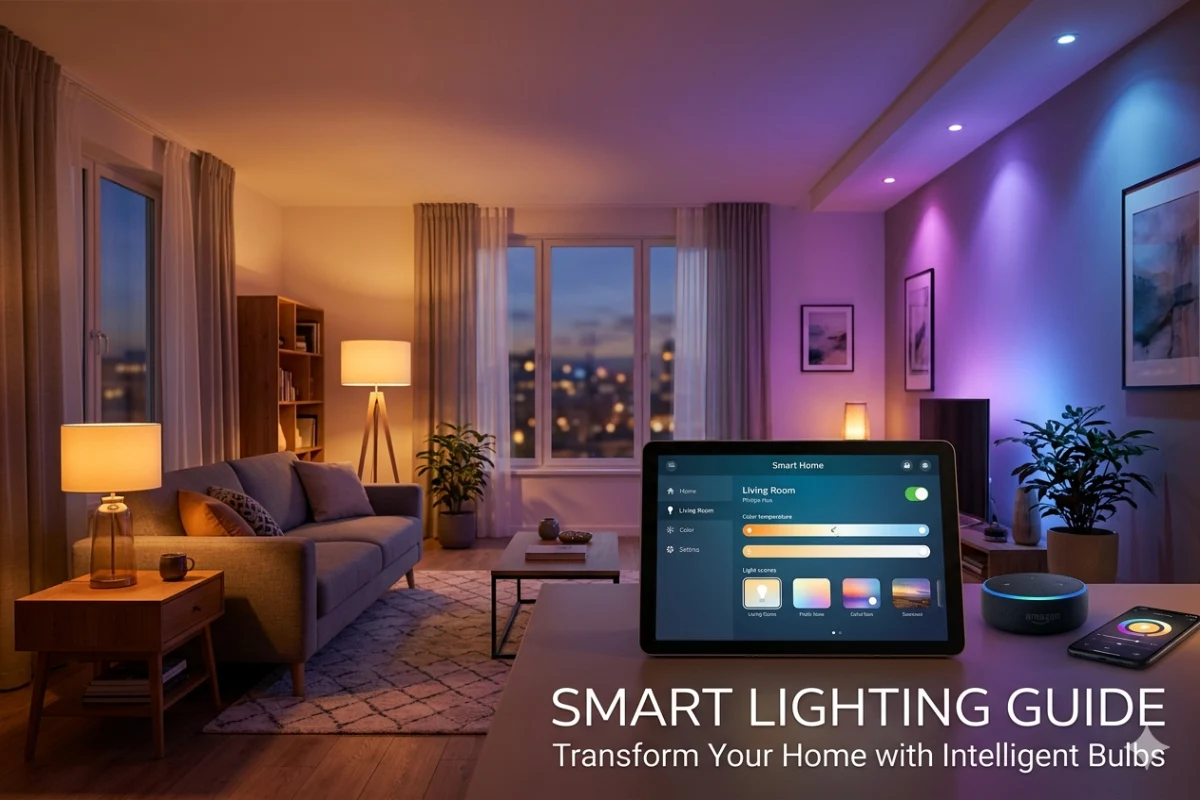
It is becoming increasingly popular for homeowners to make their homes smart by installing some intelligent devices in their house. Smart lighting is one such device which has gained much popularity lately and which can bring about many conveniences for you.
While conventional lighting can only be turned on or off via a wall switch, smart lighting allows you to control your lights from a distance using your phone or any other means.
Here we will tell you all about smart lighting, its benefits, the best models of smart lighting, how to install them, tips and tricks, and how to create beautiful color scenes with them.
Smart lighting is part of our home automation guide.
What Is Smart Lighting?
Smart lighting systems refer to a type of lighting that is connected to the network of your home through any protocol like Wi-Fi, Zigbee, Z-Wave, Thread, Bluetooth, or Matter. They don’t have to depend upon the wall switch alone.
Modern-day smart lighting systems allow you to:
- Turn lights on or off remotely
- Adjust brightness
- Change color temperature
- Select millions of colors
- Schedule lighting
- Create automation routines
- Integrate with other smart devices
- Save Energy
Smart lighting systems have found their way into residences, offices, apartments, hotels, and other commercial establishments due to their convenience and ability to conserve energy.
Benefits of Smart Lighting
Convenience
Stop having to walk around switching lights off.
With smart lighting systems, you can control all rooms through your phone or even command your voice assistant.
Some of these examples include:
- “Turn off all lights.”
- “Dim bedroom lights to 30%.”
- “Switch kitchen lights to warm white.”
Conservation of Energy
The smart light bulbs are designed using LED technology which consumes less energy than the ordinary incandescent bulb.
Other energy conservation methods include:
- Automatic scheduling
- Motion detection
- Occupancy sensors
- Daylight sensing
- Vacation mode
Many households reduce lighting energy consumption by 40–80%.
Better Home Security
Smart lighting makes your house look inhabited.
Some security features available include:
- Random light schedules
- Lights that are triggered by motion outdoors
- Vacation automation
- Entryway illumination
- Integration with security cameras
Personalized Comfort
Lighting influences mood, productivity at work, and even sleep quality.
Smart lighting systems allow you to quickly switch from:
- Bright work lighting
- Relaxing evening lighting
- Reading mode
- Movie mode
- Party mode
- Night lights
Improved Property Value
Many homeowners are looking for houses that have smart technologies.
Installation of a smart lighting system increases property value.
How Smart Lighting Systems Work
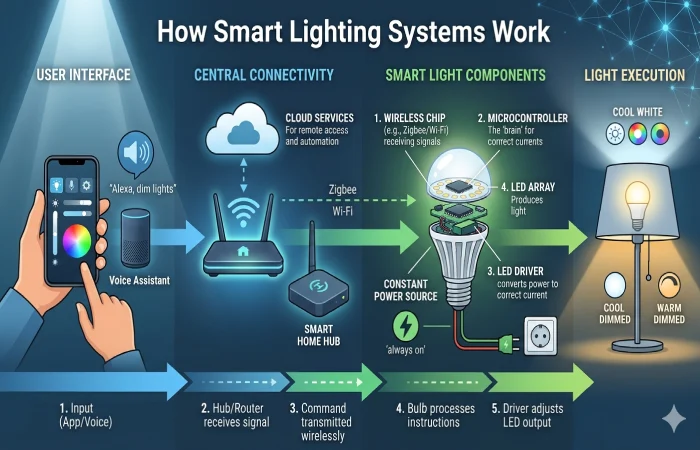
Understanding how smart lighting systems function is useful when choosing products.
Smart Bulbs
These replace traditional light bulbs and contain:
- LED lighting
- Wireless communication chip
- Small computer controller
- Power management circuitry
The bulb receives commands through your home network.
Smart Switches
Instead of replacing bulbs, smart switches replace your wall switches.
Advantages include:
- Control existing fixtures
- Lower long-term cost
- Multiple bulbs controlled together
- Traditional wall operation remains available
Smart Hubs
Some lighting ecosystems use a central hub.
The hub:
- Connects devices
- Improves reliability
- Supports automation
- Enables remote control
- Reduces Wi-Fi congestion
Mobile App
Every smart lighting system includes an app where users can:
- Control lights
- Group rooms
- Build routines
- Create scenes
- Monitor energy use
- Share access with family
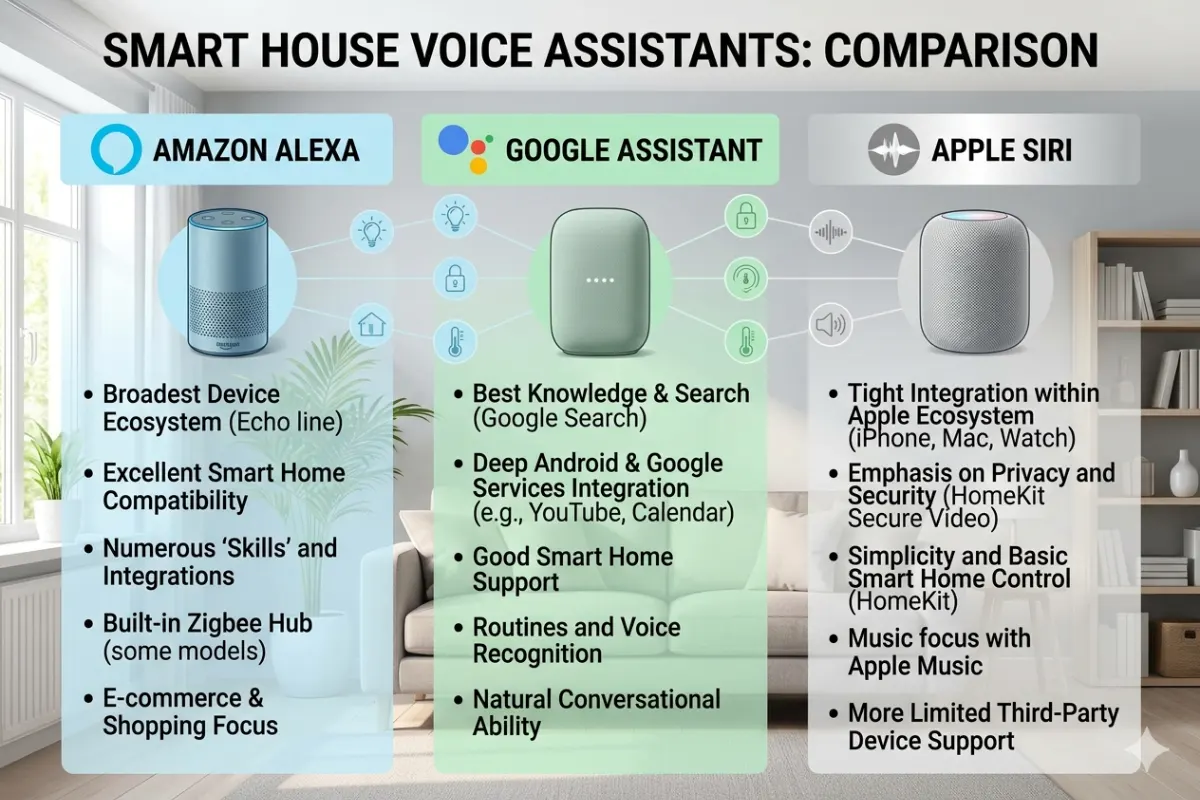
Voice Assistants
Most systems work with:
- Amazon Alexa
- Google Assistant
- Apple HomeKit
- Samsung SmartThings
Voice command allows easy management of lighting.
Best Smart Light Bulbs
The smart lighting market offers many excellent choices.
1. Philips Hue
Best overall for premium smart homes.
Features:
- Millions of colors
- Excellent automation
- Reliable hub
- Matter support
- Extensive accessories
Pros:
- Extremely reliable
- Large ecosystem
- High brightness
Cons:
- More expensive
2. TP-Link Tapo
Excellent selection for a novice.
Benefits:
- Affordable
- Easy Wi-Fi setup
- No hub required
- Good app
3. Govee Smart Bulbs
Perfect for color light.
Features include:
- RGB lighting
- Music sync
- Dynamic scenes
- Budget pricing
Perfect for entertainment rooms.
4. Nanoleaf Essentials
Ideal for Apple Home and Matter users.
Advantages:
- Thread support
- Bright whites
- Fast response
- Energy efficient
5. Wyze Bulbs
Great value.
Features:
- Low price
- Easy scheduling
- Voice control
- Adjustable white temperature
Control all lights centrally via your smart home hub.
Choosing the Right Smart Bulb
Before buying, remember:
Brightness
The light output measured in lumens.
Generally recommended values are:
- Bedroom: 800 lumens
- Living room: 800-1100 lumens
- Kitchen: 1100-1600 lumens
- Office: 1000+ lumens
Color Temperature
Warm White (2700K)
- Relaxing
- Cozy
- Bedrooms
Neutral White (4000K)
- Balanced
- Kitchens
- Bathrooms
Cool White (5000-6500K)
- Offices
- Garages
- Task lighting
RGB Colors
Color-changing bulbs feature millions of colors.
Best for:
- Gaming rooms
- Holidays
- Home theaters
- Kids’ bedrooms
- Parties
Connectivity
Choose based on your smart home.
Options include:
- Wi-Fi
- Zigbee
- Bluetooth
- Thread
- Matter
Smart Lighting Installation Tips
It is quite easy to install smart lighting, but preparation makes the process better.
Compatibility Check
Verify:
- Bulb base
- Fixture size
- Voltage
- Dimmer compatibility
- Network requirements
Upgrade Wi-Fi if Needed
Large smart homes may need:
- Mesh Wi-Fi
- Additional access points
- Strong signal coverage
Poor Wi-Fi causes delayed responses.
Name Rooms Clearly
Good examples:
- Kitchen
- Master Bedroom
- Hallway
- Patio
- Dining Room
This simplifies voice commands.
Group Similar Lights
Create groups such as:
- Upstairs
- Downstairs
- Outdoor
- Living Area
Managing multiple lights becomes easier.
Update Firmware
Manufacturers regularly release updates for:
- Security
- Stability
- New features
- Compatibility
Enable automatic updates whenever possible.
Keep Manual Control
Avoid cutting power to smart bulbs using wall switches.
Instead:
- Use smart switches
- Install wireless remotes
- Use automation
This keeps bulbs online.
Smart Lighting Automation Ideas
Automation makes smart lighting truly intelligent.
Morning Routine
At 6:30 AM:
- Bedroom lights slowly brighten
- Bathroom lights activate
- Kitchen lights turn on
- Coffee area illuminates
A gradual sunrise effect helps you wake naturally.
Good Night Routine
At bedtime:
- All downstairs lights turn off
- Bedroom lights dim
- Porch light stays on
- Hallway night light activates
Everything happens with one command.
Motion Detection
Install motion sensors in:
- Hallways
- Bathrooms
- Closets
- Laundry rooms
- Garage
Lights turn off automatically when there is no movement detected.
Vacation Mode
When you’re away:
- Lights turn on randomly
- Outdoor lights follow sunset
- Indoor lights simulate occupancy
This helps deter potential intruders.
Movie Night
Create a scene where:
- Living room lights dim to 15%
- TV backlight turns blue
- Floor lamps switch off
Perfect for immersive viewing.
Gaming Mode
RGB lighting can:
- Match game colors
- Pulse with sound
- Synchronize with displays
- Enhance immersion
Dinner Mode
Dining room lights become:
- Warm white
- 40% brightness
- Soft ambient glow
Ideal for family meals.
Smart Lighting Color and Scenes
Scenes combine multiple lighting settings into a single preset.
Relax Scene
Settings:
- Warm white
- 20–30% brightness
- Living room lamps only
Perfect after work.
Reading Scene
Configuration:
- Neutral white
- 100% brightness
- Reading lamp focused
Reduces eye strain.
Focus Scene
Ideal for home offices.
Includes:
- Cool white
- Bright illumination
- Minimal shadows
Improves concentration.
Party Scene
Activate:
- Rotating colors
- Music synchronization
- Dynamic effects
- Accent lighting
Creates an energetic atmosphere.
Sleep Scene
Prepare your body for rest.
Features:
- Very warm lighting
- Low brightness
- Gradual dimming
- Automatic shutdown
Holiday Scenes
Customize colors for celebrations:
- Christmas
- Halloween
- Diwali
- New Year
- Birthday parties
One tap instantly transforms your home.
Smart Lighting for Every Room
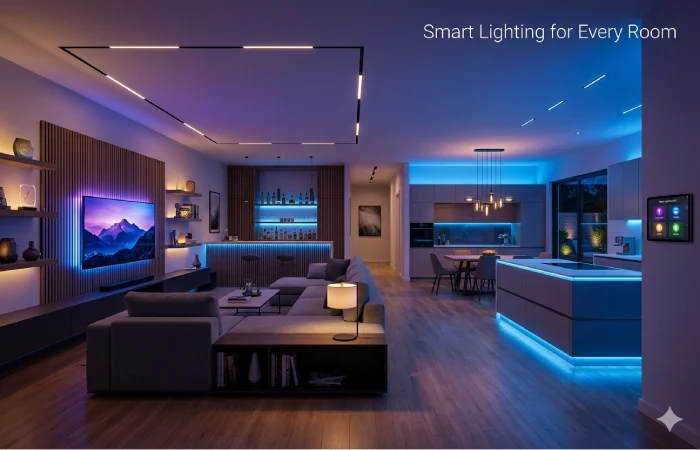
Living Room
Recommended features:
- Dimmable bulbs
- Accent lamps
- TV bias lighting
- Voice control
Kitchen
Prioritize:
- Bright task lighting
- Under-cabinet LEDs
- Motion sensors
- White lighting
Bedroom
Choose:
- Warm white
- Sunrise alarms
- Night mode
- Bedside voice control
Bathroom
Install:
- Bright mirror lighting
- Motion activation
- Waterproof fixtures where required
Outdoor Lighting
Consider:
- Smart floodlights
- Path lights
- Garden lighting
- Security automation
Energy Efficiency and Savings
Despite the higher upfront cost of smart bulbs, they eventually end up paying for themselves.
Savings come from:
- LED efficiency
- Reduced usage
- Automatic off feature
- Scheduling
- Dimming
- Long life
LED smart lights usually have a life ranging from 15,000 to 25,000 hours.
Smart Lighting Do’s and Don’ts
Here are some mistakes to avoid while setting up smart lights:
- Incompatible ecosystems
- Insufficient Wi-Fi coverage
- Using old routers
- Off switch on wall sockets
- No firmware updates
- Unsuitable bulbs due to fixture
- Too complex automation schedule
Careful planning of your smart light installation will ensure you save time and avoid frustration.
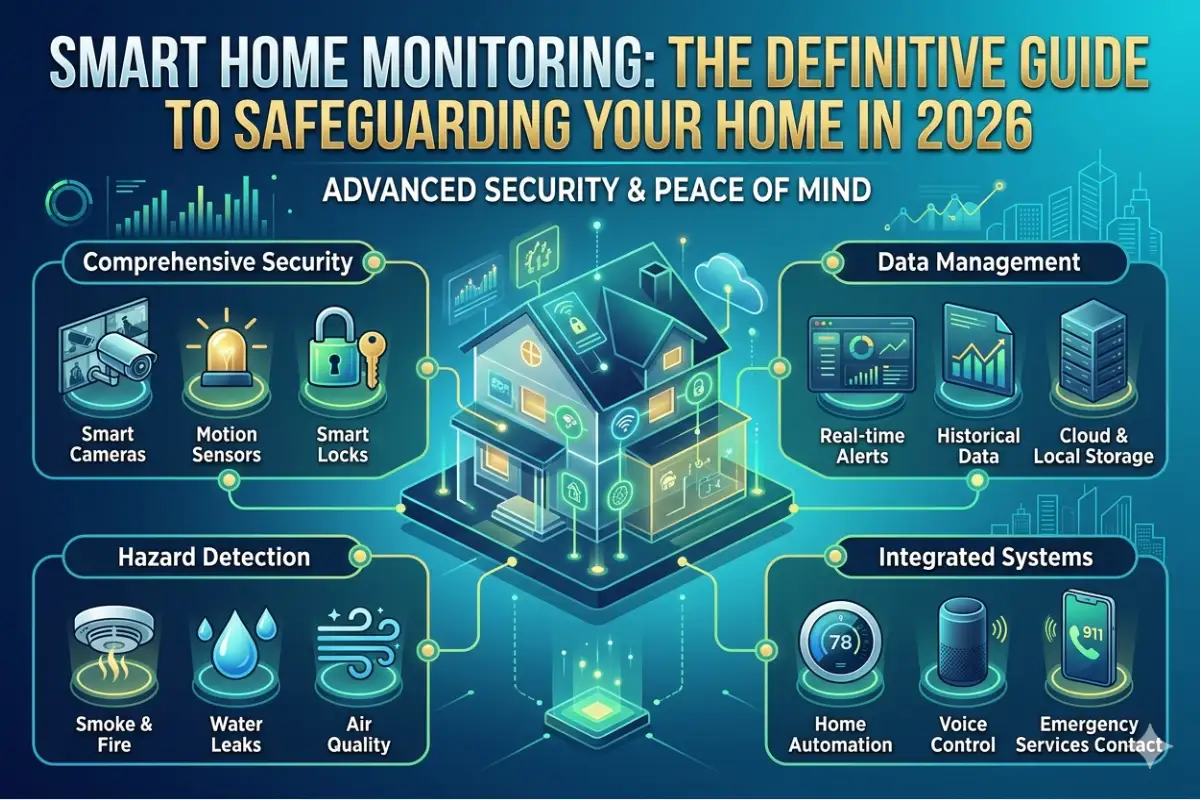
Track energy use with smart home monitoring.
The Future of Smart Lighting
Smart lighting is still changing with new technologies and standards emerging.
New trends in smart lighting include:
- AI-driven adaptive lighting
- Matter-compatible devices for easier interoperability
- Lighting that is human-centric and enables natural circadian rhythms
- Occupancy and daylight sensing technology
- Lighting monitoring and optimization
- Closer collaboration within smart home ecosystems
- Automation that is predictive of user behaviors
All of these technological developments promise to make the lighting even smarter, more efficient, and more personal in the years to come.
Conclusion
In general, the smart lighting systems can be called one of the most straightforward solutions when you want to increase the level of comfort, energy efficiency, and security in your home. With the help of modern technologies, people can benefit from all kinds of convenient features, which can’t be provided by standard lighting.
Whether you plan to change a regular light bulb or develop an entire system of lights, begin with the selection of appropriate equipment, room organization, and automation according to your schedule. Thus, you will be able to design the ideal lighting solution for your future smart home.