
Last Updated: June 16, 2026
Businesses and homes and schools and data centers all need networks to share information fast and in a way. When you connect your laptop to the internet or manage a network for a company or build a system for storing data the way devices talk to each other is decided by networking techniques.
Networking techniques are really the ways and tools and rules and designs that help devices and systems share data with each other easily and quickly. This make it possible for devices to communicate with each other. Networking techniques are important for sharing information, between devices and systems.
These techniques influence:
- Network speed
- Reliability
- Security
- Scalability
- Cost
- Performance
As organizations increasingly adopt cloud computing, AI-driven infrastructure, IoT devices, and edge computing in 2026, understanding networking techniques has become more important than ever.
Why Networking Techniques Matter
Without proper networking techniques, organizations face:
| Challenge | Impact |
| Slow connectivity | Reduced productivity |
| Network congestion | Application delays |
| Security vulnerabilities | Data breaches |
| Downtime | Revenue loss |
| Poor scalability | Growth limitations |
Modern networking techniques help organizations:
- Improve performance
- Increase reliability
- Enhance cybersecurity
- Reduce operational costs
- Support remote work
- Enable cloud adoption
What Are Networking Techniques?
Networking techniques refer to the various methods used to establish, manage, secure, and optimize communication between devices.
These techniques involve:
- Physical connections
- Data transmission methods
- Routing strategies
- Network architectures
- Communication protocols
- Wireless technologies
- Security mechanisms
Think of networking techniques as the “rules and roads” that allow digital traffic to move efficiently from one destination to another.
Types of Computer Networking Techniques
Several networking techniques are used across different environments.
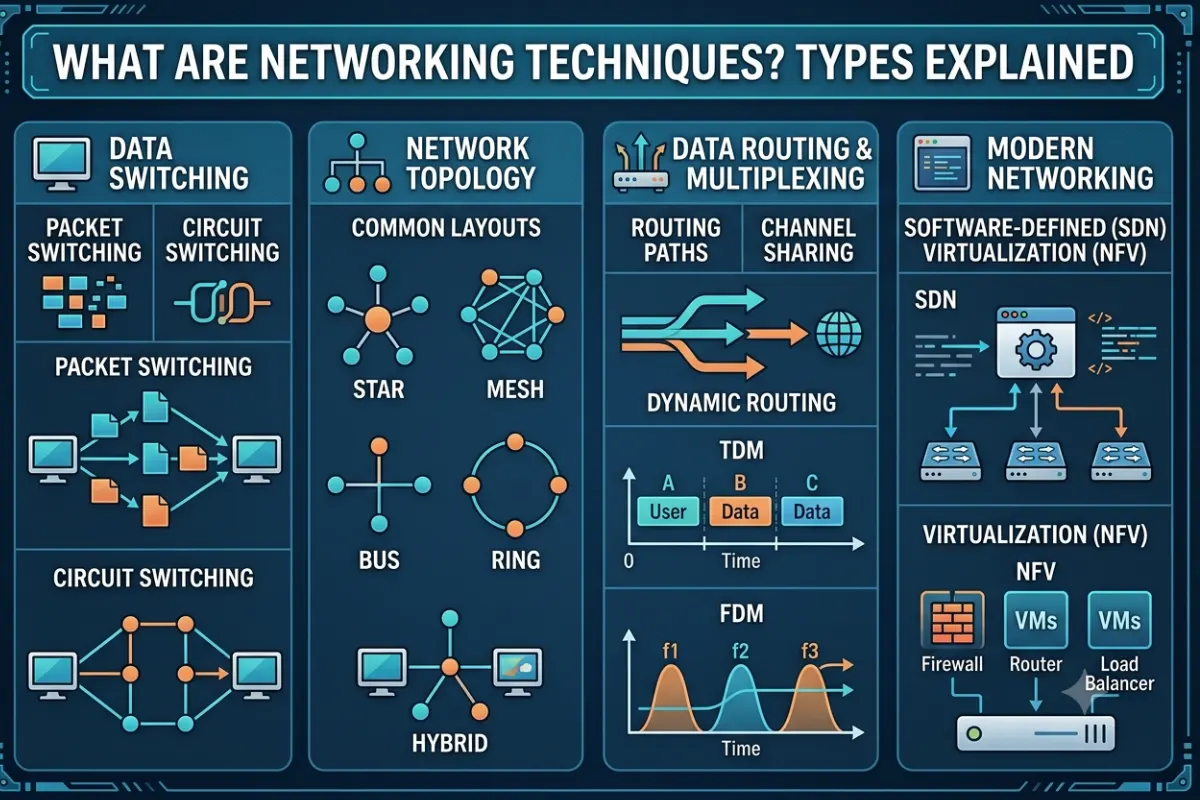
1. Circuit Switching
Circuit switching creates a dedicated communication path between devices.
How It Works
A complete path is established before communication begins.
Advantages
- Stable connection
- Predictable performance
- Minimal packet loss
Disadvantages
- Inefficient bandwidth usage
- Higher infrastructure costs
Common Uses
- Traditional telephone systems
- Legacy communication networks
2. Packet Switching
Packet switching is the foundation of modern internet communication.
Data is divided into small packets and transmitted independently.
Advantages
- Efficient bandwidth utilization
- Scalability
- Cost effectiveness
Disadvantages
- Potential latency
- Packet reordering issues
Common Uses
- Internet traffic
- Cloud services
- Enterprise networks
3. Message Switching
Entire messages are transmitted and temporarily stored at intermediate nodes.
Advantages
- Efficient resource utilization
- No dedicated path required
Disadvantages
- Increased latency
- Storage requirements
Applications
- Store-and-forward communication systems
4. Virtual Circuit Networking
A logical communication path is established before transmission.
Benefits
- Consistent routing
- Improved performance
Applications
- MPLS networks
- Telecommunications
5. Cell Switching
Data is broken into fixed-size cells.
Advantages
- Predictable performance
- Reduced delays
Common Example
ATM (Asynchronous Transfer Mode)
Networking Techniques Comparison Table
| Technique | Speed | Reliability | Cost | Scalability | Modern Usage |
| Circuit Switching | High | High | High | Low | Low |
| Packet Switching | Very High | High | Low | Very High | Extremely High |
| Message Switching | Medium | Medium | Medium | Medium | Limited |
| Virtual Circuits | High | High | Medium | High | Moderate |
| Cell Switching | High | Very High | High | Medium | Specialized |
Wired vs Wireless Techniques
One of the most common networking decisions is choosing between wired and wireless networking techniques.
Wired Networking Techniques
Wired networking uses physical cables to connect devices.
Common technologies include:
- Ethernet
- Fiber Optic
- Coaxial
Advantages
- Faster speeds
- Lower latency
- Better security
- Reliable connectivity
Disadvantages
- Installation costs
- Limited mobility
Best Use Cases
- Data centers
- Offices
- Gaming
- Enterprise networks
Wireless Networking Techniques
Wireless networking uses radio signals instead of physical cables.
Examples include:
- Wi-Fi 7
- 5G
- Bluetooth
- Zigbee
- LoRaWAN
Advantages
- Mobility
- Easy deployment
- Scalability
Disadvantages
- Signal interference
- Security concerns
- Variable performance
Best Use Cases
- Smart homes
- Remote work
- IoT deployments
- Mobile computing
Wired vs Wireless Networking Comparison
| Feature | Wired | Wireless |
| Speed | Excellent | Very Good |
| Security | High | Moderate to High |
| Mobility | Low | Excellent |
| Installation | Complex | Simple |
| Latency | Low | Higher |
| Reliability | Excellent | Good |
| Maintenance | Medium | Low |
Common Networking Transmission Techniques
Unicast
One sender communicates with one receiver.
Example:
- Sending an email
- Accessing a website
Benefits
- Efficient
- Secure
Broadcast
One sender transmits data to all devices on a network.
Example:
- DHCP requests
Benefits
- Fast device discovery
Multicast
One sender communicates with multiple selected recipients.
Example:
- Video conferencing
- IPTV
Benefits
- Bandwidth savings
Anycast
Data is delivered to the nearest available destination.
Example:
- Content Delivery Networks (CDNs)
Benefits
- Reduced latency
- Faster responses
Common Networking Topologies
Network topology defines how devices are arranged and connected.
Bus Topology
All devices share a common communication line.
Advantages
- Low cost
- Easy setup
Disadvantages
- Single point of failure
- Poor scalability
Star Topology
All devices connect to a central switch or hub.
Advantages
- Easy management
- High reliability
Disadvantages
- Dependency on central device
Most modern business networks use star topology.
Ring Topology
Devices connect in a circular pattern.
Advantages
- Organized data flow
Disadvantages
- One failure may affect the network
Mesh Topology
Each device connects to multiple devices.
Advantages
- High redundancy
- Excellent reliability
Disadvantages
- Higher cost
Common in:
- Data centers
- Smart cities
- Military networks
Hybrid Topology
Combines multiple topologies.
Advantages
- Flexibility
- Scalability
Disadvantages
- Complex design
Network Topology Comparison
| Topology | Reliability | Cost | Scalability | Complexity |
| Bus | Low | Low | Low | Low |
| Star | High | Medium | High | Low |
| Ring | Medium | Medium | Medium | Medium |
| Mesh | Very High | High | High | High |
| Hybrid | Very High | High | Very High | High |
Advanced Networking Techniques in 2026
The networking landscape continues evolving rapidly.
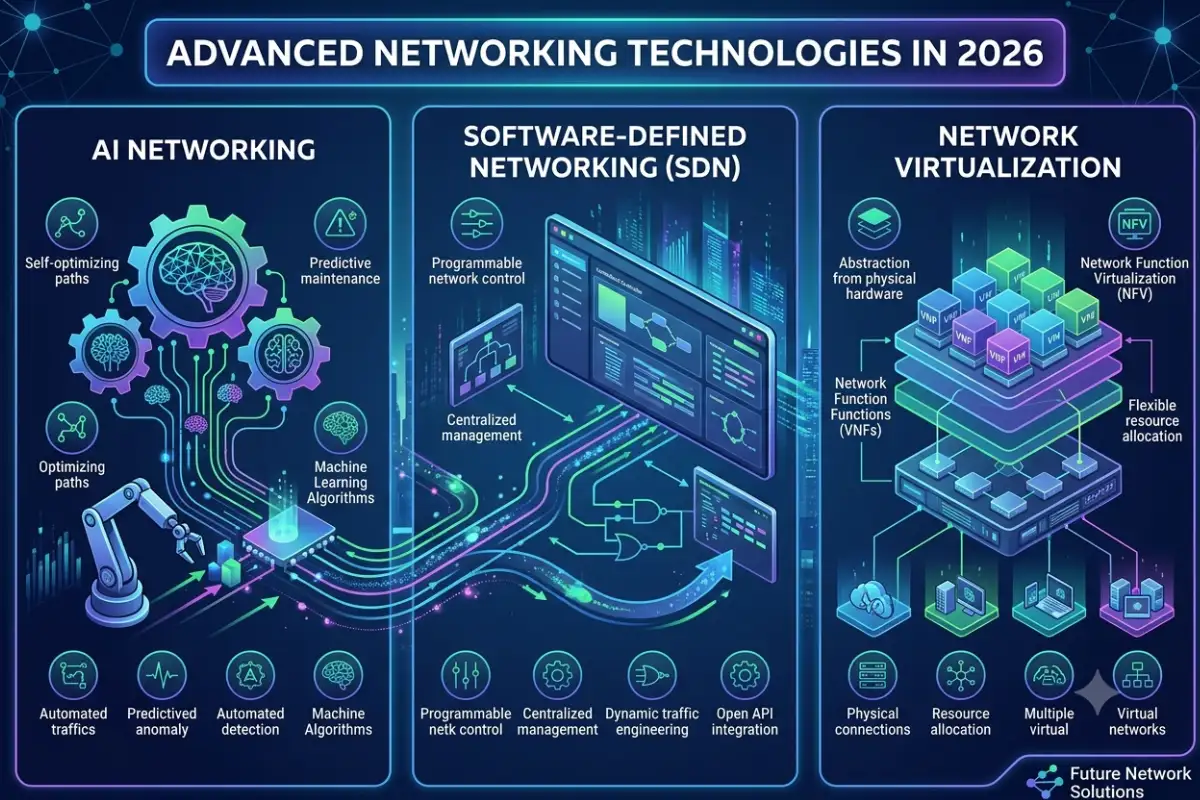
Software-Defined Networking (SDN)
SDN separates network control from hardware.
Benefits include:
- Centralized management
- Automation
- Faster deployment
Network Virtualization
Creates multiple virtual networks on a shared infrastructure.
Advantages:
- Lower costs
- Better resource utilization
- Cloud compatibility
AI-Powered Networking
AI is transforming network operations.
Capabilities include:
- Predictive maintenance
- Automated troubleshooting
- Traffic optimization
- Threat detection
2026 Trend
Industry analysts estimate that over 70% of enterprise networks now use some form of AI-assisted network management.
Edge Networking
Processes data closer to users and devices.
Benefits:
- Reduced latency
- Improved performance
- Better user experience
Common applications:
- Autonomous vehicles
- Smart factories
- IoT systems
Intent-Based Networking (IBN)
Administrators define business goals rather than manually configuring devices.
The network automatically adjusts settings to achieve desired outcomes.
Networking Technology Adoption Trends (2026)
| Technology | Adoption Rate |
| Cloud Networking | 91% |
| Wi-Fi 7 | 67% |
| SDN | 74% |
| AI Networking | 72% |
| Network Automation | 79% |
| Edge Networking | 61% |
Choosing the Right Approach
The best networking technique depends on organizational goals.
Choose Wired Networking If:
- Maximum speed is required
- Security is critical
- Low latency is essential
- Devices remain stationary
Examples:
- Data centers
- Corporate offices
- Trading systems
Choose Wireless Networking If:
- Mobility is important
- Rapid deployment is needed
- Large areas require coverage
Examples:
- Smart homes
- Warehouses
- Educational campuses
Choose Mesh Networking If:
- High reliability is necessary
- Large coverage areas exist
- Network redundancy is required
Examples:
- Smart cities
- Industrial facilities
Choose SDN If:
- Managing large enterprise networks
- Automating operations
- Supporting hybrid cloud environments
Best Networking Techniques by Use Case
| Use Case | Recommended Technique |
| Home Network | Wi-Fi 7 + Ethernet |
| Small Business | Star Topology + Managed Switches |
| Enterprise | SDN + Hybrid Cloud Networking |
| Data Center | Fiber + Leaf-Spine Architecture |
| Smart City | Mesh Networking |
| Manufacturing | Edge Networking |
| Remote Workforce | VPN + Cloud Networking |
| IoT Deployment | Wireless Mesh + Edge Computing |
Future of Networking Techniques
The future of networking will focus on:
- AI-driven optimization
- Autonomous networks
- Quantum-safe security
- Wi-Fi 8 technologies
- 6G integration
- Advanced edge computing
- Zero-trust networking
Organizations adopting these techniques early will gain significant advantages in performance, security, and scalability.
Frequently Asked Questions
What are networking techniques?
Networking techniques are methods and technologies used to connect devices, transmit data, manage communication, and optimize network performance.
What is the most common networking technique today?
Packet switching is the most widely used networking technique because it powers the internet and modern enterprise networks.
Which is better: wired or wireless networking?
Wired networking offers higher speed and reliability, while wireless networking provides greater flexibility and mobility.
What is the best network topology?
Star topology is the most commonly used because it balances reliability, scalability, and ease of management.
What networking technique is growing fastest in 2026?
AI-powered networking and Software-Defined Networking (SDN) are among the fastest-growing networking technologies.
Conclusion
Networking techniques are really important for anyone who works with technology. This includes things like packet switching and wireless communication. It also includes things like SDN and edge computing. These networking techniques are the base of our world today.
The way you set up your network depends on what you want to do. It also depends on how money you have to spend and how much security you need. For companies a mix of wired and wireless connections works well. This also includes automation. Using artificial intelligence to manage the network. Adding cloud networking to this mix helps the network perform well and be ready for the future.
As networks get smarter and more able to work on their own knowing about networking techniques will still be a skill. This is true for people who work in technology for businesses and for people who’re just really into technology. Networking techniques, like these will keep being important.