
Last Updated: June 22, 2026
In the year 2026 making sure networks run well is really important for every company that does business online, not the big ones. These days we have apps that work in the cloud artificial intelligence doing lots of work, internet connected devices everywhere and people working from, over the place. This means networks have to handle a lot complicated and time sensitive information than they used to.
When a network is slow or does not work right it does not just make it hard for people to use things. It also affects how money a company makes, how safe it is and how well it runs. That is why companies are spending a lot of money to make their networks better manage how bandwidth they use make sure important things get done first and reduce delays.
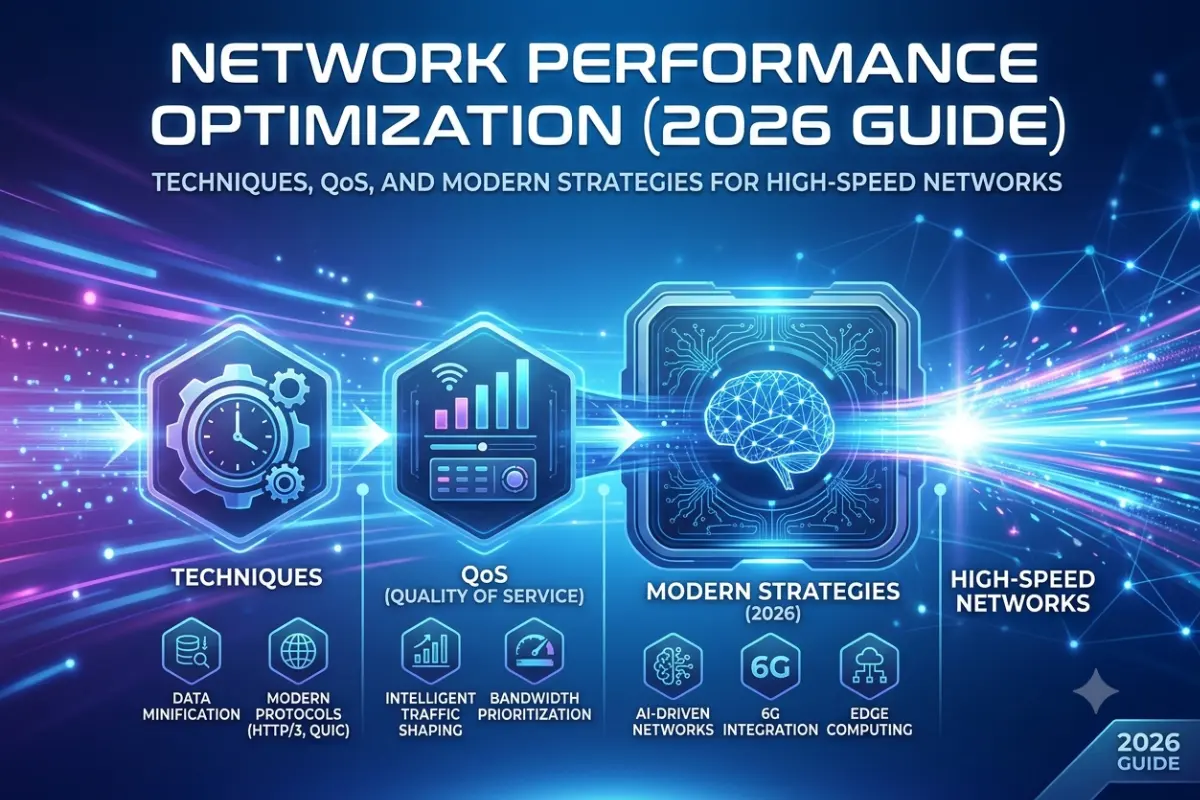
This guide will tell you about how to make networks run better in the year 2026. It has a lot of information comparisons based on research organized tables and strategies that really work to help you understand how to keep your network running smoothly.
Performance tuning from our networking techniques guide.
What Is Network Performance Optimization?
Optimization of Network performance is the enhancement of the efficiency of data delivery through a network, which includes increasing the network‘s speed, efficiency, and reliability.
Core Objectives:
- Reduce latency (response delay)
- Increase bandwidth efficiency
- Prevent packet loss and jitter
- Improve application performance
- Ensure Quality of Service (QoS)
Key Network Performance Metrics
Understanding performance metrics is essential before applying optimization techniques.
| Metric | Definition | Ideal 2026 Enterprise Range |
| Latency | Time taken for data to travel | < 20 ms (internal networks) |
| Jitter | Variation in packet delay | < 5 ms |
| Packet Loss | % of lost data packets | < 0.1% |
| Throughput | Actual data transfer rate | 70–95% of bandwidth |
| Bandwidth Utilization | Network capacity usage | 60–80% optimal |
Insight (2026 Trend)
Current AI networks through bandwidth allocation depending on different application, thus, it totally changes for the way to dynamic routes. When compare to static routes, it can get about 30-35% better through put efficiency.
Network Optimization Techniques
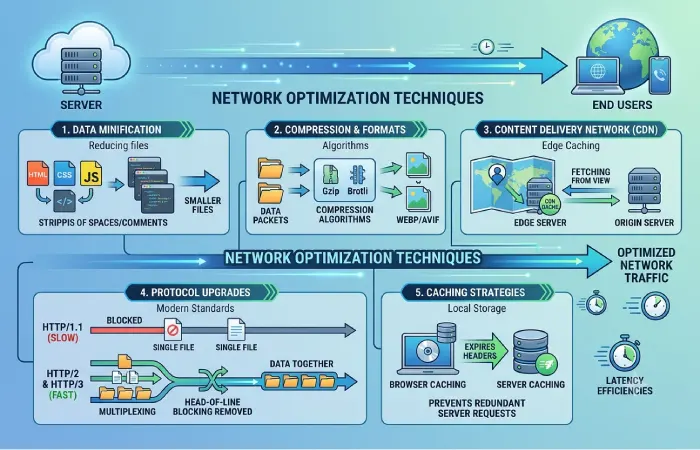
Optimization of networks no longer is a mere one-layer task. It is hardware, software, cloud and AI enabled intelligence.
- Traffic Shaping
Controls data flow to prioritize critical applications like video conferencing and cloud workloads.
- Load Balancing
Distributes traffic across multiple servers or links to avoid congestion.
- Data Compression
Reduces packet size to improve transmission speed.
- Caching Mechanisms
Stores frequently accessed data closer to the user.
- Protocol Optimization
Today protocols such as QUIC greatly reduces the latency of handshake compared to TCP.
- AI-Based Traffic Routing
AI network: have the capability to learn from previous traffic flow and to intelligence design routes through different servers on time.
How to Improve Network Speed
Correcting either of the hardware or configuration faults will help, a solid answer for this question would be improvements to both configuration and infrastructure.
Infrastructure Improvements:
- Upgrade to fiber-optic connections
- Deploy Wi-Fi 6E or Wi-Fi 7 routers
- Use SD-WAN architectures
- Implement edge computing nodes
Configuration Improvements:
- Reduce background bandwidth usage
- Optimize DNS resolution (e.g., cloud DNS services)
- Enable hardware acceleration on routers
- Segment networks using VLANs
For office networks, see our enterprise and office networking guide.
Reducing Network Latency Explained
Latency is one of the most critical performance bottlenecks in 2026, in particular for gaming, finance, cloud computing.
Causes of High Latency:
- Long physical distance between servers
- Network congestion
- Inefficient routing paths
- Poor DNS resolution
- Legacy TCP handshake delays
Latency Reduction Techniques
| Technique | Impact on Latency | Use Case |
| Edge Computing | Very High Reduction | IoT, AI apps |
| CDN Deployment | High Reduction | Web applications |
| Anycast Routing | Medium Reduction | Global services |
| Protocol Upgrade (QUIC) | High Reduction | Streaming, APIs |
| MPLS Networks | Medium Reduction | Enterprise WAN |
2026 Observation
Average API response time for distributed applications delivered by an edge-cen tric IS has been reduced by up to 40% against centralized cloud-only solutions.
Bandwidth Management Techniques
Bandwidth management is about fair, enabling users and applications to efficiently utilize them.
Key Techniques:
- Bandwidth Throttling
Bandwidth is assigned dynamically with AI systems
- Traffic Prioritization
Assigns higher bandwidth priority to critical applications.
- Time-Based Allocation
Allocates bandwidth based on peak and off-peak hours.
- Dynamic Allocation
Automated system: The given system, which is moved on demand, is a system which vehicle has to fulfill bundle of requested car.
Bandwidth Management Comparison (2026)
| Method | Efficiency | Complexity | Best For |
| Static Allocation | Low | Low | Small networks |
| Rule-Based QoS | Medium | Medium | Enterprises |
| AI Dynamic Allocation | Very High | High | Cloud + large-scale systems |
| Hybrid SD-WAN | Very High | High | Global businesses |
QoS Networking Explained
Among many other services QoS makes sure that all major a traffic types are transported with higher priority than less popular ones.
In 2026, contemporary QoS systems are autonomous as well, which integrated the great advancements of AI technology, constantly adapting based on usage.
QoS Traffic Classes:
- Voice traffic (highest priority)
- Video conferencing
- Business-critical applications
- Bulk data transfers
- Background updates
QoS Implementation Comparison
| QoS Method | Description | Performance Gain |
| Best Effort | No prioritization | Low |
| Differentiated Services (DiffServ) | Class-based priority | Medium |
| Integrated Services (IntServ) | Reservation-based QoS | High |
| AI-Driven QoS | Real-time adaptive QoS | Very High |
Key Insight
Reports that organizations using QoS based on AI experience as much as 50% less outages during peak rush hours.
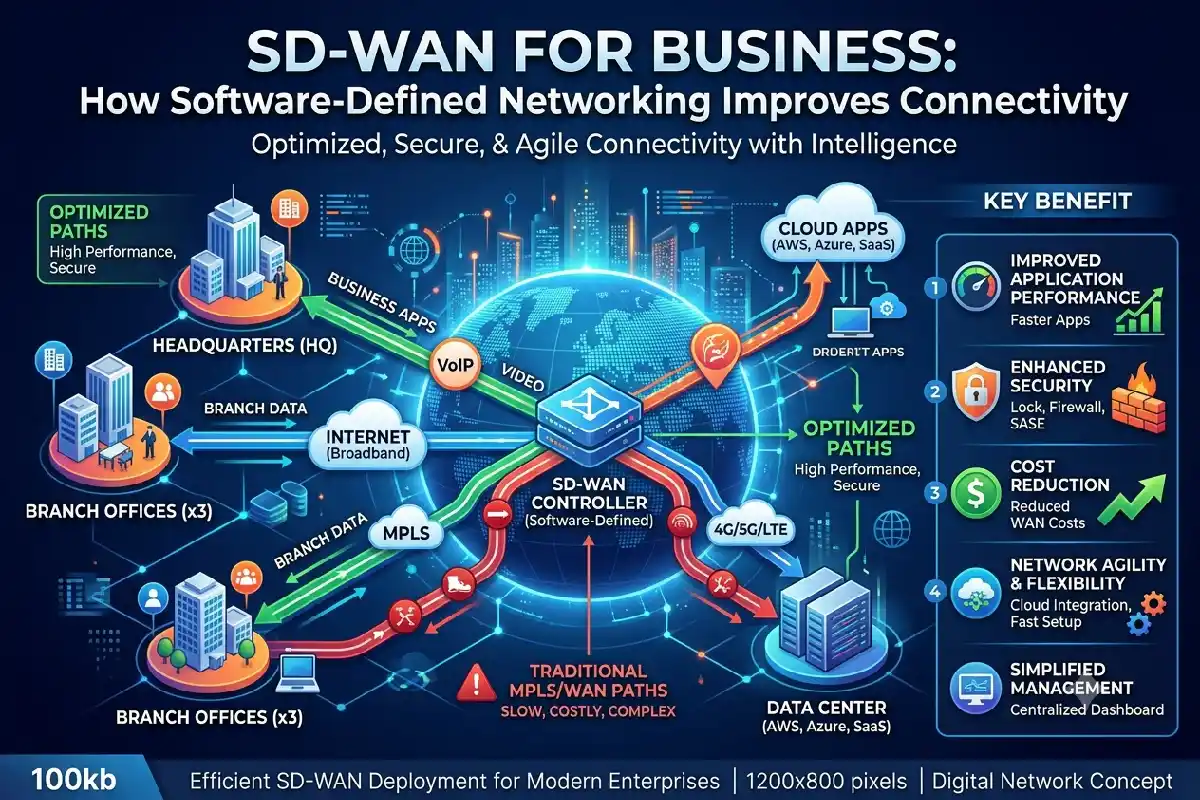
SD-WAN and Modern Network Architecture
Reports that organizations using QoS based on AI experience as much as 50% less outages during peak rush hours.
Software-Defined Wide Area Networking has become a standard for enterprise connectivity for 2026.
Benefits of SD-WAN:
- Centralized control
- Intelligent path selection
- Reduced MPLS dependency
- Improved cloud performance
- Lower operational cost
Comparison: Traditional WAN vs SD-WAN (2026)
| Feature | Traditional WAN | SD-WAN |
| Routing | Static | Dynamic |
| Cost Efficiency | Low | High |
| Cloud Optimization | Poor | Excellent |
| Scalability | Limited | High |
| AI Integration | None | Advanced |
AI and Machine Learning in Network Optimization
It is now a core driver of network performance optimization in 2026.
AI Capabilities in Networking:
- Predictive congestion detection
- Automated rerouting
- Self-healing networks
- Adaptive bandwidth allocation
- Anomaly detection for security
Example:
When a spike in the video conference is detected, the AI systems will automatically redirect unimportant traffic to other channels and is given extra bandwidth dedicated to conferencing solutions.
2026 Network Performance Trends
Global Adoption Trends
AI-driven networking adoption: ████████████ 72%
SD-WAN deployment in enterprises: ██████████ 65%
Edge computing integration: █████████ 58%
Full IPv6 migration: ███████ 45%
Legacy infrastructure dependency: █████ 30%
Performance Improvement Benchmarks (2024–2026)
| Year | Avg Latency (ms) | Avg Throughput Efficiency | AI Optimization Usage |
| 2024 | 38 ms | 68% | 25% |
| 2025 | 29 ms | 76% | 48% |
| 2026 | 21 ms | 87% | 72% |
Network Optimization Strategy Framework (2026)
A modern optimization strategy follows a layered approach:
Infrastructure
- Fiber, 5G, Wi-Fi 7
- Edge computing nodes
Transport
- SD-WAN
- MPLS optimization
- Protocol upgrades
Application
- CDN integration
- Load balancing
- API optimization
Intelligence
- AI monitoring
- Predictive analytics
- Automated QoS
Go deeper with our advanced networking technologies guide.
Common Network Performance Problems and Fixes
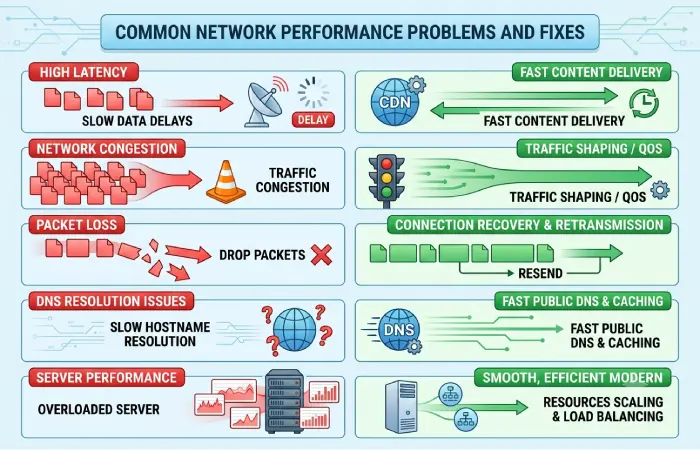
| Problem | Cause | Solution |
| Slow internet speed | Congestion | Traffic shaping |
| High latency | Routing inefficiency | Edge computing |
| Packet loss | Network overload | Load balancing |
| Jitter | Unstable connection | QoS tuning |
| Bandwidth saturation | Unmanaged usage | Bandwidth control |
Future of Network Performance Optimization
By late 2026 and beyond, networks are expected to become:
- Fully autonomous (self-optimizing)
- AI-native by default
- Quantum-ready in enterprise research environments
- Highly decentralized with edge-first architecture
The shift is clear: from manual configuration to intelligent, adaptive network ecosystems.
Conclusion
Network performance optimization in 2026 is not about making things go faster. It is about making sure all the traffic works together well using artificial intelligence to make good decisions and making sure everything works smoothly across the cloud the edge and the systems in our own buildings.
Companies that put money into quality of service networking ways to manage how bandwidth we use, software defined wide area networks and ways to reduce latency are seeing real improvements in how users feel about the system how well it runs and how much it can handle.
The future of networks is not about sending data from one place to another. Network performance optimization is key to making this happen. The future belongs to networks that think for themselves adjust to what’s happening and make themselves better, in real time which is a big part of network performance optimization.