
Last Updated: June 22, 2026
In 2026 the way we think about office security has changed a lot. Now it is about bringing together security systems and cybersecurity systems and using artificial intelligence to make our networks smarter. We are not just protecting one computer or device we are protecting a system that includes smart devices, cloud services people working from different places and security systems that can work on their own.
This guide will give you an professional look at smart office security systems. It will cover things like
- office security systems
- Technologies used for surveillance and access control
- quality smart locks and cameras, for businesses
- How to design a network that is secure
- Cybersecurity frameworks that use the Zero Trust architecture to keep everything safe.
1. Smart Office Security Environment (2026)
Today’s corporations work in complex and highly distributed environments, where the traditional concept of perimeter protection is not applicable anymore. Continuous verification and adaptive access are typical features of modern cybersecurity.
Main Industry Changes (2026)
- Proliferation of Zero Trust Architecture (ZTA)
- AI-powered threat detection in both physical and digital layers
- Cloud-native security orchestration platforms (SECaaS)
- Expansion of IoT-driven attack surfaces
Enterprise Adoption Benchmarks
| Security Capability | Enterprise Adoption (2026) |
| AI Surveillance Systems | 82% |
| Zero Trust Architecture | 69% |
| Biometric Access Control | 76% |
| Unified Security Dashboards | 88% |
2. Smart Office Security Architecture
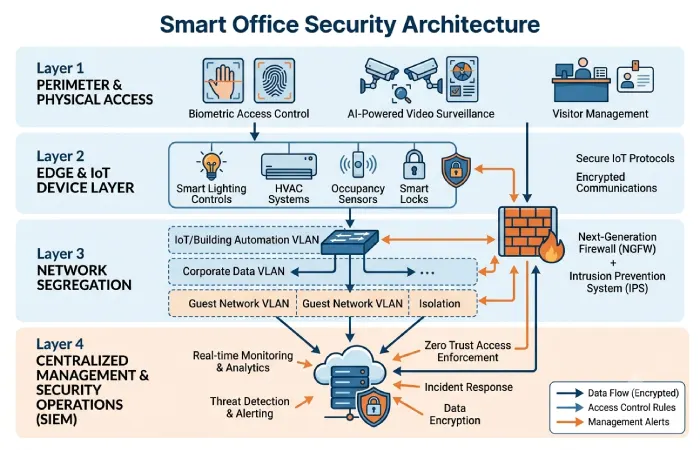
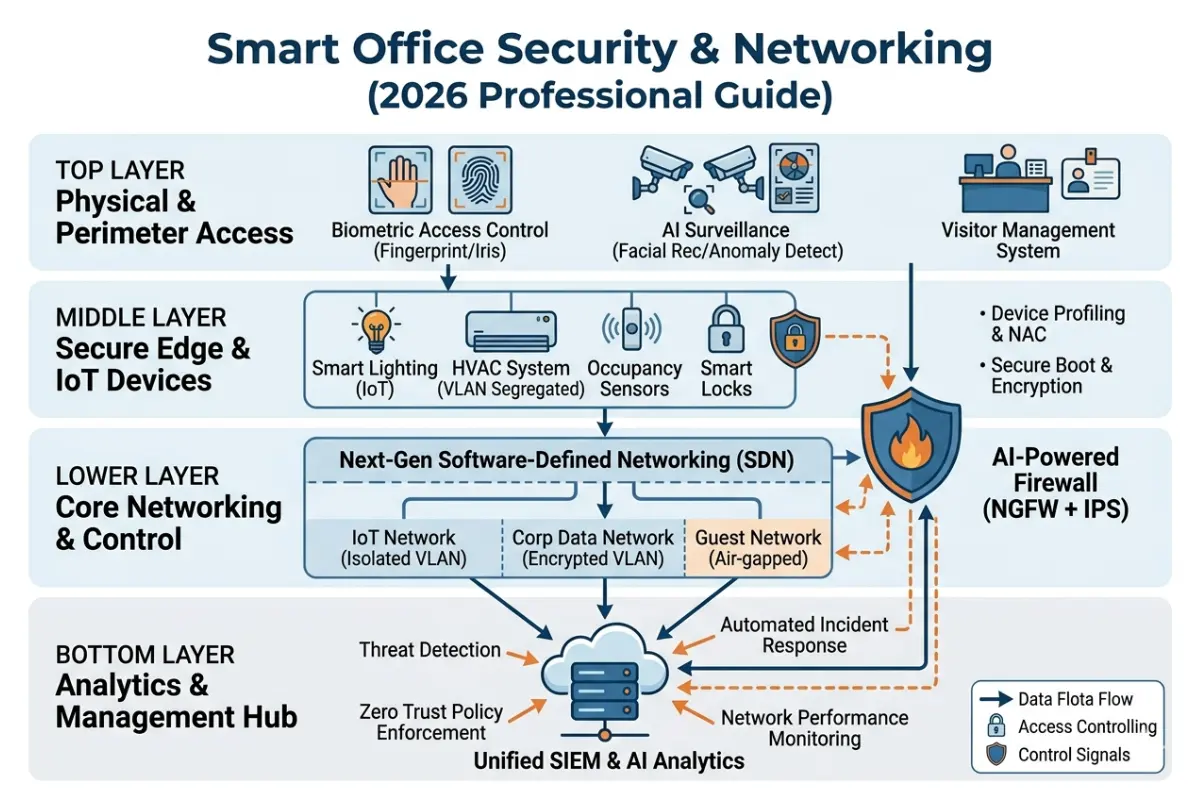
A modern security framework is structured across four integrated layers:
Physical Security Layer
- AI-enabled surveillance cameras
- Smart biometric access systems
- Intrusion detection sensors
- Automated alarm systems
Network Security Layer
- Next-generation firewalls (NGFW)
- Security VPN gateways
- Network segmentation (VLAN architecture)
- IDS/IPS
Identity & Access Layer
- Multi-factor authentication
- Role-based access control (RBAC)
- Device trust validation
- Identity federation (SSO platforms)
Intelligence & Analytics Layer
- AI-powered anomaly detection
- Security information and event management (SIEM)
- Predictive threat modeling
- Automated incident response systems
Start with our smart office setup walkthrough.
3. Enterprise Smart Security Cameras (Benchmarking in 2026)
Modern surveillance solutions use AI on edge nodes which provides the ability to process data on-site without using cloud resources.
Comparison Chart
| Vendor | AI Capability | Resolution | Deployment Model | Enterprise Suitability |
| Ring | Motion analytics, object detection | Up to 4K | Cloud + Hybrid | SMB environments |
| Arlo Technologies | AI object classification, zone alerts | 4K HDR | Cloud-based | Mid-market enterprises |
| Google Nest | Behavioral detection, activity zones | 2K | AI cloud ecosystem | AI-integrated offices |
| Hikvision | Advanced analytics, thermal imaging | 4K–8K | On-premise NVR | Large enterprises |
Performance Index (AI Capability Score)
Google Nest ██████████ 9.3
Arlo █████████▉ 9.1
Hikvision █████████▊ 9.0
Ring █████████ 8.7
Interpretation
- Cloud-native systems dominate SMB deployments
- Local AI solutions continue to be crucial for regulated sectors
- Hybrid models represent the fastest growing segment (+34% YoY)
4. Smart Locks for Enterprise Office Security
Access control systems in smart offices in 2026 include biometric authentication, encrypted credentials, and audit-proof access logs.
Comparison Table
| Device | Authentication Methods | Ecosystem Integration | Battery Efficiency | Security Rating |
| August Wi-Fi Smart Lock | Mobile, PIN, auto-unlock | Cross-platform | Medium | High |
| Yale Assure Lock 2 | Fingerprint, PIN, app | Apple HomeKit | High | Very High |
| Schlage Encode Plus | Apple Key, PIN, mobile | Apple ecosystem | High | Very High |
| Samsung Smart Door Lock SHP-DP609 | Fingerprint, RFID, PIN | SmartThings | Very High | Enterprise Grade |
Security Performance Index
Samsung SHP-DP609 ██████████ 96
Schlage Encode Plus █████████▉ 94
Yale Assure 2 █████████▌ 91
August Wi-Fi Lock ████████▌ 88
Key Insight
Biometric-first authentication systems are now the enterprise standard due to reduced credential compromise risk.
5. Secure Smart Office Network Design
Network security in smart offices gadget is built on Zero Trust principles and continuous verification mechanisms.
Core Security Model: Zero Trust Architecture (ZTA)
Principles:
- No implicit trust within the network perimeter
- Continuous authentication of users and devices
- Micro-segmentation of network resources
- Least-privilege access enforcement
Enterprise Network Security Stack
| Component | Function | Effectiveness |
| Next-Gen Firewall | Traffic filtering & threat prevention | 95% |
| VPN Gateway | Encrypted remote access | 90% |
| IDS/IPS | Intrusion detection & prevention | 93% |
| VLAN Segmentation | Network isolation | 97% |
6. Cybersecurity Framework in Smart Offices
Growth of IoT ecosystems has greatly increased the number of attack vectors.
Primary Threat Categories (2026)
- IoT device exploitation
- Credential-based phishing attacks
- Lateral movement within segmented networks
- Cloud API abuse and misconfiguration
Security Control Mechanisms
Multi-factor authentication (MFA)
Mandatory across:
- Administrative dashboards
- Cloud platforms
- Identity providers
Endpoint detection and response (EDR)
Provides continuous monitoring for:
- End-user devices
- IoT endpoints
- Server infrastructure
AI-based Security Monitoring
Detects:
- Anomalies in user behavior
- Unauthorized access attempts
- Patterns of data thefts
Cybersecurity Effectiveness Benchmark
Zero Trust + AI ██████████ 92%
MFA + EDR █████████▊ 88%
Traditional Firewall ██████▌ 65%
Legacy Antivirus ████▎ 45%
7. Integrated Smart Office Security Architecture
Modern enterprise environments require unified security orchestration platforms integrating physical and digital security systems.
Architectural Layers
Physical Security
- Smart surveillance systems
- Biometric access control
- Environmental sensors
Network Security
- Segmented VLAN architecture
- Encrypted communication layers
- Next-gen firewalls
Application Security
- Cloud security platforms
- Identity and access management systems
- API security controls
Intelligence Layer
- Predictive analytics engines
- AI-based threat detection
- Automated incident response systems
Reference Enterprise Stack
- Surveillance: Google Nest/Arlo Technology
- Access control: Yale Assure lock 2/Schlage Encode Plus
- Network Security: Cisco secure firewall (NGFW devices)
- Identity Management: Microsoft Entra ID (Zero Trust IAM by Microsoft)
- Security monitoring: AI-enabled SIEM solutions
8. Enterprise Implementation Checklist
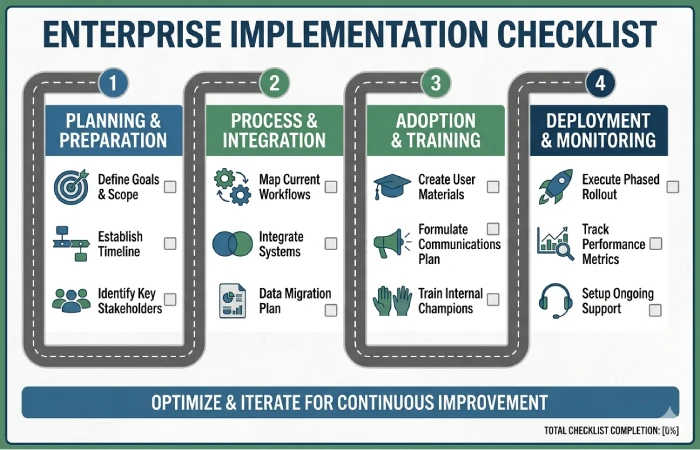
Physical Security
- AI-enabled surveillance deployed
- Biometric access control implemented
- Restricted zone monitoring active
Network Security
- VLAN segmentation configured
- Enterprise firewall deployed
- VPN enforced for remote access
Cybersecurity Controls
- MFA enforced across all systems
- EDR deployed on all endpoints
- Zero Trust policy implemented
Monitoring & Response
- Centralized SIEM dashboard active
- AI anomaly detection enabled
- Automated incident response configured
Securing a remote team? See our smart office for remote work guide.
9. Future Outlook (2026–2028)
Autonomous Security Systems
AI will autonomously:
- Detect threats
- Isolate compromised systems
- Trigger remediation workflows
Passwordless Enterprise Environments
Authentication will shift toward:
- Biometrics
- Device identity
- Behavioral patterns
Unified Security Convergence
Physical + cyber security will operate under:
- Single orchestration platforms
- Real-time intelligence layers
- Predictive risk scoring systems
Conclusion
Office security in 2026 is about working together being smart and always checking things. Companies that use Zero Trust frameworks, security cameras with intelligence and unified security systems are much better at dealing with cyber threats and physical threats.
The direction for companies is clear: security is not, about the outside walls anymore. It is a system that always changes and uses data to make decisions and it is part of every single layer of the office environment. Office security is always looking at the office security systems to make sure they are working properly.
Related Guide:
Smart Office: Complete Guide to Building a Modern Workspace in 2026