
Last Updated: September 21, 2026
The age of home security is long gone. Modern homes boast about their smart gadgets which can monitor their activities, turn on lights automatically, alert owners wherever they are, and provide them information regarding what happens at home. The other most essential smart gadget for ensuring security of your home is the smart motion sensors.
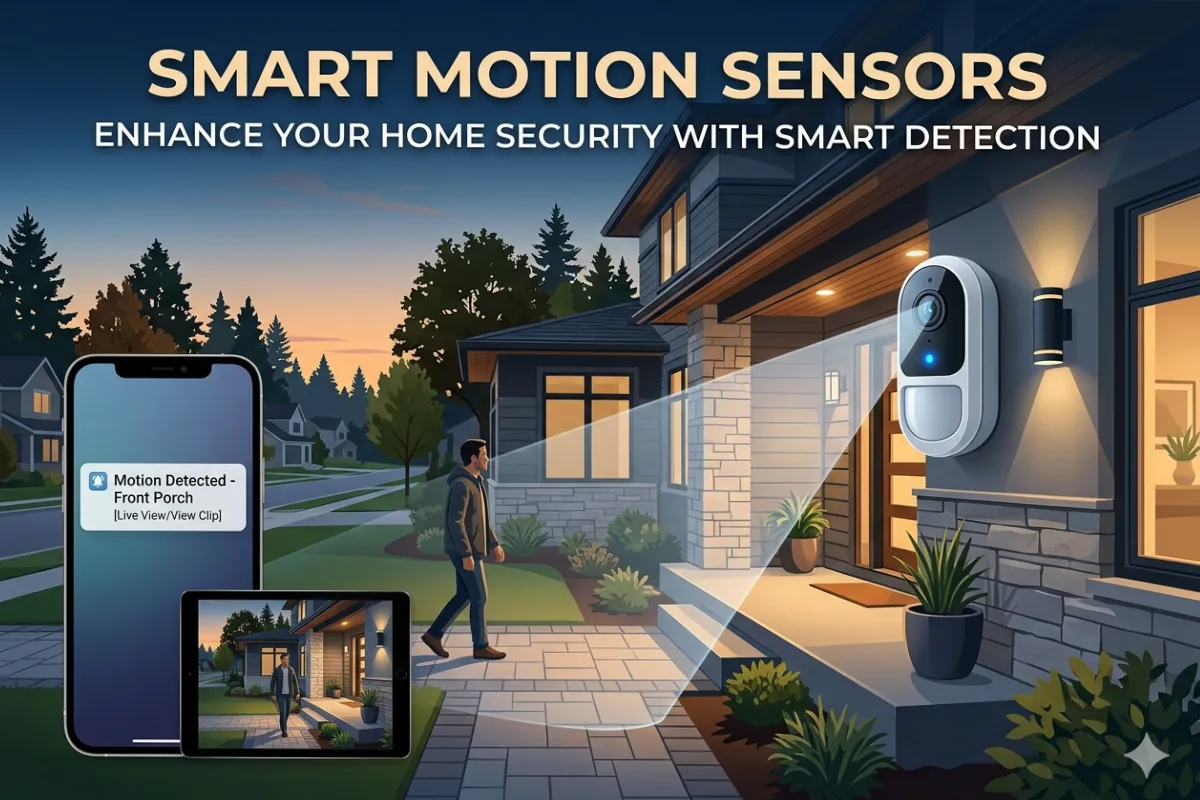
While standard motion sensors just sound an alarm whenever there is movement detected, smart motion sensors work in combination with your phones, cameras, smart lights, voice assistants, and home automation system. They are efficient, reduce false alarms, and increase security and energy efficiency of your house.
If you require installing such sensors at the entrance to your home, garage, gardens, or any other place inside the house, you will find this article useful, as it provides information about how they work, different types of smart motion sensors, their advantages, and how to choose the appropriate one.
Motion sensors from our smart home security pillar.
What are Smart Motion Sensors?
A smart motion sensor is an advanced device that can sense movement in a particular zone. Once any movement has been sensed, the device may be able to do one or more of the following actions:
- Sending instant notifications to your smartphone
- Activating security cameras
- Triggering alarm systems
- Turning on smart lights
- Recording security footage
- Starting home automation routines
Smart motion sensors can be connected via Wi-Fi, Zigbee, Z-Wave, Matter, or Bluetooth, unlike the regular sensors.
Motion sensors are adaptable smart gadgets that you can have at various locations within your property. The gadgets are usually fixed at door entrances for the purpose of detecting anyone coming into or out of the house, hallway areas to automate the lighting system, and in living rooms to make your indoor space more secure. Motion detection is also useful in the garage and driveway since it allows you to monitor any activities taking place either through the movement of pedestrians or the vehicles. Backyard areas can also have motion sensors in order to monitor outdoor spaces. Staircases may have motion sensors installed for the purpose of illuminating the steps. Basement areas could also have sensors installed.
Advantages of Smart Motion Sensors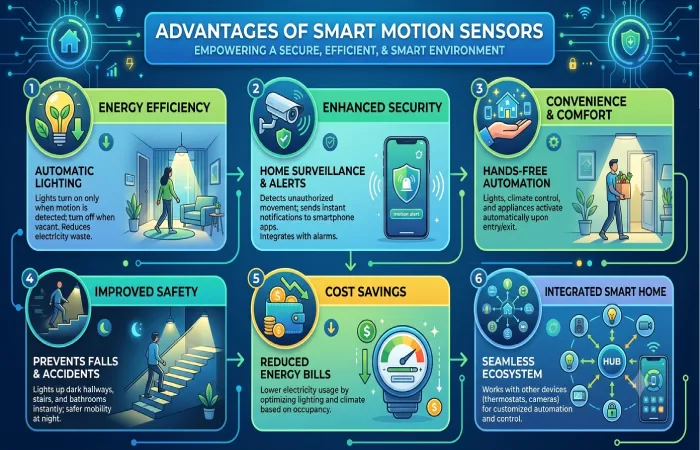
When using smart motion sensors, security and convenience come at once.
Improved Home Security
A motion sensor will notify homeowners when any unanticipated movement happens before any intrusion takes place.
Some of its advantages include:
- Real-time motion detection
- Immediate smartphone alerts
- Faster emergency response
- Enhanced burglary prevention
Home Automation
There are different tasks that can be done using motion sensors.
For example:
- Turning hallway lights on when someone walks by
- Activating outdoor floodlights at night
- Starting security cameras upon movement
- Opening smart blinds during daylight hours
Automation improves convenience while reducing manual control.
Savings of Energy
Smart motion sensors keep lights off unnecessary.
For example:
- Bathroom lights switch off automatically after no movement.
- Office lights turn off after everyone leaves.
- Garage lighting activates only when needed.
This reduces electricity consumption throughout the home.
Remote Monitoring
Whether traveling or busy with work, advanced motion sensors will enable you to remotely monitor activity via mobile applications.
Notifications will be received each time there is activity, keeping you connected with your property regardless of location.
Reduction of False Alarms
Modern sensors use intelligent algorithms to distinguish between:
- Humans
- Pets
- Environmental movement
- Shadows
- Tree branches
- Temperature changes
This significantly improves reliability.
Best Smart Motion Sensors
The type of sensors that will be used depends on the size of your house, the level of automation, and security. Below is a list of smart motion sensors that you can consider purchasing.
1. Philips Hue Motion Sensor
This sensor works for:
- Smart lighting automation
- Indoor use
- Hue ecosystems
Features:
- Daylight sensing
- Temperature monitoring
- Fast response
- Zigbee connectivity
2. Aqara Motion Sensor P2
Best for:
- Matter compatibility
- Apple Home
- Google Home
- Alexa
Advantages include:
- Low power consumption
- Compact design
- Fast detection
- Long battery life
3. Ring Alarm Motion Detector
Designed specifically for Ring Alarm systems.
Features include:
- Wireless installation
- Pet detection
- Mobile alerts
- Easy integration
4. Eve Motion Sensor
Ideal for Apple Home users.
Highlights:
- HomeKit compatibility
- Water-resistant housing
- Outdoor support
- Privacy-focused operation
5. Aeotec SmartThings Motion Sensor
This sensor works for:
- SmartThings hubs
- Home automation
- Temperature monitoring
Additional features:
- Motion detection
- Light sensing
- Temperature measurements
Wireless Motion Detectors for Home
Nowadays, wireless motion detectors are used more often than wired detectors due to ease and convenience of installation.
Benefits of Wireless Motion Sensors
Easy Installation
No drilling into walls or installing electrical cables required.
Most devices install using:
- Screws
- Adhesive strips
- Magnetic mounts
Flexible Placement
You can install sensors:
- On ceilings
- On walls
- Near entrances
- Above garages
- In hallways
Battery-operated means that installation becomes possible virtually anywhere.
Expandable Systems
Adding additional sensors is simple.
Many homeowners gradually expand coverage by installing sensors in:
- Bedrooms
- Kitchens
- Outdoor pathways
- Backyards
- Storage rooms
Mobile Connectivity
Wireless sensors typically connect directly with:
- Smartphones
- Smart hubs
- Voice assistants
- Security cameras
This enables complete remote monitoring.
PIR vs Microwave Motion Sensors
There are various technologies being utilized by motion sensors when detecting motion. You need to know how these differ.
| Feature | PIR Sensors | Microwave Sensors |
| Detection Method | Infrared body heat | Microwave radio waves |
| Accuracy | High | Very High |
| False Alarms | Low | Moderate |
| Cost | Affordable | More expensive |
| Outdoor Performance | Good | Excellent |
| Wall Penetration | No | Can detect through thin materials |
| Power Usage | Low | Higher |
PIR (Passive Infrared) Sensors
These sensors can detect infrared radiation from people and animals.
Advantages:
- Energy efficient
- Affordable
- Reliable indoors
- Long battery life
Best suited for:
- Living rooms
- Hallways
- Bedrooms
- Offices
Microwave Motion Sensors
These sensors send radio waves and detect reflected waves.
Advantages:
- Longer detection range
- More sensitive
- Better outdoor performance
Best For:
- Warehouses
- Large garages
- Commercial properties
- Outdoor security
Which One Is Better?
Most homeowners find PIR sensors very accurate while producing minimal false alarms.
However, microwave sensors are best suited for large outdoor areas due to their extreme sensitivity.
Many premium security systems combine both technologies for maximum accuracy.
Activate smart alarm systems on detection.
Pet Friendly Motion Sensors
The biggest fear of most homeowners when it comes to security systems is the possibility of having their pets accidentally set off an alarm, thus decreasing the system’s accuracy. Luckily, there are pet friendly motion sensors that will help avoid that problem. Such modern devices have the ability to ignore motion under a certain weight limit and do not register movements made by cats and dogs as something suspicious. Depending on the particular model, they usually provide protection against pets up to 20, 40 or 80 pounds (9, 18 or 36 kg).
While regular motion sensors react on any type of movement, smart sensors for pet owners apply advanced technologies of detection which consider several aspects to detect an intruder among other objects within a room. The sensors can recognize various heat signatures, sizes of objects, angles of detection and movement patterns to find out whether an alarm should be triggered. In this way, false alarms are minimized whereas intruders are reliably detected by the sensor.
For achieving the highest level of operation, right installation is vital. Motion sensors for pets should be installed about 7 to 8 feet off the ground and be far enough from spots where pets like climbing such as shelves, furniture and counters. In addition, one needs to remember not to place such sensors near heating vents or any other heat sources. Thus, with proper installation the sensor will work properly providing home security while pets are moving around the house.
Motion Sensors with Smart Lights
Another common automation in the modern world of technology is the automation of motion sensor-controlled smart lights.
It eliminates the search for the switch as the lights will automatically come on upon detecting movement.
Examples are:
- Porch lights
- Garage lighting
- Bathroom lights
- Hallway lights
- Closet lighting
- Basement lighting
Benefits
Increased Safety
Automatic lighting reduces accidents during nighttime.
Better Security
Outdoor flood lights serve to startle any would-be intruders and provide recording by cameras.
Energy Saving
The lights will automatically turn off after a certain period without any movements being detected.
Convenience
Hands Free Lighting Is Useful When:
- Carrying groceries
- Walking upstairs
- Entering the garage
- Returning home late
Smart Home Integrations
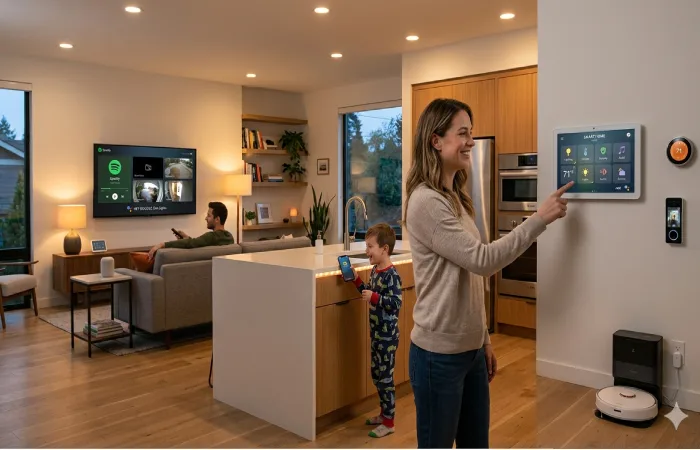
The current motion detectors integrate well with smart home systems.
Some common integrations include:
Amazon Alexa
Examples:
- Turn on lights
- Announce motion detection
- Activate routines
Google Home
Automations include:
- Lighting control
- Security alerts
- Camera activation
Apple Home
Users can automate:
- Home scenes
- Smart locks
- Security notifications
Samsung SmartThings
Supports advanced automation between:
- Sensors
- Cameras
- Door locks
- Thermostats
- Smart plugs
Installation Tips
To maximize detection accuracy:
- Install sensors 6–8 feet above the ground.
- Avoid direct sunlight.
- Keep away from heating vents.
- Do not face windows directly.
- Test detection zones after installation.
- Adjust sensitivity if supported.
- Replace batteries annually or as recommended.
Good positioning significantly enhances performance.
Typical Mistakes to Make
A lot of people face issues with false alarms due to incorrect installation.
Mistakes that should be avoided are:
- Installing near air conditioners
- Facing moving curtains
- Pointing toward busy roads
- Ignoring firmware updates
- Blocking sensors with furniture
- Setting sensitivity too high
Making an additional effort during the setup process can save a lot of trouble in the future.
Lock smart door locks automatically on motion.
The Future of Smart Motion Detectors
Advances in motion detector technology keep advancing due to the growth of artificial intelligence.
Future smart motion sensors are expected to offer:
- AI-powered human recognition
- Facial identification
- Activity classification
- Advanced intrusion detection
- Radar-based sensing
- Improved battery life
- Matter compatibility
- Greater privacy controls
- Predictive home automation
This will further enhance smart homes’ security and energy efficiency.
Conclusion
With all the developments in modern-day technologies, advanced motion sensors are a must for everyone who wants their house to be secure. These devices are used not just to detect the presence of an intruder but also to control lights and cameras, save energy, and give real-time notifications from any location you are at.
If you are interested in buying the best smart motion sensors, want to compare wireless motion detectors for home, learn about the differences between PIR and microwave sensors, need pet-friendly motion sensors, or combine motion sensors with smart lights, you will find the information that you need here.
As the technologies of smart homes continue evolving, the role of motion sensors will only grow. Buying good motion sensors now will help you protect your house and gain many additional benefits.