
Last Updated: September 21, 2026
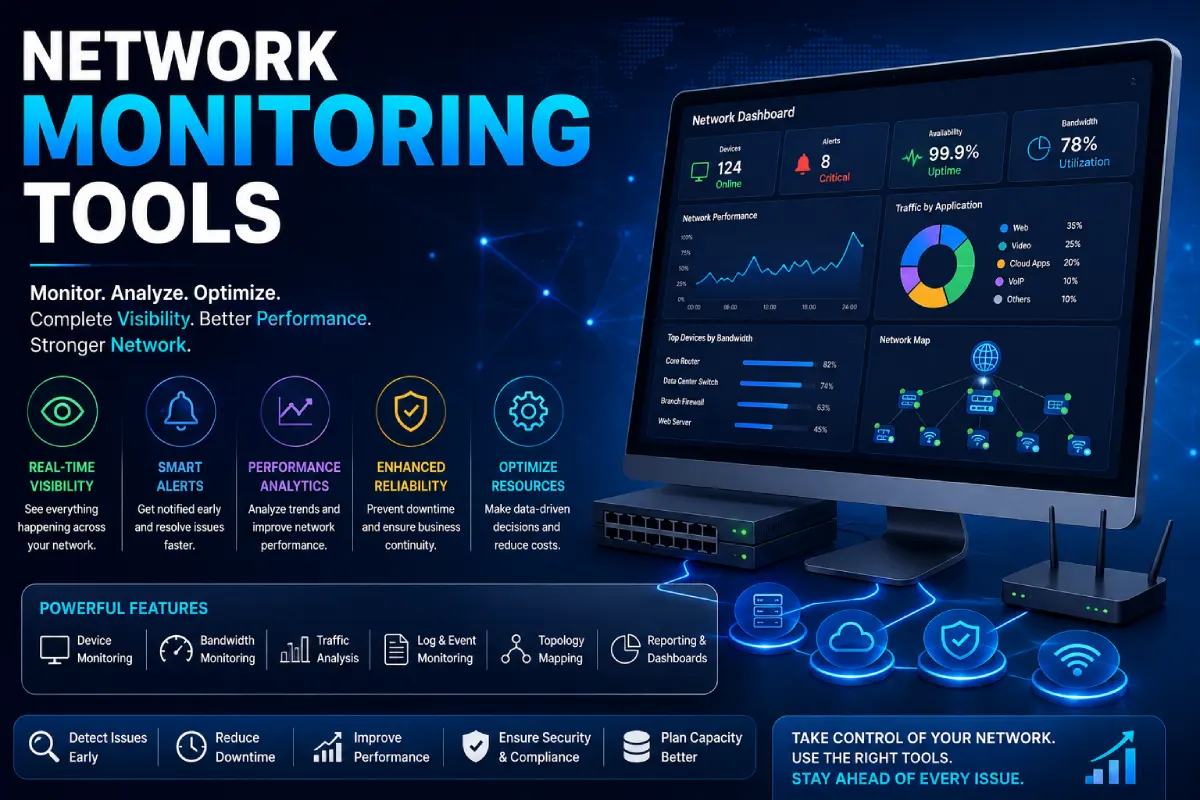
Network Monitors These enable the IT staff to constantly monitor the status, availability and performance of the network infrastructure.
Today, the majority of business relies on robust networks for cloud applications, communication, remote working, web pages, in-house systems and customer service. When it goes wrong and becomes congested with more traffic, high latency or data loss then little problems can have serious effects on productivity.
Network monitoring software aids team members in identifying these problems before.
Monitoring tends to be device and interface-centric in traditional solutions, but platforms today can stick device metrics, traffic, cloud telemetry, synthetic testing, and other information together to give a bigger picture.
The right tool can help answer important questions such as:
- Is the network accessible?
- Which is blinging?
- 2.2Is bandwidth being used efficiently?
- In which directions is the latency spreading?
- Are packets being dropped?
- What applications or users are impacted?
- When did the problem start?
“For the overarching strategy, read our complete guide on Security & Networking.”
What Are Network Monitoring Tools?
Network monitoring tools are software applications that gather data collected from infrastructure and network devices.
They can monitor:
- Routers
- Switches
- Firewalls
- Servers
- Access points
- Network interfaces
- Cloud infrastructure
- WAN connections
- Internet paths
- Network traffic
Most traditional network monitoring tools would use protocols like SNMP, ICMP, NetFlow, sFlow or streaming telemetry to gather data.
The information gathered is generally visualized using dashboards, charts, topology maps and alarms.
How Do Network Monitoring Tools Work?
A typical monitoring workflow looks like this:
1. Discover Network Devices
Firewalls, servers, routers, switches and any other devices that are connected to the software are detected.
2. Collect Network Data
Collects details about device status, interface information, latency, packet loss, network traffic ect.
3. Analyze Performance
The software correlates the current performance with the thresholds, historical data or the predicted behavious.
4. Detect Problems
If something strange happens the monitoring system will send us an alert.
5. Notify the IT Team
Alerts can be sent by E-mail, MessageSystem, ticket system or other integrations.
6. Investigate the Root Cause
IT teams analyzed the problem, such as what sat behind the problem using dashboards, traffic data, topology data and previous data.
By being proactive in this way, the teams will be able to solve many problems to prevent major outages from occurring.
What Can Network Monitoring Tools Monitor?
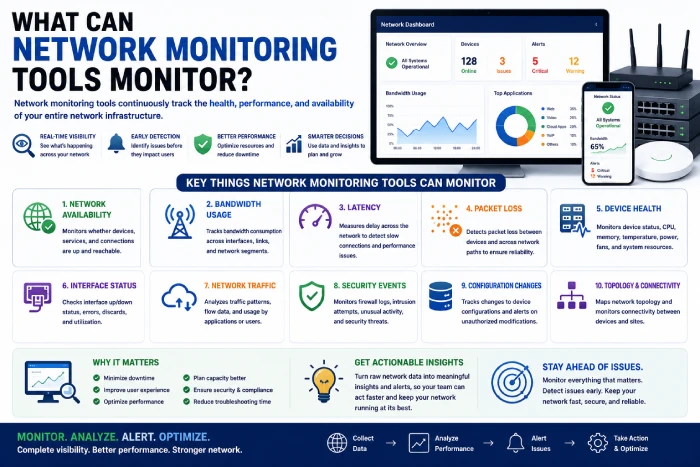
Network Availability
Reachability tools can determine if devices and services are “alive”.
For instance, an alert can notify you that a router and/or switch has become unresponsive.
Bandwidth Usage
Bandwidth monitoring provides teams with an understanding of how the bandwidth of the network is being used.
IT administrators can identify:
- Saturated connections
- High-traffic devices
- Heavy applications
- Aberrant use behaviors.
- Capacity problems
This data could also be used for future network planning.
Latency
Latency: Refers to the time it takes for data to be transferred.
High latency can affect:
- Video conferencing
- Cloud applications
- VoIP
- Remote desktops
- Online services
Tracking the latency trend over time can also assist in pinpointing common issues.
Packet Loss
Packet loss is when a data packet does not arrive to wherever it was meant to be.
Heavy packet loss can result in sluggish connections, poor voice quality, application errors, and unreliable operation.
Device Health
Many tools monitor hardware and system metrics such as:
- CPU usage
- Memory usage
- Interface errors
- Temperature
- Device availability
- Port status
This allows IT teams to anticipate hardware issues before complete failure.
Key Features of Network Monitoring Tools
1. Real-Time Monitoring
Real-time dashboards give a snap shot of the network health.
It would also mean that IT support staff could view important information at a glance without trouble of having to check individual devices.
2. Automatic Device Discovery
Automation discoveries can also be used to identify network devices, reducing the overhead of manual configuration.
Some automated network topology discovery can be done by certain systems.
3. Alerts and Notifications
Alerts are the most useful features.
A monitoring system can notify IT teams when:
- Device goes online The device becomes available to join. It can then either be discovered or automated to join by the other device.
- There is a bandwidth gure0 for.
- It introduces packet loss, so that more packets are never reaching the destination. The ability of the system to resist errors in the network decreases.
- The latency is very high
- Interface errors are as follows.
Good alarm management also considers noise reduction, escalation rules and maintenance windows so alert hits don‘t exceed what teams can handle.
4. Network Topology Mapping
Topology maps display where the devices are connected.
This can be helpful when troubleshooting for example the IT team will be able to for example find out which device belongs to which network segment very quickly.
5. Historical Reporting
Real-time information your information source for what‘s happening now.
Historical record reveals what happened in the past.
Reports can help identify:
- Recurring outages
- Long-term bandwidth expansion9. The forward-looking bandwidth expansion that occurred over a long time scale.
- Performance trends
- Capacity requirements
- Devices that are used too frequently to be effective:
6. Traffic Analysis
Other systems like modern network are capable of studying flow of traffic, trying to find source and destination.
This can help answer questions such as:
Which application is using the most bandwidth?
or:
In which network segment is the unusual traffic originating?
Benefits of Network Monitoring Tools
Detect Problems Earlier
Keep a watch on the monitoring system so you can spot problems proactively!
Rather than waiting for someone to report, “The internet is slow,” the IT team might already have a warning indicator for, for example, more latency or packet loss.
Reduce Downtime
Faster detection and troubleshooting may result in a shorter period of impact of a network problem on users.
Improve Network Performance
Monitoring enables IT teams to determine bottlenecks and performance issues.
- Improving the efficiency of network resource utilization and configuration.
Improve Capacity Planning
Historical data provides information about the growth of network usage over time.
As bandwidth demands rises constantly, administrators will be able to plan upgrades on the equipment before the usage gets out of control.
Reduce Troubleshooting Time
A consolidated dashboard could provide data that would normally have to be obtained by checking all of these across multiple devices.
Most current network monitoring tools are using more and more combinations of different telemetry sources to help teams shift the levels of abstraction from a symptom detection towards a hypothesis investigation.
Network Monitoring Tools for Different Businesses
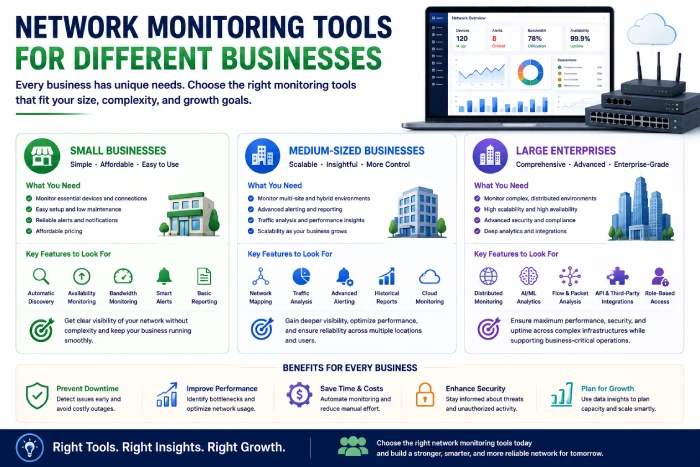
Small Businesses
The monitoring systems do not have to be super complex for small business.
Look for:
- Easy deployment
- Automatic discovery
- Simple dashboards
- Reliable alerts
- Affordable pricing
- Basic reporting
The objective should be to be visible just enough, but not over-complication.
Medium-Sized Businesses
Growing businesses may need:
- Multi-site monitoring
- More sophisticated alerting
- Network mapping
- Traffic analysis
- Cloud monitoring
- Integrations
The ‘1’ can be scaled up to become the second number in the case of large networks. Scalability becomes more important once the network grows.
Large Enterprises
Enterprise environments may require broader capabilities such as:
- Distributed monitoring
- Hybrid-cloud visibility
- Procure investments by convincing fund managers that their investments are performing better than the overall market. Technologies used for advanced traffic analytics.
- Classified as a large scale device monitoring.
- API access
- Automation
- Role-based access
- Advanced reporting
Today, the scope of enterprise monitoring has expanded to include not just large Enterprise data centers, but also the entire Cloud (Public/Private Hybrid ), Wide Area Network/WAN and Internet.
Open-Source vs. Commercial Network Monitoring Tools
Both methods are effective.
Open-Source Tools
Popular examples include:
- Zabbix
- Nagios
- OpenNMS
- LibreNMS
These can offer considerable flexibility and could be appealing for companies that have the technical human resources to run their own infrastructure.
Commercial Tools
Commercial platforms often provide:
- Easier deployment
- Vendor support
- Polished dashboards
- Automatic discovery
- Integrations
- Advanced reporting
- Enterprise features
The right decision will vary depending on your budget, technical resources, topology and how many units you are wishing to monitor.
How to Choose the Right Network Monitoring Tool
1. Determine What You Need to Monitor
List your infrastructure first.
Do you need to monitor:
- Network devices?
- Servers?
- Cloud services?
- Internet performance?
- Applications?
- WAN connections?
- Network traffic?
Do not pay for a feature that you have no use for.
2. Check Protocol Support
Ensure the tool can support the protocols and telemetry sources used by your infrastructure.
SNMP is still useful in monitoring more traditional network devices, however for a more detailed look at what traffic is flowing over your network and how it is performing, flow technologies and newer telemetry techniques would be required.
3. Evaluate Alerting
A good monitoring platform must give you meaningful alerts, rather than hundreds of messages that no one pays any attention to.
Look for:
- Threshold alerts
- Escalation
- Alert suppression
- Maintenance windows
- If you want to be notified of promotions or news, there are various ways in which you can stay informed.
4. Check Scalability
What do you envision as the future of your business?
What works to find 20 devices does not necessarily work on hundreds or thousands.
5. Look at Integrations
Useful integrations can include:
- Ticketing systems
- Slack
- Microsoft Teams
- SIEM platforms
- Cloud services
- Automation platforms
Integrations enable monitoring data to be incorporated into an entire IT workflow.
6. Consider AI Features
Several of today‘s monitoring tools are beginning to incorporate AI to aid in investigating network issues, providing synopses, spotting anomalies, or even providing decision guidance on machine troubleshooting. Today‘s recently available diagnostic tools 2026 are more and more framing AI assisted investigation as a means of closing the gap between detection and diagnosis.
But don‘t go after it just because ‘it advertises AI.’
Determine initially whether the AI truly addresses a problem faced by your IT department or not.
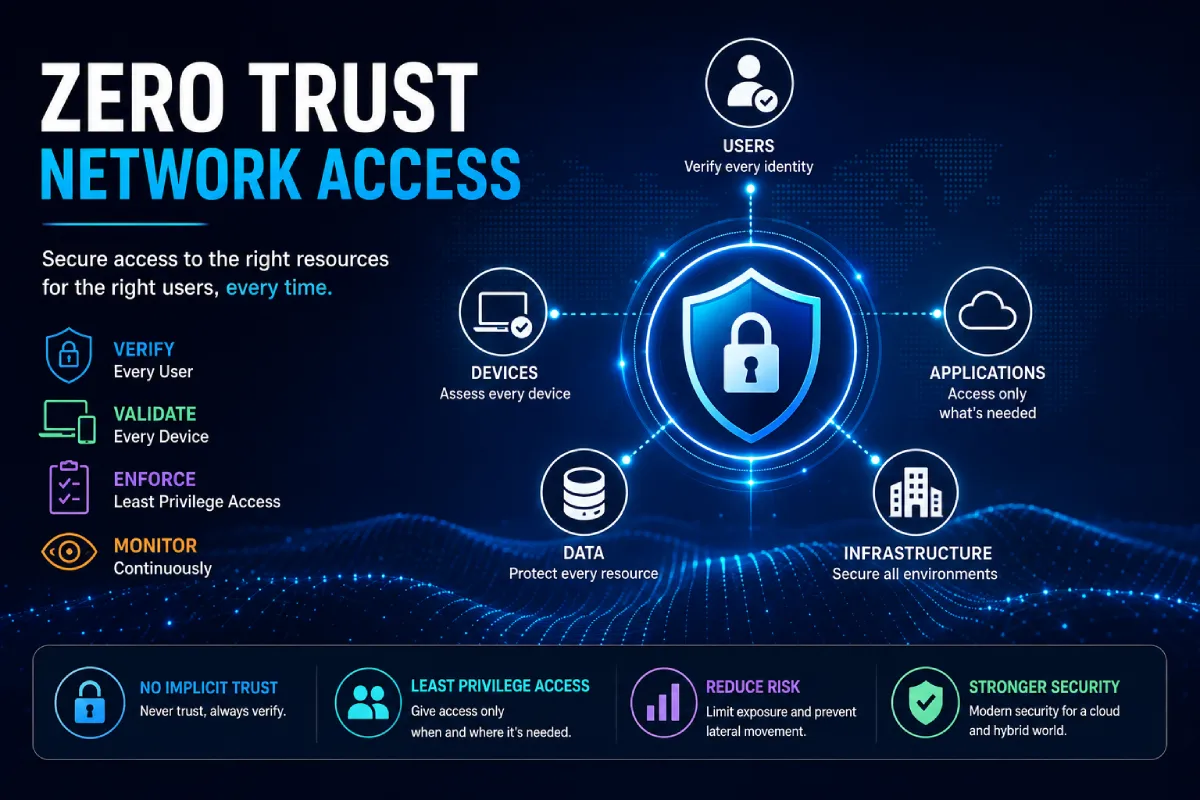
“To take the next step, see our detailed guide on Zero Trust Network Access.”
Common Network Monitoring Mistakes
Monitoring Too Many Things
Additional data doesn‘t always make things better.
Concentrate on indicators that allow you to identify and fix actual problems.
Creating Too Many Alerts
Too many alerts.
Set carefully the thresholds.
Ignoring Historical Data
Specific historical information is mainly needed for capacity planning or unknown recurring failures.
Choosing a Tool That’s Too Complex
A robust platform is of little use if your staff aren’t able to set it up or operate it easily.
Failing to Test Alerts
The monitoring system is really only benefits if the alerts get to who needs to take action.
Best Practices for Network Monitoring
Monitor Critical Devices First
Computers first begin with routers, switches, firewalls, servers, and the network connections: all of these components are crucial to keeping the day-to-day business running.
Establish Baselines
Have a sense of the normal network performance.
Configure Meaningful Alerts
Increment the Triggers so they provide Alerts when still needed.
Review Network Trends
Identify trending use historical data on a regular basis to help predict bunch formation and capacity requirements.
Automate Responses Carefully
Low impact changes: simple errors should sometimes be detected by automated remediation and should never allow high-impact alterations to occur without the correct controls.
Keep Monitoring Updated
Monitor changes to the infrastructure to update the configuration used for monitoring.
Frequently Asked Questions
What are network monitoring tools?
Network monitoring tools gather network information on an ongoing basis and analyze this data to enable the IT teams to monitor availability, performance, the volume of traffic, and the health of the devices.
What is the most important feature of network monitoring software?
Reliable monitoring and alerting are a prerequisite. Based on the environment, autodiscovery, topology mapping, traffic analysis, historical reporting and cloud visibility can also be relevant.
Do network monitoring tools use SNMP?
Most common network monitoring tools use SNMP to gather information from network devices. The newer platforms also support ICMP, NetFlow/IPFIX /sFlow, streaming telemetry, cloud flow logs and other sources.
Can network monitoring tools prevent outages?
While they can‘t promise that outages won‘t happen, they can at least identify the warning signs and assist IT teams in replying sooner.
Are free network monitoring tools available?
Yes. There are free open-source applications, including Zabbix, Nagios, OpenNMS and LibreNMS, but they may be more difficult to install and manage.
Do small businesses need network monitoring?
When a company relies on its network to conduct its daily business, monitoring can still offer useful insights, even with limited infrastructure. The key point is to opt for a monitoring solution that is appropriate for a company‘s size and technical requirements.
Conclusion
Tools available to monitor the network provide the IT team with insight into how the infrastructure is functioning and performing. He can watch the device‘s availability, bandwidth, latency, packet loss, interface status, traffic and various other statistics while giving a notice when problems happen.
Now today‘s network monitoring is also very flexible in aggregation. Many tools are combining network measurements, traffic and cloud telemetry, topology, synthetic tests, and AI-powered troubleshooting altogether. The best tool isn‘t always the one with the most features.
Select a platform that meets the requirements of your network in terms of scale, infrastructure, monitoring and technical support, cost, integration with existing systems and expansion. Begin with the most critical systems for your business, develop valuable performance indicators, set relevant alerts, and use historical information to see you network and system performance evolve.
Good network monitoring is not just for knowing when things break. It‘s also about knowing enough about your network so you know when something is wrong and you can keep your business connected.