
Last Updated: September 28, 2026
5G home internet is becoming a practical alternative to traditional cable and fiber broadband. Makes the use of a nearby 5 G cellular network to provide internet services to your home instead of the use of a cable or fiber line into your home.
For households desiring simple install, comparable speeds, and less wires, this could be a selling point. However 5 Gs performance is highly situational and varies based on location, network capability, signal strength, and provider at your address.
Here’s how 5G home internet works, how fast it can be, and what you should consider before switching in 2026.
5G Home Internet Explained
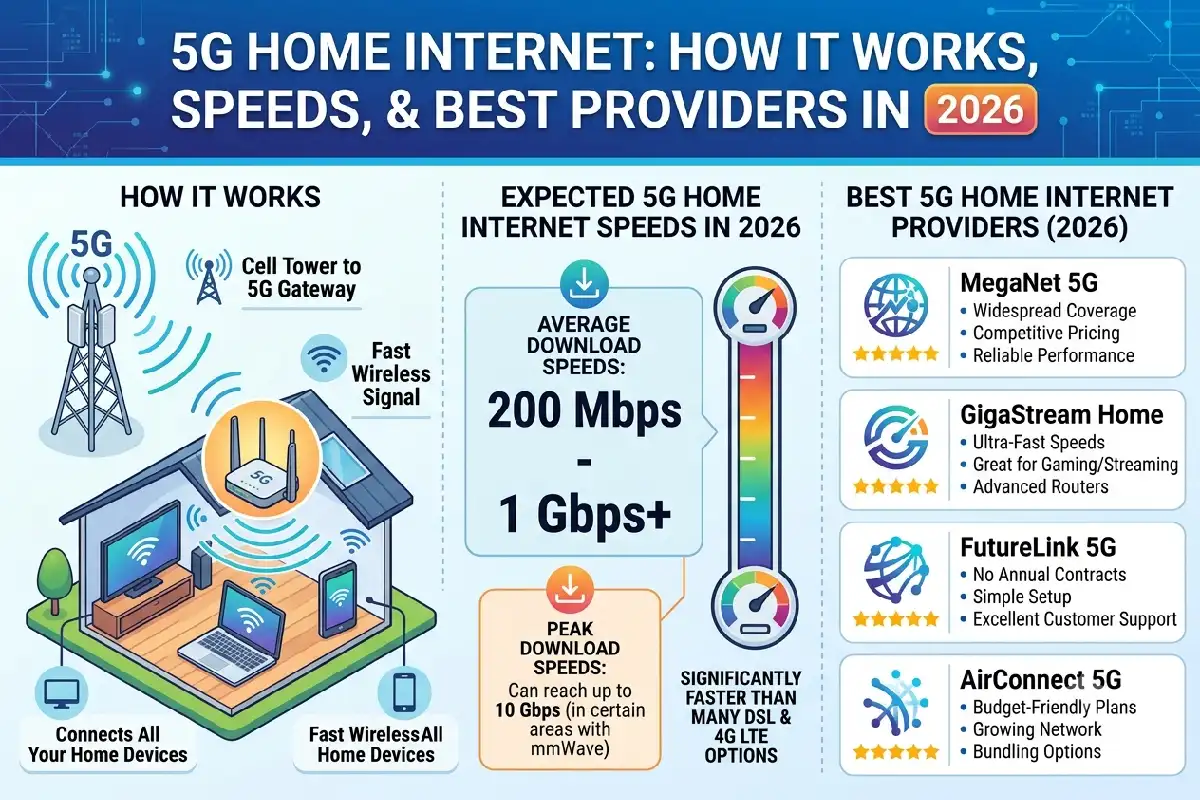
5G home internet is a type of fixed wireless internet. It uses 5G cellular technology to deliver an internet connection to a gateway installed inside your home.
The basic process is simple:
5G tower → 5G gateway → Wi-Fi → your devices
Rather than plugging your modem into a cable or fiber-optic cable, the gateway sleeps wirelessly to the provider‘s cellular network. This gateway then functions much like a regular Wi-Fi router. Mobile phones, laptops, TVs, tablets, gaming systems, and even smart-home devices will all be able to connect to it.
This, however, is a different case from having your smartphone act as a hotspot. A dedicated home internet gateway is designed to provide connectivity to an entire household rather than a few temporary devices.
One of the biggest advantages is installation. In some cases, the provider and location, it is possible to install the gateway on your own, without sending a technician to run a new cable to the dwelling.
Verizon explains that even its 5G Home Internet gateway can be installed independently, but self-installation can‘t be offered everywhere:
How much speed can I expect to get with 5 G home internet?
There isn’t one universal 5G home internet speed.
Performance depends on factors including:
- Distance from the cellular site
- 5G spectrum being used
- Network congestion
- Building materials
- Gateway placement
- Provider network capacity
- Your selected plan
Some 5G home connections deliver speeds similar to standard cable broadband, while faster implementations can approach gigabit speeds.
Also, a quick look atverizon can provide some speed estimates. They show median download speeds of 25–85 Mbps among some 5G Home configurations and 300–1,000 Mbps on their fastest 5 G Home Ultimate configuration on high band spectrum.
According to T-Mobile, Rely Home Internet customers regardless of their location can usually expect download speeds of roughly 170–354 Mbps, but real-world speeds will depend on circumstances such as location, time of day, and how strong the signal is.
This variability is important. Unlike a wired connection, you shouldn’t assume that advertised maximum speeds are what you’ll continuously receive.
5G vs Fiber vs Cable

Choosing between 5G vs fiber vs cable depends on what internet infrastructure is available at your address and how you use your connection.
| Feature | 5G Home Internet | Fiber | Cable |
| Connection | Wireless | Fiber-optic cable | Coaxial cable |
| Installation | Often simple | Usually technician installation | Usually self-install or technician |
| Download speed | Varies widely | Very fast | Fast |
| Upload performance | Usually lower than fiber | Excellent | Usually lower than download |
| Availability | Location dependent | Limited in some areas | Widely available |
| Performance consistency | Can fluctuate | Generally very consistent | Can vary with congestion |
5G vs Fiber
Radio makes more sense for users who want the best possible speeds, latency, upload speeds, etc, across the board, because repeatedly high numbers are what cable is set up for. The fiber is potential strength.
Consider, for instance, the voltage Verizon offers on fiber, which comes with symmetric speed levels, so the speed of uploading may be much more similar to the speed of downloading that with a number of fixed-wireless solutions.
Which can matter for people who frequently upload gigabyte files, stream live to the net, use cloud-based software, or have multiple power users concurrently.
But cable might be more reliable where the 5 G signal is weak.
5G home internet can therefore be particularly useful where fiber hasn’t reached a neighborhood but strong 5G coverage already exists.
5G vs Cable
Cable internet can provide fast speeds and has an established infrastructure across many areas.
The main attraction of 5G is convenience. You don’t necessarily need a wired broadband connection entering the property, and installation may simply involve positioning and activating a gateway.
However, cable may offer more predictable performance in locations where the 5G signal is weak.
Excellent 5G Home Internet Offers for the Year 2026
There isn’t one best 5G home internet plan for every household. Availability is extremely address-specific, so comparing the services actually offered at your home is more useful than comparing advertised nationwide maximums.
Two big US options are Verizon and T-Mobile.
Verizon 5G Home Internet
Several 5G Home packages are available from Verizon.
Is as follows today 5G Home, 5G Home Plus, 5G Home Ultimate. Depending upon the plan and network technology available at a given address, Verizon claims maximum download speeds from 100 Megabits per second (Mbps) to as much as 1 Gbps (Gigabits per second).
Verizon offers a router with 5 G Home plans and provides multi-year base-rate price guarantees varying by plan.
T-Mobile 5G Home Internet
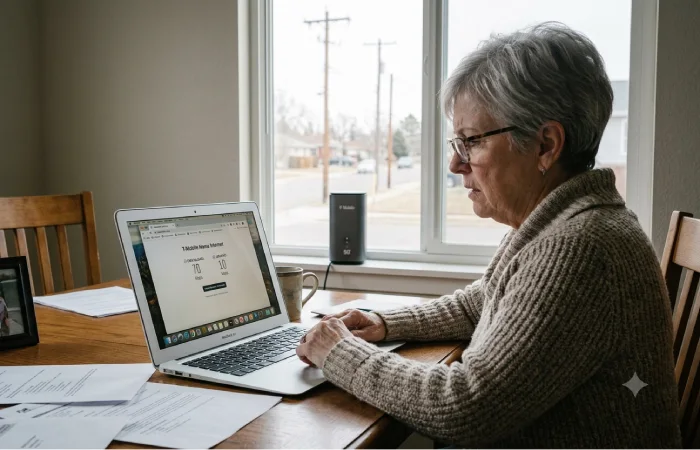
T-Mobile is another major fixed-wireless provider.
Their home internet service offers unlimited data and a Wi-Fi gateway, with certain eligible plans including a five-year price guarantee. T-Mobile also points out that actual speeds may vary based on several factors including location, network conditions, signal strength, and time of day.
When comparing plans, look beyond maximum download speed. Check the regular monthly price, equipment charges, data policies, upload speeds, price guarantees, discounts, and what speeds are specifically available at your address.
Setting Up 5G Home Internet
One reason people consider 5G home internet is the relatively simple setup.
After receiving your gateway, you‘ll typically need to:
- Place the gateway in an area with a strong 5G signal.Connect it to power.
- Wait for the gateway to establish a network connection.
- Wait for the gateway to establish a network connection.
- Configure your Wi-Fi network using the provider‘s app or setup process.
- Run a speed test.
The location of the gateways can be significant.
C However, an area by a window or an outside wall might have more cell strength than an inside room. Do not hide the gateway in cabinets, or cover it with objects that could disturb wireless output.
Should the Wi-Fi signal not suffice in all rooms, it may be worth considering a mesh system or Wi-Fi extender to extend the coverage around the house.
5G Coverage and Limitations
The biggest limitation of 5G home internet is availability.
Getting 5G service on your mobile does not necessarily mean that you are eligible for fixed 5G home broadband at your address. Home broadband is only offered where providers can deliver it based on network coverage and capacity to that location.
Even two houses in the same neighborhood can potentially have different service options.
Speed can also fluctuate. Verizon (For example), 5G Home Internet performance will vary by location, device, network connection, and other conditions of use that affect cellular networks.
A second way that signals for wireless have barriers is through physical barriers. Walls, windows, surrounding buildings, trees, terrain, and gateway placement may affect performance.
Another consideration is upload speed. Many 5G home internet plans provide substantially faster downloads than uploads. That‘s generally OK for most streamings, browsing and working. But if users need to transfer large files or live streaming frequently, fiber might be better.
Is 5G Home Internet the Right Choice in 2026?
Most effective 5G home internet is when you already have solid 5G coverage and need an alternative to a traditional cable broadband.
Of course, this would be especially attractive for: streaming, working remotely, surfing, making video calls, the use of smart-home devices, and the usual household-to-internet activities.
Fiber may still make more sense when maximum consistency, symmetrical upload speeds, and very low latency are priorities. Another option is cable which could also work well where fixed-wireless is weak.
The important thing is to compare downlink speeds available at your address, not just maximum advertised speeds.
FAQs
Does 5G home internet need a cable line?
Generally, no. The internet connection between the provider’s network and your gateway is wireless, although the gateway still needs electrical power.
How does 5G home internet perform for streaming?
The Beam2 is a consistent performer, and when connected to a robust 5 G home network, will handle 1080p or 4 K video stream examples with relative ease, though the number of concurrent streams will vary based on your realWorld speed.
What is the impact of 5G home internet on gaming?
It can be. However, competitive gamers should consider latency and connection consistency in addition to download speed.
Can 5G home internet replace cable?
For many households, yes. Is it supposed to replace cable? It depends on 5 G coverage, real speed, network stability, price and home use.
Final Thoughts
5G home internet has evolved into a serious broadband option in 2026. Its wireless delivery, fairly simple installation, good speeds, and growing accessibility, all represent factors as to why it attracts so much interest for homes beyond the established cable platform.
Drop and look for providers at your specific address, compare actual speed ranges, uploads, prices, equipment, and network policies. While having a great 5G connection as your regular home internet can be ideal, fiber, cable, and 5G each have their own benefits depending on your location and needs.