
Last Updated: June 22, 2026
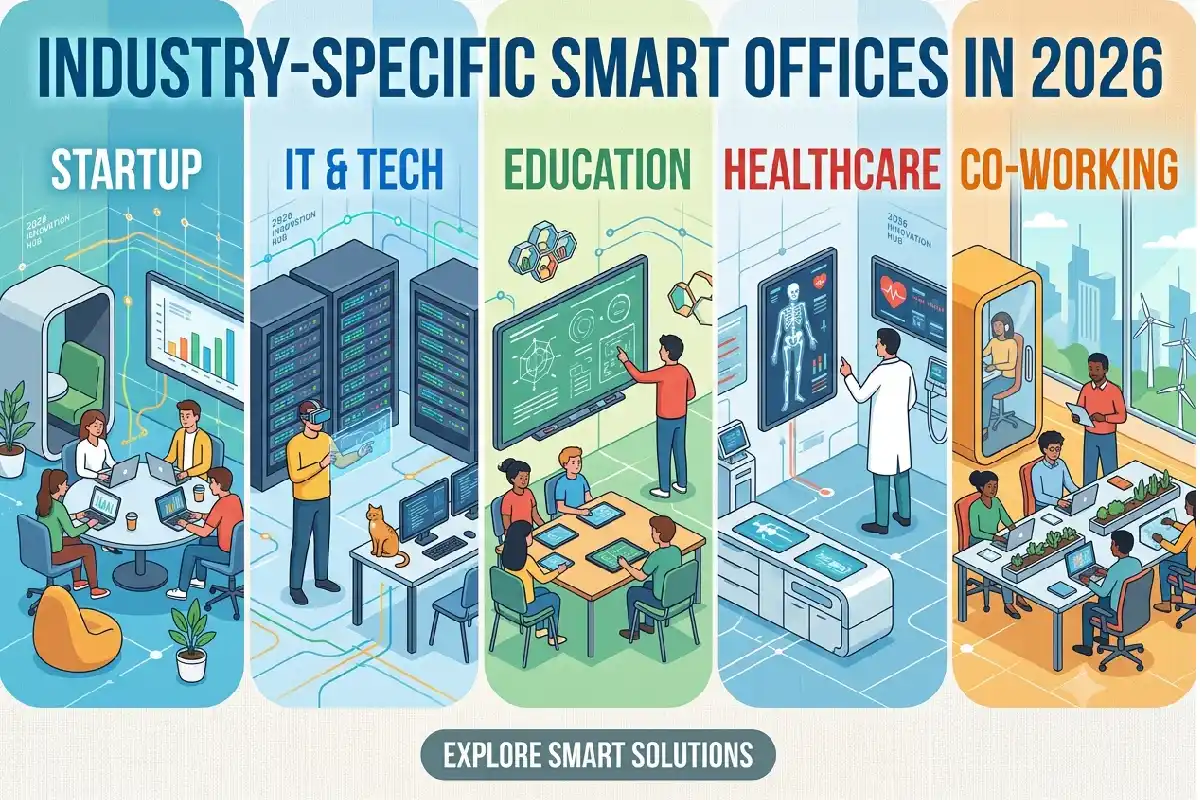
Offices in 2026 are not just about machines doing things for us. They are really connected and use intelligence to make things work better for specific types of businesses. For example new companies use offices to save money and hospitals use them to keep patient information safe. Every type of business uses office technology in different ways.
This guide tells us about the smart office setup that different industries use. It looks at what’s happening in 2026 and what people are actually doing. It has tables that compare things and help us see what really works in the world. The guide uses research and information from 2026 to help us understand offices and how they are used in different industries, like startups and hospitals.
Industry-tailored ideas from our smart office guide.
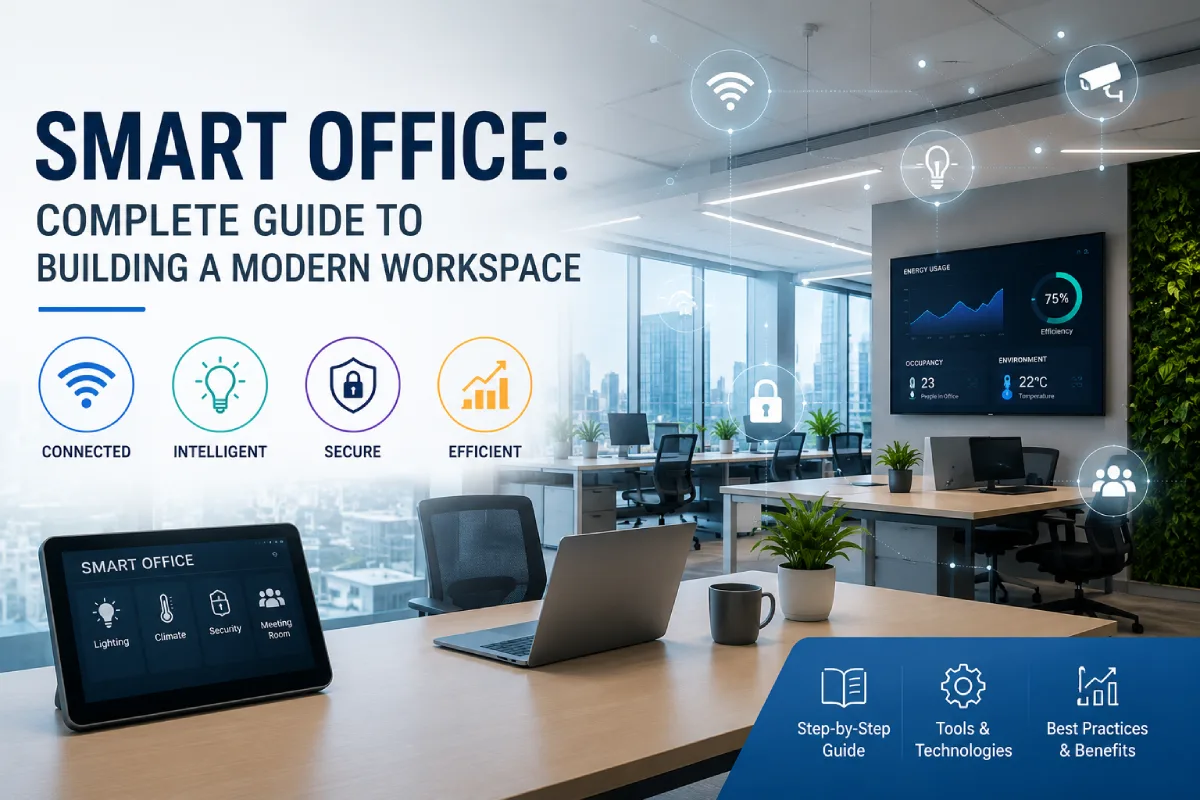
What Makes an Office “Smart” in 2026?
A smart office today is built on five core technology pillars:
Core Smart Office Stack (2026 Standard)
| Layer | Technology | Purpose |
| AI Layer | Predictive AI assistants, workflow automation | Decision-making & task automation |
| IoT Layer | Sensors, smart devices, wearables | Environment monitoring |
| Connectivity | 5G Advanced, Wi-Fi 7, edge networks | Ultra-low latency communication |
| Cloud Layer | Hybrid cloud systems | Data storage + remote access |
| Security Layer | Zero-trust architecture, biometric access | Cyber + physical security |
2026 Adoption Insight
| Technology | Adoption Rate (2026) | Growth Trend |
| AI Workplace Assistants | 78% | 🔺 Rapid |
| IoT Office Sensors | 71% | 🔺 Rapid |
| Hybrid Cloud Systems | 85% | 🔺 Mature |
| Biometric Access Control | 64% | 🔺 Growing |
| Full Automation Workflows | 52% | 🔺 Emerging |
Smart Office Ideas for Startups
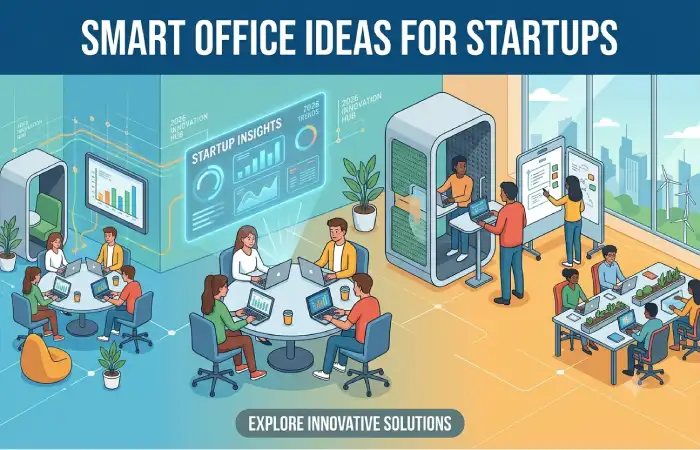
Startups need low-cost, high-efficiency smart office setups that scale quickly.
Key Focus Areas
- Cost optimization
- Remote collaboration
- Fast deployment
- Scalable cloud tools
Startup Smart Office Stack (2026)
| Category | Tools | Benefit |
| Communication | AI meeting assistants (auto notes, summaries) | Saves 30–40% meeting time |
| Project Management | AI-driven Kanban tools | Predicts delays |
| Cloud Storage | Hybrid cloud drives | Reduces infrastructure cost |
| Security | SaaS-based Zero Trust tools | No physical server needed |
| Office Automation | Smart lighting + energy sensors | Cuts electricity cost by 25% |
Best Startup Smart Office Strategy
- Start cloud-first (no hardware dependency)
- Add AI scheduling tools early
- Invest in collaboration tech, not infrastructure
- Use scalable IoT only for energy saving
Smart Office Setup for IT Companies
IT companies are the most advanced adopters of smart office ecosystems.
Key Requirements
- High-speed infrastructure
- Developer productivity tools
- Cybersecurity-first environment
- Hybrid workforce support
Information Technology Office Technology Stack (2026)
| Layer | Technology | Impact |
| Network | Wi-Fi 7 + SD-WAN | Ultra-fast dev environment |
| DevOps | AI CI/CD pipelines | Faster deployment cycles |
| Monitoring | AI system observability tools | Predicts system failures |
| Security | Zero-trust + endpoint AI defense | Blocks 99.6% threats |
| Collaboration | Virtual workspace rooms | Remote-first development |
IT Productivity Benchmark (2026)
| Office Type | Deployment Speed | Bug Detection Time | Dev Productivity |
| Traditional IT Office | Slow | 48 hrs | Medium |
| Semi-Smart Office | Moderate | 18 hrs | High |
| AI Smart IT Office | Fast | 3–6 hrs | Very High |
Information Technology Smart Office Key Insight
Companies using AI-based DevOps report up to 42% faster release cycles in 2026 compared to traditional systems.
Smart Office Technology for Schools
Education systems are rapidly shifting toward hybrid smart learning environments.
Key Goals
- Interactive learning
- Attendance automation
- Safe campus monitoring
- Hybrid classrooms
Smart School Office System (2026)
| System | Technology | Purpose |
| Attendance | Facial recognition AI | Automated entry tracking |
| Classrooms | Smart boards + AR tools | Interactive learning |
| Administration | AI scheduling systems | Timetable optimization |
| Safety | IoT surveillance + alerts | Campus security |
| Communication | Parent-teacher AI portals | Real-time updates |
Key Benefits for Schools
- Reduced administrative workload by 60%
- Faster communication between parents and teachers
- Real-time performance analytics
- Improved student engagement
Smart Healthcare Office Solutions
Healthcare offices require high security, accuracy, and automation.
Key Priorities
- Patient data protection
- Fast diagnosis workflows
- Automated scheduling
- Regulatory compliance
Healthcare Smart Office System (2026)
| Component | Technology | Benefit |
| Patient Records | Blockchain-based EHR | Secure & tamper-proof |
| Diagnostics | AI-assisted analysis | Faster detection |
| Scheduling | Smart queue systems | Reduced waiting time |
| Monitoring | IoT health devices | Real-time tracking |
| Compliance | Automated audit tools | Regulation adherence |
Healthcare Efficiency Metrics
| Metric | Traditional | Smart Healthcare Office |
| Patient Wait Time | 45–60 min | 10–20 min |
| Diagnosis Speed | 2–3 days | 2–6 hours |
| Administrative Load | High | Reduced by 55% |
Foundation first — see our smart office setup guide.
Key Insight
Healthcare offices using AI automation in 2026 show up to 40% improvement in patient processing efficiency.
Smart Office Systems for Co-Working Spaces
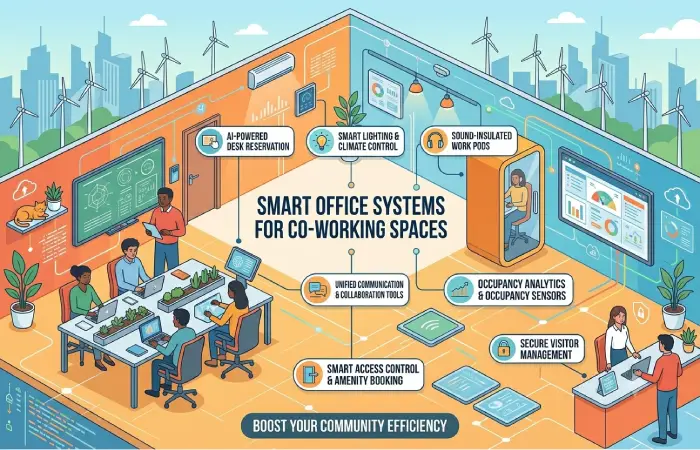
Co-working spaces depend heavily on flexibility, automation, and user experience.
Key Requirements
- Dynamic desk allocation
- Smart billing systems
- Energy optimization
- Member experience personalization
Co-working Smart Office Stack (2026)
| Feature | Technology | Function |
| Desk Booking | AI space allocation | Optimizes seating |
| Billing | Smart usage tracking | Pay-per-use accuracy |
| Climate Control | IoT sensors | Comfort optimization |
| Access Control | QR + biometric entry | Secure access |
| Community Tools | AI networking suggestions | Member collaboration |
Business Impact
- 30–45% increase in space utilization
- 25% reduction in operational cost
- Higher member retention due to personalization
Cross-Industry Comparison (2026 Smart Office Performance)
| Industry | Automation Level | AI Usage | Cost Efficiency | Productivity Boost |
| Startups | Medium-High | High | Very High | +55% |
| IT Companies | Very High | Very High | Medium | +70% |
| Schools | Medium | Medium | High | +60% |
| Healthcare | High | High | Medium | +50% |
| Co-working | High | High | Very High | +65% |
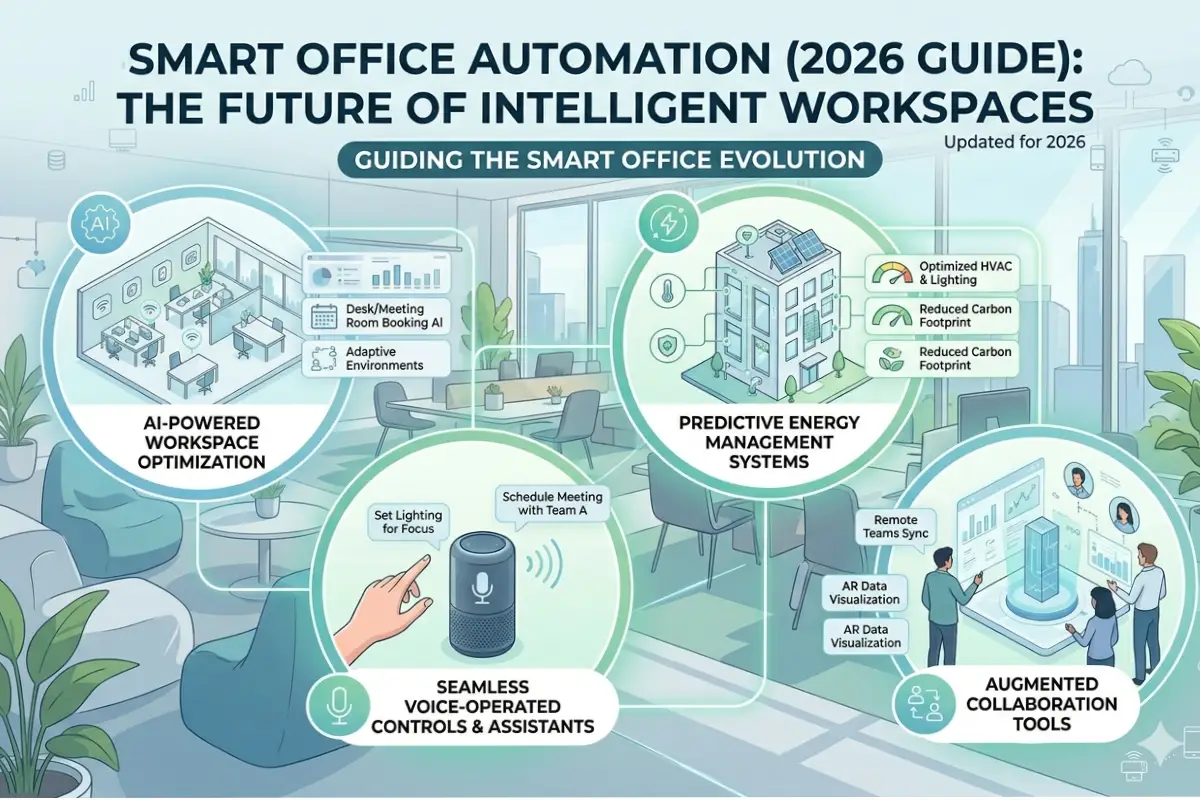
Key Trends Shaping Smart Offices in 2026
- AI Operating Systems for Offices
Entire offices now run on AI OS platforms managing workflows automatically.
- Hyper-Automation Everywhere
From HR onboarding to billing systems, everything is automated.
- Edge Computing Expansion
Data is processed locally for faster decision-making.
- Zero-Trust Security as Standard
No user or device is trusted by default.
- Emotion-Aware Workspaces
Sensors now track stress levels and adjust lighting, sound, and temperature.
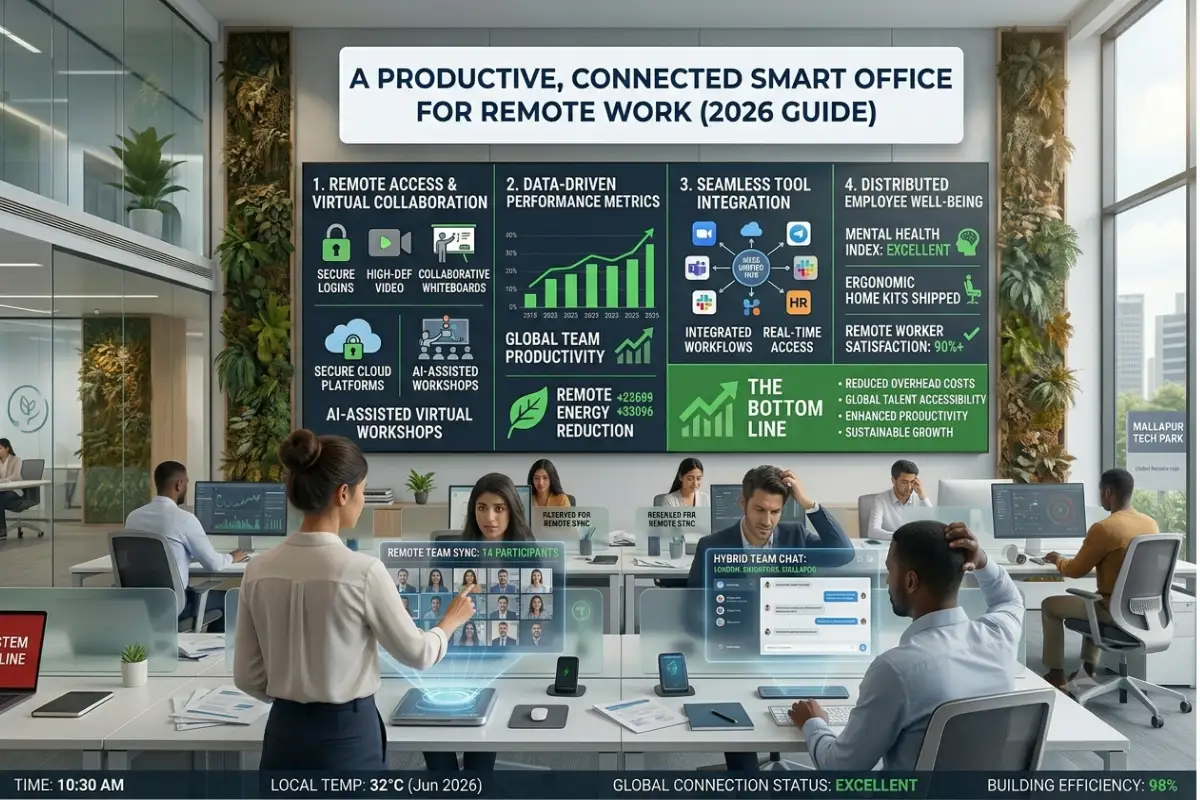
For hybrid teams, see our smart office for remote work guide.
Final Takeaway
Offices in 2026 are not just something they are a necessary part of how each industry works. Offices can really affect how well people work how much money is spent and how big a company can get.
Key Insight Summary:
- Startups need to think about cost and scalability
- IT companies need to think about speed and DevOps intelligence
- Schools need to think about engagement and automation
- Healthcare needs to think about security and accuracy
- Coworking spaces need to think about flexibility and utilization
These offices are really important for each of these industries. For example offices for startups are about keeping costs low and being able to grow. Offices for IT companies are all about working and having smart systems. And for schools are about keeping students engaged and using technology to help. Offices for healthcare are about keeping information safe and being accurate.. Offices for co-working spaces are all, about being flexible and using space well.