
Last Updated: September 15, 2026
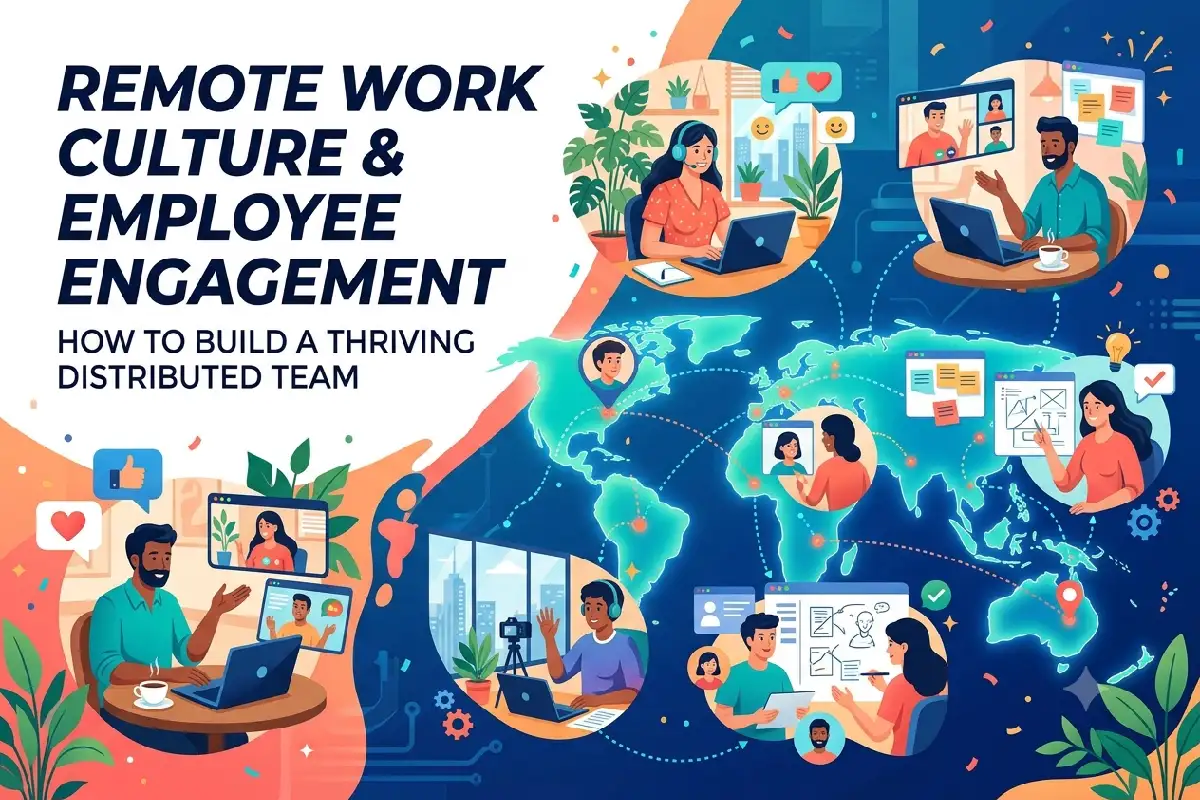
Remote work culture and employee engagement have become critical parts of modern workplace strategy. A distributed team can be productive without sharing an office, but productivity alone does not create a healthy work environment.
Remote employees also need trust, communication, recognition, social connection, career development, and a clear sense of belonging. Without these elements, employees can gradually become disconnected from their colleagues and the organization.
A strong remote work culture creates systems that help people collaborate effectively while still giving them autonomy. The goal is not to recreate the traditional office through video calls. It is to build a work environment designed specifically for distributed employees.
In this guide, you will learn how to build a remote work culture, improve engagement, organize virtual team building activities, recognize remote employees, combat isolation, and successfully onboard new team members.
What Is Remote Work Culture?
Remote work culture is the collection of values, behaviors, communication practices, expectations, and working systems that shape how employees experience work when they are not physically together.
It influences how teams communicate, make decisions, collaborate, celebrate achievements, resolve problems, and support one another.
A healthy remote culture does not require employees to be online constantly. Instead, it establishes clear expectations while giving employees flexibility and ownership over their work.
For example, a distributed team might use written updates for routine communication, scheduled meetings for important discussions, and project-management software for tracking tasks.
The result is a workplace where employees understand what is expected without feeling that they need to prove they are working every minute.
Why Remote Work Culture Matters for Employee Engagement
Employee engagement is closely connected to how people experience their workplace.
Remote employees can face challenges that are less visible than those experienced in a traditional office. They may struggle with isolation, communication gaps, unclear expectations, limited recognition, or fewer opportunities to interact informally with colleagues.
Strong remote work culture addresses these problems before they become major engagement issues.
| Remote challenge | Culture response | Engagement benefit |
| Social isolation | Regular informal interaction | Stronger relationships |
| Communication gaps | Clear communication rules | Better collaboration |
| Lack of visibility | Transparent project updates | Greater trust |
| Limited recognition | Digital recognition systems | Higher motivation |
| Meeting overload | Async communication | Better work-life balance |
| Unclear expectations | Defined goals and ownership | Greater autonomy |
| Weak onboarding | Structured remote onboarding | Faster integration |
The key is consistency. A one-time virtual event will not fix a disconnected workplace. Engagement improves when employees experience supportive practices throughout their employee lifecycle.
Building Remote Work Culture
Building remote work culture starts with defining how your organization expects people to work together.
Company values should not remain statements on a website. They should influence everyday decisions.
If your organization values autonomy, managers should avoid unnecessary monitoring. Though transparency is important, employees should have access to relevant project information. If collaboration matters, teams need practical tools and communication processes that support it.
Establish Clear Communication Norms
One of the biggest mistakes remote teams make is treating every communication as urgent.
Instead, define which communication channels should be used for different situations.
For example:
- Email for formal or external communication
- Chat for quick questions
- Project-management tools for task updates
- Video meetings for complex discussions
- Shared documents for collaborative work
- Async updates for routine progress reporting
Also establish reasonable response-time expectations.
Employees should know when immediate responses are required and when they can respond later.
Create a Documentation-First Culture
Remote teams cannot rely on hallway conversations or overheard discussions.
Important information should be documented.
Meeting decisions, project requirements, processes, deadlines, responsibilities, and important announcements should be accessible to the people who need them.
This approach also helps employees working across different time zones because they do not have to attend every meeting to stay informed.
Give Employees Autonomy
Remote work works best when employees are evaluated on meaningful outcomes rather than online presence.
Managers should define:
- What needs to be achieved
- Who owns the work
- When it is due
- What quality looks like
- How progress will be measured
Employees can then decide how to organize their working time.
This creates accountability without turning remote work into digital surveillance.
Virtual Team Building Activities
Virtual team building activities can help distributed employees build relationships, but they should feel natural rather than forced.
Not every employee wants another mandatory video call after spending the day in meetings.
The best activities are short, inclusive, and optional when possible.
Virtual Coffee Chats
Pair employees randomly for a 15- or 20-minute informal conversation.
The goal is not to discuss projects. Employees can talk about hobbies, travel, books, food, technology, or anything else they find interesting.
Online Games
Short multiplayer games can provide an easy social experience.
Teams can organize trivia competitions, word games, puzzles, or casual challenges.
Avoid making every event competitive. Some employees may prefer collaborative activities.
Interest-Based Groups
Create optional communities around shared interests.
Examples include:
- Fitness
- Photography
- Books
- Cooking
- Gaming
- Technology
- Movies
- Travel
These groups can create connections that would otherwise happen naturally in a physical office.
Remote Lunch Sessions
A team can occasionally have an informal lunch or coffee session over video.
However, participation should not become an expectation. Giving employees the option to join keeps social activities from becoming another work obligation.
Remote Employee Recognition Ideas
Recognition is particularly important for distributed teams because employees do not always receive the informal appreciation that happens naturally in an office.
A manager might notice someone’s contribution during a meeting or hear positive feedback from another colleague. Remote teams need deliberate ways to make that recognition visible.
Public Recognition
Celebrate achievements in team communication channels.
Recognition can highlight:
- Successful projects
- Customer wins
- Helpful collaboration
- Process improvements
- Problem-solving
- Learning and development
- Milestones
Specific recognition is more meaningful than simply saying “great job.”
Explain what the employee did and why it mattered.
Peer-to-Peer Recognition
Recognition should not come only from managers.
Give employees opportunities to recognize colleagues who helped them.
A simple monthly peer-recognition system can encourage employees to notice contributions that managers may not see.
Personalized Appreciation
Not everyone wants public recognition.
Some employees may prefer a private message, one-to-one conversation, professional development opportunity, or additional responsibility.
Managers should learn how individual employees prefer to receive recognition.
Recognition Through Growth
Recognition does not always have to involve money.
Organizations can recognize strong performance through:
- Training opportunities
- Conference attendance
- Mentorship
- New project ownership
- Leadership opportunities
- Professional certifications
- Flexible scheduling
The most effective recognition connects achievement with meaningful growth.
Combating Remote Work Isolation
Remote work isolation can develop when employees have limited social interaction, weak team relationships, or little connection with the organization’s mission.
It is not solved simply by scheduling more meetings.
In fact, excessive meetings can make the problem worse by increasing fatigue without creating genuine connection.
Build Connection Into the Workday
Create opportunities for employees to interact naturally.
For example, teams can have optional social channels, informal coffee conversations, interest groups, or occasional in-person gatherings when practical.
Managers should also make time for one-to-one conversations that are not entirely focused on task updates.
Watch for Signs of Disconnection
Managers should pay attention to changes such as:
- Reduced participation
- Increasing withdrawal
- Missed communication
- Declining collaboration
- Reduced enthusiasm
- Unusual changes in work patterns
These signs do not automatically mean an employee is disengaged. They are reasons to have a supportive conversation.
Protect Work-Life Boundaries
Remote employees may find it difficult to disconnect because work is physically close to their personal lives.
Organizations can help by discouraging unnecessary after-hours communication and respecting employees’ working hours.
A culture that rewards constant availability can quickly create burnout.
Onboarding Remote Employees Successfully
Remote onboarding should begin before the employee’s first working day.
New employees need more than login credentials and a list of meetings. They need context, relationships, tools, expectations, and a clear understanding of how the organization operates.
Create a Remote Onboarding Checklist
| Onboarding stage | What to provide |
| Before day one | Accounts, equipment, schedule and welcome information |
| Day one | Team introduction and company orientation |
| First week | Role training and key processes |
| First month | Initial goals and regular manager check-ins |
| First 60–90 days | Performance feedback and development discussion |
Assigning an onboarding buddy can also help.
A buddy gives the new employee someone they can approach with practical questions that may feel too minor or informal to ask a manager.
Explain the Unwritten Rules
Every organization has informal working practices.
New employees need to understand things such as:
- How quickly people normally respond
- Which communication tools are preferred
- How meetings are handled
- How decisions are documented
- When employees are expected to be available
- How managers provide feedback
- Where important information is stored
Making these expectations explicit reduces uncertainty.
Remote Management and Employee Engagement
Managers have a major influence on remote employee engagement.
Remote management should focus on outcomes, communication, support, and development rather than constant supervision.
A useful management rhythm might include a weekly one-to-one, regular team meetings, written project updates, quarterly development conversations, and ongoing informal communication.
The exact schedule will depend on the team’s work.
The important point is that employees should know when and how they can communicate with their manager.
Measure Outcomes, Not Online Status
Presence indicators are poor substitutes for performance.
A green status icon does not demonstrate meaningful progress.
Instead, managers should use measurable objectives and deliverables.
For knowledge workers, this may include completed projects, quality improvements, customer outcomes, revenue contribution, response quality, or other role-specific metrics.
Technology That Supports Remote Engagement
Technology should make remote work easier, not create additional complexity.
A modern remote team may need several categories of tools.
| Technology category | Primary purpose |
| Video conferencing | Meetings and face-to-face communication |
| Team chat | Fast communication |
| Project management | Tasks, deadlines and ownership |
| Cloud storage | Shared documents and files |
| Knowledge management | Company information and processes |
| Recognition platforms | Employee appreciation |
| HR platforms | Employee lifecycle management |
| Collaboration tools | Real-time document and project work |
The most important consideration is not how many tools a company has.
It is whether employees know where information belongs.
A fragmented technology environment can create communication fatigue and make employees spend too much time searching for information.
How to Measure Remote Employee Engagement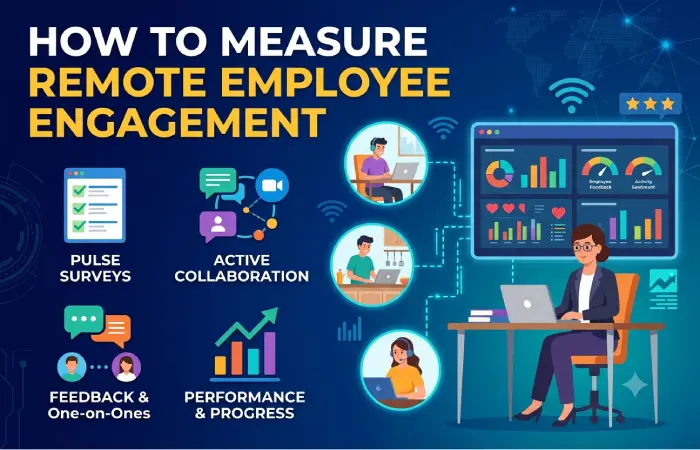
Remote employee engagement should be measured using several signals rather than a single score.
Useful measurements include:
- Employee engagement surveys
- Pulse surveys
- Retention and turnover
- Participation in development programs
- Manager one-to-one completion
- Internal mobility
- Absenteeism
- Employee feedback
- Collaboration patterns
- Performance against agreed objectives
Use Short Pulse Surveys
Long annual surveys may provide useful information, but short pulse surveys can identify problems sooner.
Questions could include:
- Do you understand your current priorities?
- Do you feel connected to your team?
- Do you receive useful feedback?
- Do you feel recognized for your contributions?
- Do you have the tools required to do your job?
- Do you have opportunities to develop your skills?
The purpose is not simply to collect scores.
Organizations should communicate what they learned and what actions they plan to take.
Remote Work Culture Mistakes to Avoid
Some remote-work practices can unintentionally reduce engagement.
Too Many Meetings
Adding meetings to compensate for the lack of physical interaction often creates fatigue.
Use asynchronous communication when a live discussion is unnecessary.
Excessive Monitoring
Screenshots, keystroke tracking, and constant activity monitoring can undermine trust.
Use appropriate performance measures instead.
Forced Fun
Mandatory social activities can feel artificial.
Give employees choices and create multiple ways to connect.
Ignoring Career Development
Remote employees still want to learn, advance, and take on meaningful responsibilities.
Career development should remain part of regular management conversations.
Treating Everyone the Same
Employees have different communication styles, time zones, responsibilities, and home environments.
A strong remote culture provides consistency without eliminating flexibility.
Remote Work Culture vs Traditional Office Culture
Remote culture is not simply an office culture transferred to a laptop.
| Area | Traditional office | Remote-first approach |
| Communication | Often spontaneous | More intentional |
| Documentation | May be informal | Usually more important |
| Visibility | Physical presence | Outcome-based |
| Social interaction | Naturally occurring | Deliberately created |
| Meetings | Often frequent | Mix of async and live |
| Management | In-person supervision | Trust and accountability |
| Recognition | Often informal | Needs deliberate systems |
| Onboarding | Face-to-face | Structured digital experience |
The strongest distributed organizations design their systems around remote work rather than attempting to reproduce every office habit online.
A Practical Remote Engagement Framework
A simple framework can help organizations build a sustainable remote culture.
- Define expectations
Explain communication, availability, performance, and collaboration standards.
- Build trust
Give employees ownership over their work and avoid unnecessary monitoring.
- Create connection
Provide meaningful opportunities for employees to build relationships.
- Recognize contributions
Make achievements visible and connect recognition with growth.
- Support development
Provide learning, feedback, mentorship, and career opportunities.
- Measure engagement
Use surveys, feedback, retention data, and performance outcomes to identify problems.
- Improve continuously
Remote work culture should evolve as teams, technologies, and employee expectations change.
Remote Work Culture and Employee Engagement: Key Takeaways
A successful remote workplace is built around people rather than technology alone.
The strongest remote teams typically share several characteristics:
- Clear communication expectations
- Strong documentation
- Trust-based management
- Meaningful employee recognition
- Opportunities for social connection
- Structured remote onboarding
- Flexible but accountable working practices
- Ongoing career development
- Regular employee feedback
- Technology that reduces rather than increases friction
Remote work culture and employee engagement are closely connected. When employees understand their role, trust their managers, feel connected to colleagues, receive recognition, and have opportunities to grow, distributed work can become a long-term advantage rather than simply an alternative to office work.
Frequently Asked Questions
How do you build a strong remote work culture?
Start with clear expectations for communication, collaboration, availability, performance, and documentation. Combine those expectations with trust, recognition, social connection, employee development, and regular feedback.
What are the best virtual team building activities?
Useful options include virtual coffee chats, trivia, online games, interest-based groups, informal lunches, and collaborative challenges. Activities should be inclusive and preferably optional.
How can companies recognize remote employees?
Companies can use public recognition, private appreciation, peer-to-peer recognition, professional development opportunities, project ownership, and other meaningful rewards that match individual preferences.
How can companies combat remote work isolation?
Create opportunities for informal interaction, encourage team relationships, provide regular one-to-one conversations, support employee communities, and protect work-life boundaries.
How should companies onboard remote employees?
Provide equipment and accounts before day one, introduce the employee to their team, explain communication and documentation practices, assign an onboarding buddy, define early goals, and schedule regular check-ins during the first 90 days.
How do you measure remote employee engagement?
Use a combination of pulse surveys, engagement surveys, retention data, employee feedback, development participation, manager check-ins, and role-specific performance outcomes.
Does remote work reduce employee engagement?
Remote work does not automatically reduce engagement. Engagement depends heavily on management quality, communication, employee autonomy, recognition, social connection, career development, and the overall employee experience.
How often should remote teams have meetings?
There is no universal schedule. Teams should use meetings when real-time discussion adds value and use asynchronous communication for routine updates. The goal should be effective collaboration rather than maximizing meeting frequency.